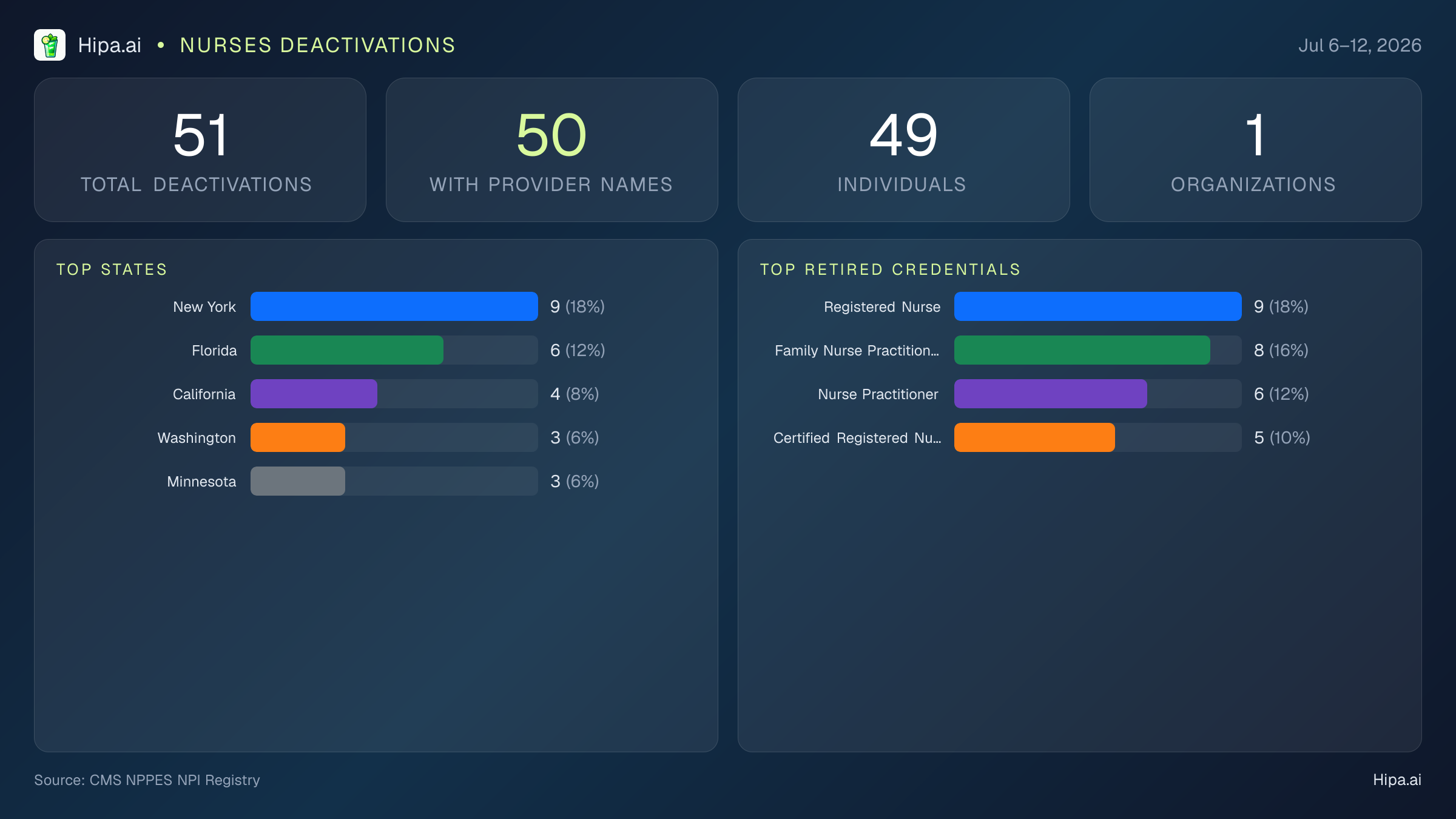
The CMS NPPES public registry recorded 51 NPI deactivations within the Nurses segment for the week of July 6-12, 2026. Of these, Hipa.ai's name cache captured 50 records with retrievable names before CMS privacy policies scrubbed identifying information, leaving one record without a publicly available name. The majority of deactivations, 49, were for individual providers, with one organizational NPI also deactivated. New York led all states with 9 deactivations, accounting for 18% of the total.
Geographic Trends in Nurse Deactivations
Geographically, New York experienced the highest number of NPI deactivations for nurses this week, with 9 records. Florida followed with 6 deactivations, representing 12% of the total. California saw 4 deactivations, or 8%. Washington, Minnesota, and Texas each recorded 3 deactivations, each making up 6% of the week's total. Several other states, including Oregon, Kansas, Tennessee, Arizona, New Mexico, and Ohio, each had 2 deactivations, while North Carolina, Alaska, and Georgia each registered 1 deactivation. This distribution suggests a broad geographic spread, with slightly higher concentrations in populous states.
Credential and Taxonomy Mix
An analysis of the primary taxonomies among the named deactivated records reveals a mix of generalist and specialist nursing roles. "Registered Nurse" was the most common taxonomy, with 9 deactivations, representing 18% of the named total. "Family Nurse Practitioner" followed closely with 8 deactivations, or 16%. "Nurse Practitioner" accounted for 6 deactivations (12%), while "Certified Registered Nurse Anesthetist" saw 5 deactivations (10%). "Licensed Practical Nurse" had 4 deactivations (8%). Other specialized roles such as "Adult Health Nurse Practitioner," "Neonatal Nurse Practitioner," and "School Registered Nurse" each had 2 deactivations, indicating administrative changes across various nursing specialties.
Deactivations in Context
NPI deactivations are an administrative function of the CMS NPPES registry and do not inherently signify adverse actions against a provider. These status changes can occur for various reasons, including a provider retiring, changing their entity type and obtaining a new NPI, or consolidating multiple NPIs. As the registry continues to age and the healthcare workforce evolves, a consistent volume of deactivations is expected as part of ongoing data maintenance and provider lifecycle management.