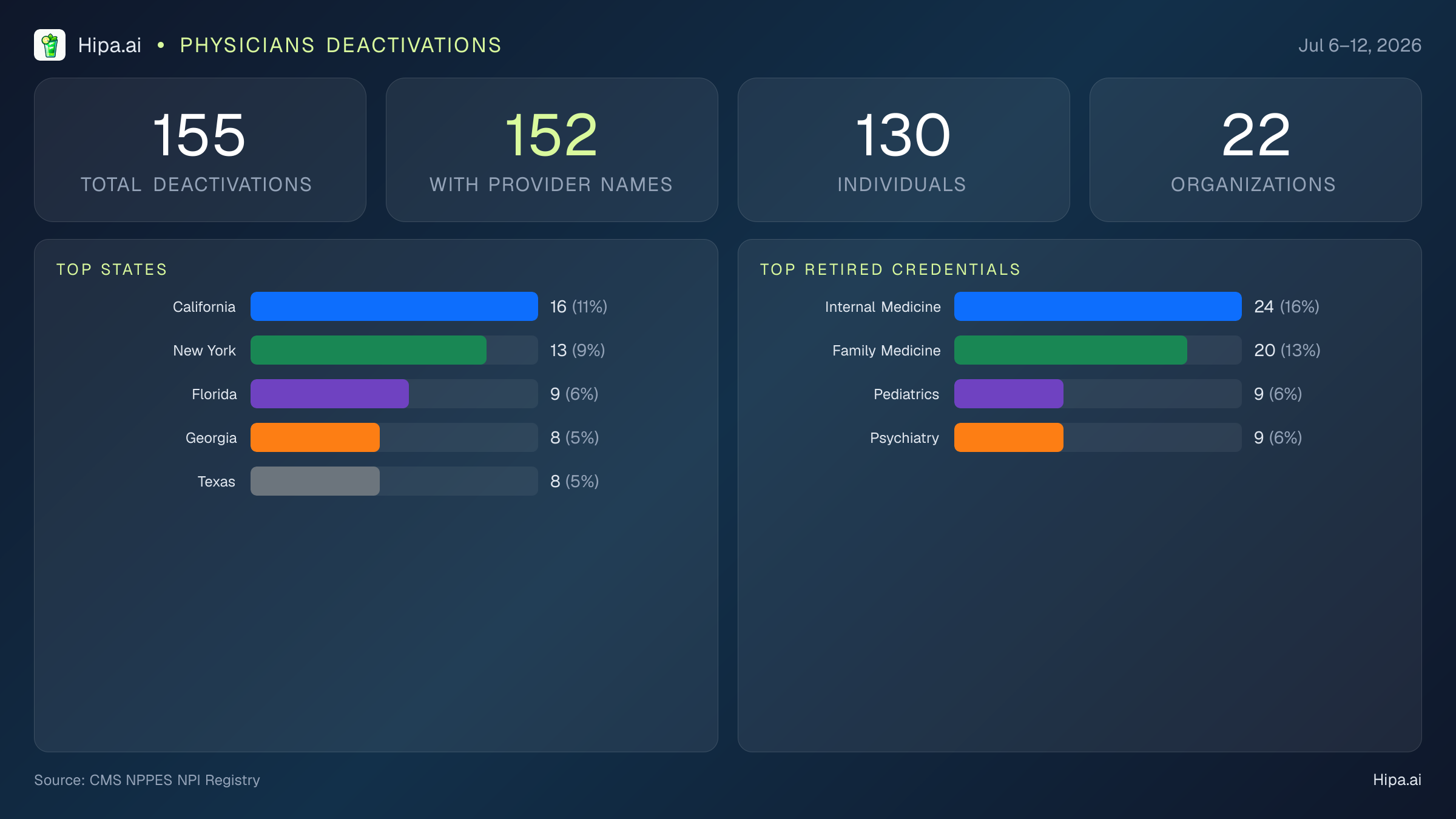
This week, the CMS NPPES registry recorded 155 NPI deactivations within the Physicians segment. Of these, 152 records had retrievable names, while 3 records were scrubbed by CMS due to privacy policies, meaning their identifying information was removed. The deactivations included 130 individual physicians and 22 organizations. California led all states with 16 deactivations, representing 11% of the total.
Geographic Distribution of Deactivations
Geographically, California's 16 deactivations (11%) placed it at the top, indicating a significant number of administrative changes in the state with the nation's largest healthcare workforce. New York followed with 13 deactivations (9%), and Florida with 9 deactivations (6%). Other states with notable numbers included Georgia and Texas, each with 8 deactivations (5%), and Oregon with 7 deactivations (5%). Kentucky, Illinois, and Pennsylvania each recorded 6 deactivations (4%). This distribution often reflects states with large and dynamic healthcare workforces, where provider movement, retirement, or administrative updates are more frequent.
Credential and Taxonomy Mix
Among the named deactivated physician records, Internal Medicine was the most common specialty, accounting for 24 deactivations (16%). Family Medicine followed closely with 20 deactivations (13%), highlighting a notable number of primary care physicians among the deactivated records. Pediatrics and Psychiatry each recorded 9 deactivations (6%), while Ophthalmology and General Practice each saw 8 deactivations (5%). Other specialties with multiple deactivations included Diagnostic Radiology, Urology, and Cardiovascular Disease, each with 5 deactivations (3%). This mix reveals deactivations across a broad spectrum of medical fields, from foundational primary care to various specialized practices.
Contextualizing NPI Deactivations
NPI deactivations are an administrative status change in the federal registry and do not inherently indicate license actions, malpractice, or that a provider has ceased practicing entirely. Providers may have their NPIs deactivated for various reasons, including retirement, changing practice locations, consolidating multiple NPIs under a new entity, or routine administrative updates by CMS to maintain an accurate registry. The ongoing deactivations reflect the dynamic nature of the U.S. healthcare workforce and the continuous maintenance of the NPPES system, which tracks healthcare providers nationwide.