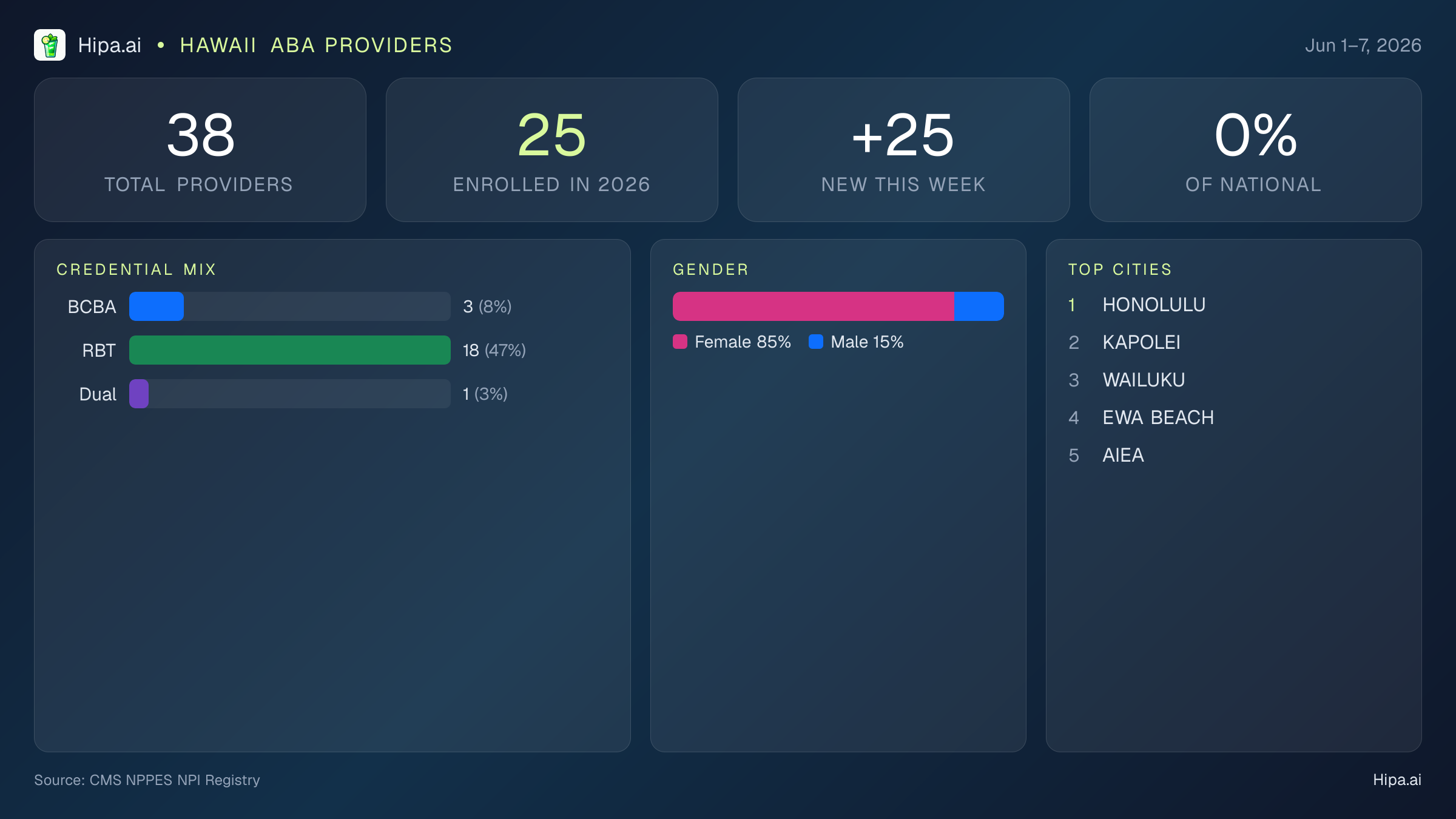
Hawaii saw 38 behavioral health providers added in the latest CMS NPI registry weekly update, representing a 0% share of the national total. This minimal contribution suggests a smaller, potentially underserved market for behavioral health services, particularly within the specialized field of ABA. Of these, 25 providers were new this week and also new this year, indicating a modest but consistent influx.
ABA Workforce Composition
Focusing on the ABA workforce, the data shows 3 BCBA credentials and 18 RBT credentials among the new individual providers. It is important to note that these figures are not mutually exclusive, as 1 individual holds both BCBA and RBT credentials, signifying a career progression from direct service to a supervisory capacity. The resulting ratio of 6 RBTs for every BCBA suggests a significant need for direct service providers, but also highlights a potential strain on supervision capacity, which is crucial for quality ABA service delivery.
Provider Demographics
The individual provider workforce in Hawaii is predominantly female, with 29 individuals (85%) identifying as female and 5 individuals (15%) as male. There were no nonbinary providers reported. This gender distribution aligns with broader trends observed across the behavioral health sector. No specific organizations appeared multiple times in this week's update, which could indicate a fragmented market or a lack of dominant multi-state ABA chains expanding significantly in Hawaii during this period.
This snapshot of Hawaii's behavioral health provider landscape suggests a developing market, heavily reliant on direct service RBTs. To enhance ABA access and ensure robust service quality, continued growth in the BCBA population and potential expansion by larger organizational providers will be essential to balance the workforce and strengthen supervision.