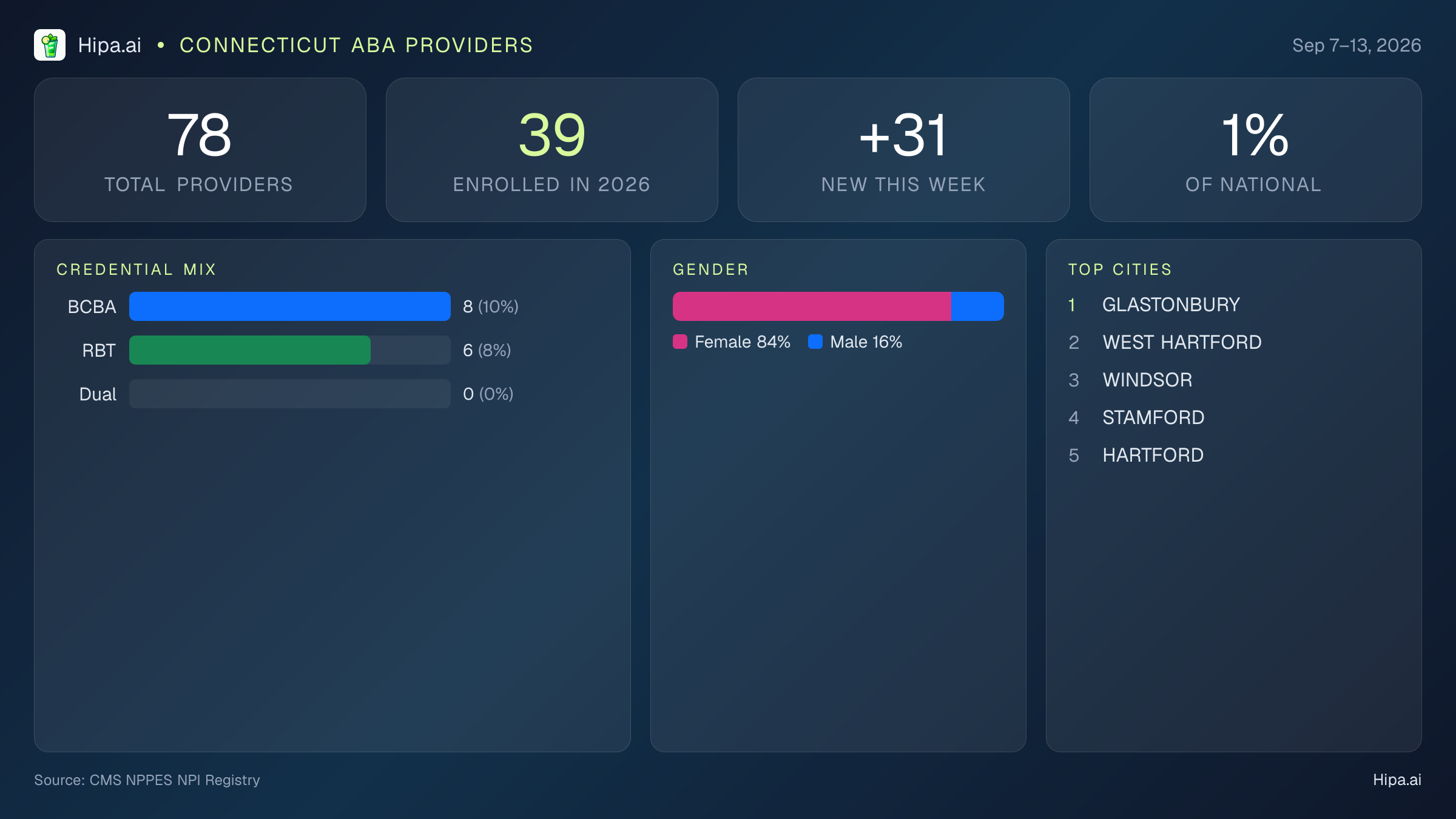
Connecticut recorded 78 providers in the latest CMS NPI registry weekly update, representing 1% of the national weekly total. The registry lists 31 providers added this week and 39 added this year, including 64 individuals and 14 organizations. That activity signals a meaningful, continuing behavioral health presence in the state, while the NPI data remains a measure of registry participation—not confirmed staffing, caseloads or appointment availability.
ABA Workforce Mix
The credential summary includes 8 BCBAs, 6 RBTs and no dual BCBA-RBT credentials. These credential categories should be read cautiously: taxonomy and credential fields can overlap, and the summary does not represent mutually exclusive groups. The broader “other” credential field includes multiple behavioral health professions, with LCSW appearing 12 times and LPC 4 times. The BCBA and RBT counts suggest a relatively small ABA workforce in this weekly snapshot, with more listed supervisors than technicians. That pattern does not establish staffing ratios, but it points to limited documented direct-service capacity alongside a supervisory base that could support RBT growth. Fourteen providers carry multiple taxonomies, further showing that individual records may represent overlapping roles or services.
Demographics and Organizations
Gender data identifies 54 female providers, 10 male providers and no nonbinary providers; the reported breakdown is 84% female, 16% male and 0% nonbinary. No notable organization appears multiple times in the update. The leading listed cities are Glastonbury, West Hartford, Windsor, Stamford and Hartford, indicating activity across several established population centers rather than a single location.
Connecticut’s update suggests a broadly distributed behavioral health workforce with a small documented ABA cohort, making continued BCBA and RBT recruitment important to expanding access.