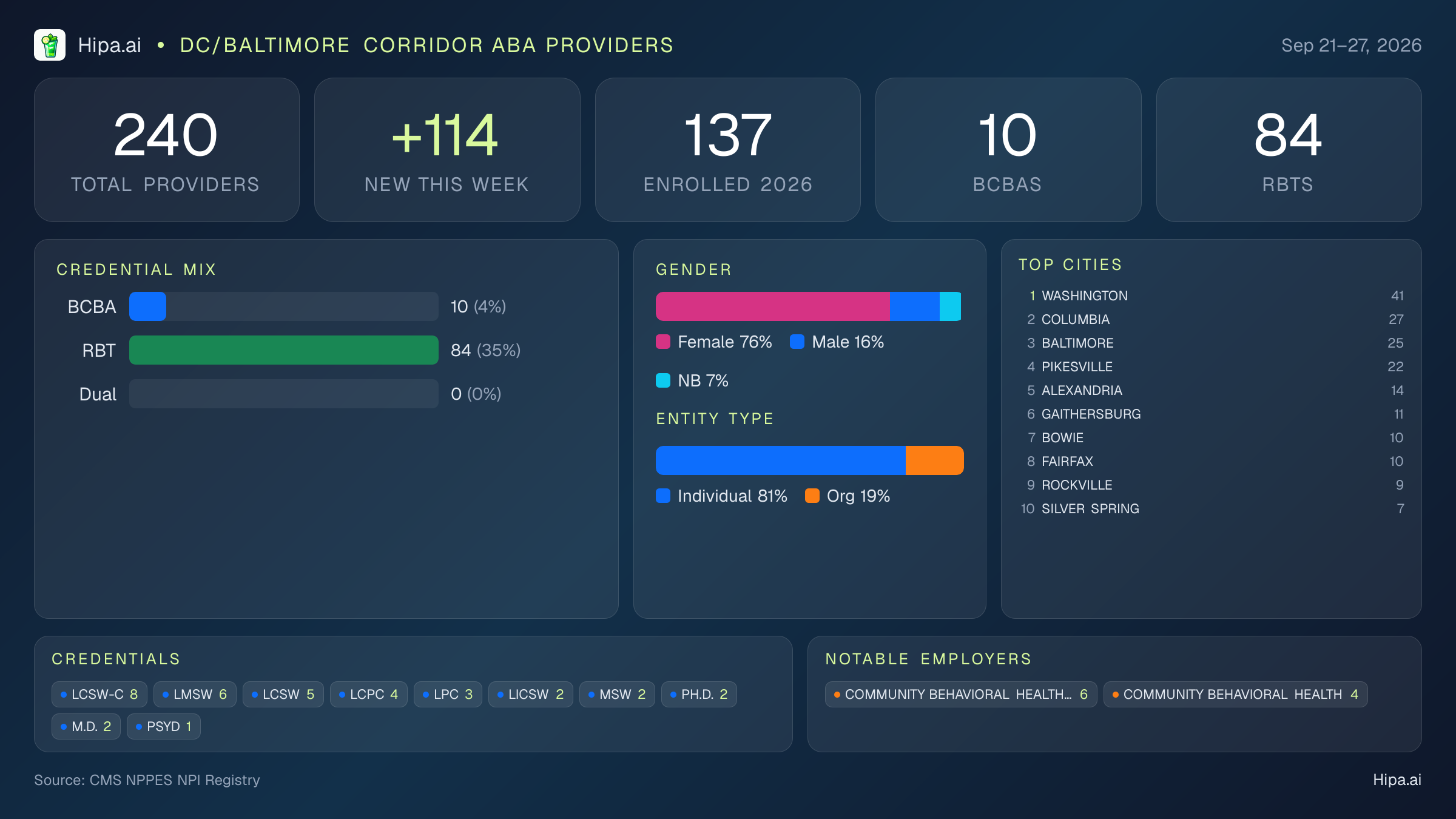
| ABERNATHY, BREANNA | FAIRFAX, VA | - | RBT | 09/21/2026 |
| ABREGO, BRITNEE | COLUMBIA, MD | - | RBT | 09/26/2026 |
| ABUBAKAR, KHADIJAT | BALTIMORE, MD | - | RBT | 09/24/2026 |
| ABUDU, IBILAYO | COLUMBIA, MD | - | RBT | 09/21/2026 |
| ACAB, CHALE'T | HERNDON, VA | - | BCBA | 09/15/2020 |
| ACHA, CEPHAS | WASHINGTON, DC | - | Case Manager/Care Coordinator | 01/22/2024 |
| ADAM THIBODEAU PLLCORG | ARLINGTON, VA | - | Clinical Social Worker | 09/21/2026 |
| ADETUNJI, FOLASHADE | WASHINGTON, DC | - | Case Manager/Care Coordinator | 09/25/2026 |
| AFFINITY COMMUNITY DEVELOPMENT, INC.ORG | SILVER SPRING, MD | - | Counselor | 10/25/2025 |
| AGANZE, ESTELLA | FAIRFAX, VA | - | RBT | 11/22/2022 |
| AKEM, JOHN PAUL JAM | WASHINGTON, DC | - | Case Manager/Care Coordinator | 09/24/2026 |
| AKTAR, ZAHANARA | GAITHERSBURG, MD | LCSW | Clinical Social Worker | 02/20/2023 |
| ALVAREZ-GIBSON, FOLASADE | PIKESVILLE, MD | - | RBT | 09/23/2026 |
| ANDERSON, AMY | WASHINGTON, DC | - | Clinical Social Worker | 03/01/2023 |
| ANGU TUMASANG, EDMOND CHE | WASHINGTON, DC | - | Case Manager/Care Coordinator | 04/26/2024 |
| ANNAGRACE CENTER FOR BEHAVIORAL HEALTH LLCORG | BOWIE, MD | - | Mental Health Counselor | 09/21/2026 |
| ARBIT COUNSELINGORG | WASHINGTON, DC | - | Mental Health Counselor | 09/22/2026 |
| AREVALO, MELISSA | VIENNA, VA | - | RBT | 09/22/2026 |
| ATOLAGBE, TAWAKALITU | BOWIE, MD | - | Mental Health Counselor | 09/21/2026 |
| AWEH, PROMISE | WASHINGTON, DC | - | Case Manager/Care Coordinator | 10/06/2025 |
| BADDR, AHMAD MURTAZA | WOODBRIDGE, VA | RBT | RBT | 08/07/2025 |
| BAILEY, KRISTEN | GERMANTOWN, MD | MS | Mental Health Counselor | 06/08/2020 |
| BALDWIN, KAYLA | COLUMBIA, MD | - | Mental Health Counselor | 09/22/2026 |
| BELL, PRISCILLA | LAUREL, MD | LCSW-C | Clinical Social Worker | 06/05/2023 |
| BELLORIN, ANDREA | FAIRFAX, VA | - | RBT | 09/25/2026 |
| BETHEA, CIARA | PIKESVILLE, MD | - | RBT | 09/23/2026 |
| BHS2 LLCORG | STERLING, VA | - | BCBA | 09/21/2026 |
| BIRECH, IVY | BALTIMORE, MD | - | RBT | 07/15/2026 |
| BLACKMAN, CAITLIN | LEESBURG, VA | - | Mental Health Counselor | 03/03/2023 |
| BLAKE, GABRIEL | ALEXANDRIA, VA | - | RBT | 09/21/2026 |
| BLANC, ABIGGAELE | BALTIMORE, MD | - | RBT | 09/23/2026 |
| BLANKINSHIP, ANNA | SPRINGFIELD, VA | - | RBT | 09/21/2026 |
| BMORE PSYCHOTHERAPY GROUP, LLCORG | TIMONIUM, MD | - | Professional Counselor | 09/21/2026 |
| BOWE, MICHAEL | ROCKVILLE, MD | - | RBT | 09/25/2026 |
| BRAGG, KATELYN | CHANTILLY, VA | - | RBT | 09/21/2026 |
| BRIGHTPATH AUTISMORG | SILVER SPRING, MD | - | BCBA | 09/21/2026 |
| BRINKLEY, AMBER | BALTIMORE, MD | - | RBT | 09/22/2026 |
| BROKAW, MATTIE | FALLS CHURCH, VA | - | Speech-Language Pathologist | 12/02/2016 |
| BRONTE TINKEW, LEIANNA | PIKESVILLE, MD | - | RBT | 09/24/2026 |
| BROWN, ALLEN | BALTIMORE, MD | - | Addiction (Substance Use Disorder) Counselor | 09/21/2026 |
| BUCKMAN, LCSW-C, JACQUELYN | TOWSON, MD | LCSW-C | Clinical Social Worker | 09/21/2026 |
| BURGESS, CATHERINE | FAIRFAX, VA | RESIDENT COUNSELOR | Counselor | 05/16/2023 |
| BURNS, KAMERON | WASHINGTON, DC | - | Case Manager/Care Coordinator | 09/16/2026 |
| BWN INCORG | WALDORF, MD | - | Community/Behavioral Health Agency | 09/26/2026 |
| CALHOUN, ELIZA | GERMANTOWN, MD | MSW | Mental Health Counselor | 04/11/2008 |
| CAMPBELL, BRIANNA | COLUMBIA, MD | - | RBT | 09/22/2026 |
| CANNON, CHERYL | TOWSON, MD | LCSW-C | Clinical Social Worker | 03/01/2023 |
| CHIDLEY, JOE | WASHINGTON, DC | LMSW | Clinical Social Worker | 09/25/2026 |
| CHOTANI, MINHA | COLUMBIA, MD | - | RBT | 06/08/2026 |
| CLOWNEY, KNICOAL | PIKESVILLE, MD | - | RBT | 09/23/2026 |
| COATES, ANAISHA | BALTIMORE, MD | - | Mental Health Counselor | 07/19/2022 |
| COCHRAN, OWEN | GAITHERSBURG, MD | - | RBT | 08/06/2026 |
| COLLISON, VANESSA | SILVER SPRING, MD | - | RBT | 06/14/2021 |
| COLON, SHAYIANA | PIKESVILLE, MD | - | RBT | 09/25/2026 |
| COMMUNITY BEHAVIORAL HEALTHORG | COLUMBIA, MD | - | Community/Behavioral Health Agency | 02/23/2017 |
| COMMUNITY BEHAVIORAL HEALTHORG | COLUMBIA, MD | - | Community/Behavioral Health Agency | 02/23/2017 |
| COMMUNITY BEHAVIORAL HEALTHORG | COLUMBIA, MD | - | Community/Behavioral Health Agency | 02/03/2017 |
| COMMUNITY BEHAVIORAL HEALTHORG | COLUMBIA, MD | - | Community/Behavioral Health Agency | 02/23/2017 |
| COMMUNITY BEHAVIORAL HEALTH, LLCORG | COLUMBIA, MD | - | Community/Behavioral Health Agency | 02/03/2017 |
| COMMUNITY BEHAVIORAL HEALTH, LLCORG | COLUMBIA, MD | - | Community/Behavioral Health Agency | 01/23/2017 |
| COMMUNITY BEHAVIORAL HEALTH, LLCORG | COLUMBIA, MD | - | Community/Behavioral Health Agency | 02/03/2017 |
| COMMUNITY BEHAVIORAL HEALTH, LLCORG | COLUMBIA, MD | - | Community/Behavioral Health Agency | 02/23/2017 |
| COMMUNITY BEHAVIORAL HEALTH, LLCORG | COLUMBIA, MD | - | Community/Behavioral Health Agency | 01/23/2017 |
| COMMUNITY BEHAVIORAL HEALTH, LLCORG | COLUMBIA, MD | - | Community/Behavioral Health Agency | 01/02/2020 |
| CONNECTIONS HEALTHVA, LLCORG | WOODBRIDGE, VA | - | Community/Behavioral Health Agency | 08/08/2023 |
| COOK & ASSOCIATESORG | WASHINGTON, DC | - | Professional Counselor | 09/24/2024 |
| COOLEY, ALAYSIA | PIKESVILLE, MD | - | RBT | 09/25/2026 |
| CROMER, KENIESHA | BALTIMORE, MD | - | RBT | 09/23/2026 |
| CROWLEY, MICHAEL | COLUMBIA, MD | LCPC, NCC | Professional Counselor | 04/30/2018 |
| CUFF, STACEY | GAITHERSBURG, MD | - | RBT | 09/22/2026 |
| DAVIS, BRANDON | SILVER SPRING, MD | PSYD | Psychologist | 03/01/2011 |
| DEMINO, ANTONIETTA | PIKESVILLE, MD | - | RBT | 09/22/2026 |
| DJUIKOUA EYANGO, JUDITH | WASHINGTON, DC | - | Case Manager/Care Coordinator | 05/23/2019 |
| DOGBE-FOLLY, MELBA | CENTREVILLE, VA | LPC | Mental Health Counselor | 12/14/2021 |
| DOMINICUS HEALTHCARE SERVICES LLCORG | BOWIE, MD | - | Community/Behavioral Health Agency | 09/25/2026 |
| DRAKEFORD, JANICE | WALDORF, MD | - | Case Manager/Care Coordinator | 09/25/2026 |
| DUKES, JASMINE | PIKESVILLE, MD | - | RBT | 09/24/2026 |
| DWYER, PATRICK | FAIRFAX, VA | LPC | Professional Counselor | 09/22/2026 |
| EBEN MBOE, CHARLES | GAITHERSBURG, MD | - | Case Manager/Care Coordinator | 09/24/2026 |
| EDGETON-MARTIN, CAROLINE | ALEXANDRIA, VA | M.S.ED., LPC, NCC | Professional Counselor | 03/11/2026 |
| EFOMI, YONA | GAITHERSBURG, MD | - | RBT | 09/21/2026 |
| EMILY LEMKE THERAPY & CONSULTATION, LLCORG | ROCKVILLE, MD | - | Clinical Social Worker | 06/23/2026 |
| ESRAL, MICHAL | PIKESVILLE, MD | LMSW | Counselor | 09/22/2026 |
| ESTRADA, EMILY | ANNAPOLIS, MD | PH.D. | Psychologist | 03/02/2022 |
| EYONG, THERESIA | WASHINGTON, DC | - | Case Manager/Care Coordinator | 09/23/2026 |
| EYONGESI, MAGDALINE | BOWIE, MD | - | Case Manager/Care Coordinator | 09/23/2026 |
| FARAHMAND, FARZANA | MANASSAS, VA | - | RBT | 09/09/2026 |
| FATIMA, SYEDA FIZZA | ASHBURN, VA | - | BCBA | 09/28/2021 |
| FINLEY, ROBIN | ALEXANDRIA, VA | - | RBT | 09/21/2026 |
| FISH, CHALTU | PIKESVILLE, MD | - | RBT | 09/24/2026 |
| FLAMBAUM, SYDNEY | WASHINGTON, DC | CCC-SLP | Speech-Language Pathologist | 01/09/2025 |
| FRANK, GILLYAN | ALEXANDRIA, VA | - | RBT | 09/01/2026 |
| FUNDOH CHUMBA, BERTRAND | WASHINGTON, DC | - | Case Manager/Care Coordinator | 09/23/2026 |
| GABBANI, UMNIYA | BETHESDA, MD | - | Mental Health Counselor | 05/15/2023 |
| GARDNER, JALIN | BALTIMORE, MD | - | RBT | 09/21/2026 |
| GEORGE, RASHIDA | COLUMBIA, MD | - | Clinical Social Worker | 09/26/2026 |
| GIBSON, MISTY | WASHINGTON, DC | - | Mental Health Counselor | 09/23/2026 |
| GILMORE, DESTINEE | WASHINGTON, DC | - | Case Manager/Care Coordinator | 09/19/2024 |
| GREEN, LISA | BALTIMORE, MD | LGSW | Clinical Social Worker | 03/02/2012 |
| GRONOW GUTIERREZ, KAREN | HERNDON, VA | - | RBT | 02/28/2025 |
| GYAN, PATRICK | FAIRFAX, VA | - | RBT | 06/16/2025 |
| HA, KELLY | WOODBRIDGE, VA | LPC, CSOTP | Mental Health Counselor | 07/12/2022 |
| HARDING, BRANDI | CATONSVILLE, MD | LCSW-C | Clinical Social Worker | 02/22/2021 |
| HARRIS, MONIQUE | PIKESVILLE, MD | - | RBT | 09/24/2026 |
| HART ALDERMAN, TI'JAY | BALTIMORE, MD | - | RBT | 09/22/2026 |
| HARTER, MICHELLE | ALEXANDRIA, VA | LPC | Professional Counselor | 07/07/2020 |
| HASHEMI, HOMAYOUN | FAIRFAX, VA | M.D. | Specialist | 03/16/2006 |
| HASKVITZ, LEAH | HERNDON, VA | CRNA | Specialist | 07/07/2005 |
| HEALTHY MINDS PSYCHOLOGICAL SERVICESORG | WASHINGTON, DC | - | Mental Health Counselor | 02/21/2026 |
| HEART & GRACE THERAPYORG | LAUREL, MD | - | Mental Health Counselor | 10/20/2025 |
| HEAVY IS THE HEAD LLCORG | WASHINGTON, DC | - | Mental Health Counselor | 09/21/2026 |
| HETTIARACHCHILAGE, PRAVEENA | BALTIMORE, MD | - | RBT | 09/22/2026 |
| HIGGINS, ROSHANE | ROCKVILLE, MD | - | RBT | 09/25/2026 |
| HIGGINS, STAFFORD | ALEXANDRIA, VA | LCSW-C | Clinical Social Worker | 08/22/2022 |
| HIGHER LIFE PATHWAYS COUNSELING SERVICES LLCORG | ALEXANDRIA, VA | - | Counselor | 10/16/2018 |
| HILL, KALIB | PIKESVILLE, MD | - | RBT | 09/22/2026 |
| HOLDER, DINELLY | ALEXANDRIA, VA | PHD, NCC, CCMHC | Professional Counselor | 12/22/2012 |
| HOURGLASS BODY CONTOURING SPA, LLCORG | TIMONIUM, MD | - | Clinic/Center | 09/24/2026 |
| HUA, JENNIFER | ARLINGTON, VA | - | Mental Health Counselor | 09/23/2026 |
| HUNT, ASHLEY | ALEXANDRIA, VA | - | Mental Health Counselor | 09/23/2026 |
| INSIGHT COUNSELING & COACHING SERVICEORG | ROCKVILLE, MD | - | Mental Health Counselor | 01/19/2026 |
| INTERNET SOLUTIONS LLCORG | STERLING, VA | - | Clinic/Center | 08/12/2026 |
| JACKSON, MELISSA | WASHINGTON, DC | MINISTER/CSW | Counselor | 09/23/2026 |
| JONES, MYKELL | PIKESVILLE, MD | - | RBT | 09/24/2026 |
| JORDAN, DOMINIC | GLEN BURNIE, MD | - | RBT | 09/24/2026 |
| JOYNER, ALIYYAH | WASHINGTON, DC | - | RBT | 08/31/2020 |
| KAMANDPLLCORG | STERLING, VA | - | Clinic/Center | 06/02/2026 |
| KAPINOS, TIGRAN | GAITHERSBURG, MD | LCPC | Mental Health Counselor | 01/03/2023 |
| KEITH, PETER | PIKESVILLE, MD | LCPC | Professional Counselor | 08/12/2019 |
| KHODADOUST, DARYA | STERLING, VA | M.A. CCC-SLP | Speech-Language Pathologist | 08/11/2023 |
| KILEY, ANNE | BALTIMORE, MD | - | Mental Health Counselor | 10/20/2014 |
| KIMBONG, ANNE | OWINGS MILLS, MD | - | Case Manager/Care Coordinator | 09/23/2026 |
| KLEIN, ABIGAIL | ELLICOTT CITY, MD | - | BCBA | 12/02/2024 |
| KOLB, ERYKAH | GAITHERSBURG, MD | - | RBT | 09/23/2026 |
| KOLI, IDA | COLUMBIA, MD | - | RBT | 09/21/2026 |
| KUHN, LAURA | BALTIMORE, MD | LMSW | Clinical Social Worker | 01/17/2022 |
| LACKS, LYRICK | COLUMBIA, MD | - | RBT | 09/23/2026 |
| LAWSON, ANDRUSA | COLUMBIA, MD | - | RBT | 11/22/2025 |
| LCA PSYCHOLOGICAL ASSOCIATES, LLCORG | WALDORF, MD | - | Counselor | 05/28/2010 |
| LEANON HEALTH SERVICES LLCORG | WASHINGTON, DC | - | Addiction (Substance Use Disorder) Counselor | 09/25/2026 |
| LEMKE, EMILY | ROCKVILLE, MD | LCSW-C | Clinical Social Worker | 03/06/2020 |
| LENORE, JAWEYA | COLUMBIA, MD | - | RBT | 03/16/2026 |
| LEONE, CHRISTINE | REISTERSTOWN, MD | LCPC | Mental Health Counselor | 06/14/2007 |
| LIFESTANCE HEALTH - D.C., PC DBA LIFESTANCE HEALTHORG | WASHINGTON, DC | - | Counselor | 05/19/2026 |
| LIPSCOMBE-ADAMS, GENESIS | ALEXANDRIA, VA | - | RBT | 09/21/2026 |
| LITTLE BEEGINNINGS, LLCORG | MANASSAS, VA | - | BCBA | 09/21/2026 |
| LY, MADELINE | FALLS CHURCH, VA | - | Speech-Language Pathologist | 05/05/2025 |
| M S BROWN COUNSELING SERVICES LLCORG | BALTIMORE, MD | - | Clinical Social Worker | 09/11/2020 |
| MAGNOLIA GROVE BEHAVIORAL SERVICES LLCORG | FAIRFAX, VA | - | BCBA | 09/21/2026 |
| MARTIN, KEITH | WASHINGTON, DC | - | Counselor | 10/08/2025 |
| MAST, CARLYN | BALTIMORE, MD | LCSW | Clinical Social Worker | 08/09/2019 |
| MAXWELL, MOLLY | SILVER SPRING, MD | - | RBT | 09/22/2026 |
| MC CARGO, SELINA | BALTIMORE, MD | - | RBT | 09/22/2026 |
| MCCOLLOUGH, SHIANN | WASHINGTON, DC | LPC, NCC | Professional Counselor | 02/21/2024 |
| MECHLING, ALEXIA | COLUMBIA, MD | - | RBT | 07/14/2026 |
| MELAKU, LUDE | PIKESVILLE, MD | - | RBT | 09/24/2026 |
| MENSAH, NICOLE | PIKESVILLE, MD | - | RBT | 09/25/2026 |
| MICHAELS, EMILY | BETHESDA, MD | MS, MA, LPC | Community/Behavioral Health Agency | 01/26/2022 |
| MILLER, DANIELLE | BALTIMORE, MD | LMSW | Clinical Social Worker | 11/05/2025 |
| MILLER, JASMIN | WASHINGTON, DC | LICSW | Clinical Social Worker | 09/30/2024 |
| MITCHELL, ALAYA | SPRINGFIELD, VA | - | RBT | 09/21/2026 |
| MITRA SHAHRYARY LCSW, INCORG | VIENNA, VA | - | Clinical Social Worker | 06/11/2025 |
| MOOCHOON, ANNA | ROCKVILLE, MD | MA | Professional Counselor | 02/23/2022 |
| MOORE, MARY | STERLING, VA | MSW, LCSW | Clinical Social Worker | 09/23/2026 |
| MORAN ALFARO, MAYRA | ROCKVILLE, MD | - | RBT | 09/21/2026 |
| MORELAND, MEGAN | ALEXANDRIA, VA | MED, NCC | Mental Health Counselor | 08/21/2025 |
| MORGAN, ARTHUR | WASHINGTON, DC | - | Addiction (Substance Use Disorder) Counselor | 11/18/2025 |
| MORGAN, KEEVA | PIKESVILLE, MD | - | RBT | 09/25/2026 |
| MORTON, AMBER | COLUMBIA, MD | - | RBT | 05/08/2026 |
| MYRICK, TRINITY | BALTIMORE, MD | - | RBT | 09/24/2026 |
| NANA, CONCILIA | WASHINGTON, DC | - | Case Manager/Care Coordinator | 03/18/2020 |
| NDOBEGANG, SUSAN | BOWIE, MD | - | Case Manager/Care Coordinator | 10/17/2019 |
| NEIGHBORHOOD NETWORK ABA, LLCORG | OWINGS MILLS, MD | - | Community/Behavioral Health Agency | 03/21/2026 |
| NENNY COMMUNITY SUPPORT SERVICES, INCORG | BALTIMORE, MD | - | Clinic/Center | 08/10/2026 |
| NJINDANGAM, FRANK | BOWIE, MD | - | RBT | 03/24/2025 |
| ODOM, JOANNE | WASHINGTON, DC | LICSW, LCSW-C | Clinical Social Worker | 09/15/2006 |
| OMOBUDE, MEAGHON | WASHINGTON, DC | - | Mental Health Counselor | 01/04/2023 |
| OSEBOR, JOEL | BOWIE, MD | - | Professional Counselor | 09/22/2026 |
| PADGETT, TERESA | ALEXANDRIA, VA | - | Mental Health Counselor | 04/11/2026 |
| PAGE, TAYVION | PIKESVILLE, MD | - | RBT | 09/23/2026 |
| PALMER, LEANA | BOWIE, MD | - | RBT | 09/23/2026 |
| PARKER, ROGENIA | GAITHERSBURG, MD | LCSW | Clinical Social Worker | 02/09/2015 |
| PARKER, VICTORIA | BOWIE, MD | - | RBT | 09/23/2026 |
| PAZ, JAMILA | ROCKVILLE, MD | - | RBT | 09/25/2026 |
| PINZON SANCHEZ, KAREN | SILVER SPRING, MD | - | RBT | 09/25/2026 |
| POKHAREL, BIPANA | FAIRFAX, VA | LCSW | Clinical Social Worker | 09/15/2026 |
| PROMISE HEALTH SERVICES LLCORG | WALDORF, MD | - | Addiction (Substance Use Disorder) Counselor | 09/22/2026 |
| RABAKALI SALVADORI, TSHIFHIWA | COLUMBIA, MD | - | RBT | 09/21/2026 |
| RANDALL, KAYLA | HERNDON, VA | - | Assistant Behavior Analyst | 07/12/2022 |
| RAY, DIAMOND | VIENNA, VA | RBT-25-500763 | RBT | 12/22/2025 |
| RENTERIA, FRANCISCO | CHANTILLY, VA | - | RBT | 05/15/2024 |
| RISE BEHAVIOR THERAPY VIRGINIA LLCORG | HERNDON, VA | - | Community/Behavioral Health Agency | 09/22/2026 |
| ROANE, BRYNEZ | BALTIMORE, MD | LCSW-C | Clinical Social Worker | 11/17/2010 |
| ROBERSON, BARELLA | BOWIE, MD | - | RBT | 09/25/2026 |
| ROBERTS, BRYANT | WASHINGTON, DC | - | Case Manager/Care Coordinator | 09/22/2026 |
| RODRIGUEZ, ANNALYSE | VIENNA, VA | - | RBT | 09/25/2026 |
| RUIZ, JESSICA | VIENNA, VA | LCMHC, LPC, NCC | Mental Health Counselor | 07/14/2020 |
| SABIR, SADIYAH | BALTIMORE, MD | - | RBT | 09/25/2026 |
| SADIGZADE, NIGAR | ALEXANDRIA, VA | - | RBT | 09/24/2026 |
| SADIQ, YUSMA | BALTIMORE, MD | - | Mental Health Counselor | 09/22/2026 |
| SAJJAD, FATIMA | ROCKVILLE, MD | - | RBT | 09/25/2026 |
| SALAZAR, MAGDALENA | LAUREL, MD | - | RBT | 09/24/2026 |
| SARGENT, SHAUNA | SPRINGFIELD, VA | - | Speech-Language Pathologist | 08/28/2012 |
| SHAHRYARY, MITRA | FALLS CHURCH, VA | LCSW | Clinical Social Worker | 04/06/2023 |
| SHAMA, ALI MOHAMED | WASHINGTON, DC | - | RBT | 12/13/2024 |
| SHERMAN, JUNE | WASHINGTON, DC | - | Case Manager/Care Coordinator | 04/25/2024 |
| SITZMAN, CATHI | WASHINGTON, DC | PH.D. | Psychologist | 01/27/2014 |
| SMITH, CATHERINE | WASHINGTON, DC | - | Case Manager/Care Coordinator | 04/13/2012 |
| SMITH, JOSIAH | BALTIMORE, MD | THERAPIST | Mental Health Counselor | 09/25/2026 |
| SOFOLUKE, AYODEJI | WASHINGTON, DC | - | Case Manager/Care Coordinator | 06/28/2023 |
| SQUALLS, SELAH | ASHBURN, VA | - | Mental Health Counselor | 09/24/2026 |
| STANEK LUCY, CAROLYN | SILVER SPRING, MD | LGPC | Professional Counselor | 07/22/2025 |
| STEPS, LLCORG | PIKESVILLE, MD | - | BCBA | 01/04/2016 |
| STRONG MYNDS ORG INCORG | GAITHERSBURG, MD | - | Mental Health Counselor | 04/07/2023 |
| STRYJEWSKI, LIESL | TOWSON, MD | LCSW-C | Clinical Social Worker | 02/10/2020 |
| SUEIRAS, ANNABELLA | COLUMBIA, MD | - | RBT | 07/06/2026 |
| SULLIVAN, LISA | ANNAPOLIS, MD | LMSW | Mental Health Counselor | 09/26/2026 |
| SULLIVAN, MARLON | BALTIMORE, MD | - | RBT | 09/21/2026 |
| TAILORED FOR YOU BEHAVIORAL & MENTAL HEALTH SERVICES, LLCORG | OWINGS MILLS, MD | - | Clinical Social Worker | 06/29/2026 |
| TAKU, MIRANDA | WASHINGTON, DC | - | Case Manager/Care Coordinator | 09/26/2026 |
| TALBOT, KATHRYN | ELLICOTT CITY, MD | M.ED., CCC-SLP | Speech-Language Pathologist | 10/29/2011 |
| TANNER, VIVIAN | WASHINGTON, DC | - | Mental Health Counselor | 09/22/2026 |
| TANYA, ERNESTINE LAHZI | WASHINGTON, DC | - | Case Manager/Care Coordinator | 09/22/2026 |
| TAYLOR, MAXINE | OWINGS MILLS, MD | PHD, LCSW-C | Clinical Social Worker | 02/10/2022 |
| THOMPSON, VASHTA | WASHINGTON, DC | - | Clinical Social Worker | 08/13/2018 |
| TIRONA-OBIAS, SHARON | FALLS CHURCH, VA | M.D. | Case Manager/Care Coordinator | 06/18/2007 |
| TOTO MOTO ACADEMY LLCORG | ALEXANDRIA, VA | - | BCBA | 07/24/2026 |
| TOURE, ROUGUIYATOU | FAIRFAX, VA | MSW | Clinical Social Worker | 12/07/2023 |
| TUDELA, MEGAN | ANNAPOLIS, MD | LMSW | Clinical Social Worker | 09/23/2026 |
| VALDEZ GUTIERREZ, DENISSE | PIKESVILLE, MD | - | RBT | 09/23/2026 |
| VAN METER, JENNIFER | GAITHERSBURG, MD | LCPC | Mental Health Counselor | 09/12/2019 |
| VINCENT, XENIAH | PIKESVILLE, MD | - | RBT | 09/25/2026 |
| WALKER, GIOVANNA | WALDORF, MD | - | Speech-Language Pathologist | 09/03/2021 |
| WALKER, SYDNEE | GAITHERSBURG, MD | M.A.,LGPC,NCC | Mental Health Counselor | 09/23/2026 |
| WATRO, JAMIE | BALTIMORE, MD | - | BCBA | 09/24/2026 |
| WEAVER, MICHELLE | PIKESVILLE, MD | - | RBT | 09/23/2026 |
| WELLS, DANIELLE | WASHINGTON, DC | LICSW | Clinical Social Worker | 09/21/2026 |
| WILLIAMS, PARIS | COLUMBIA, MD | - | RBT | 09/26/2026 |
| WOOD, WENDY | WASHINGTON, DC | - | Counselor | 09/21/2026 |
| WOODS, KOJO | COLUMBIA, MD | - | RBT | 09/23/2026 |