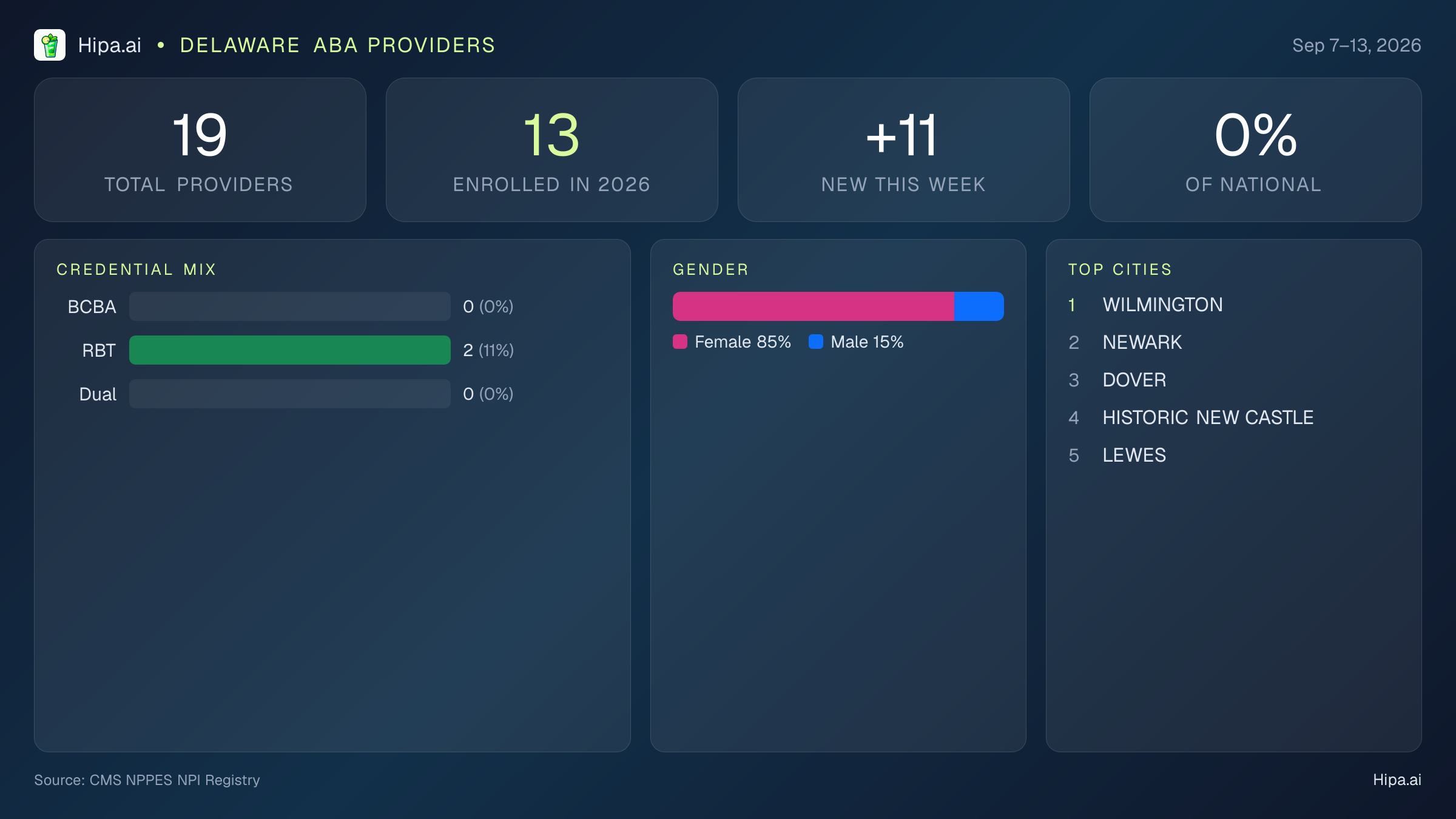
Delaware recorded 19 providers in the latest CMS NPI registry weekly update, representing 0% of the national weekly total. The update includes 11 new providers this week and 13 added this year, with 13 individuals and 6 organizations. The reported share indicates that Delaware accounts for a very small portion of national registry activity in this snapshot. NPI additions reflect records and enrollment activity, not confirmed staffing levels, caseloads or appointment availability, but the limited volume still points to a relatively small documented behavioral health market.
ABA Workforce Mix
The credential summary lists 0 BCBAs, 2 RBTs and 0 dual BCBA-RBT credentials. That is not a complete count of ABA professionals statewide; it reflects the credentials captured in this weekly registry extract. The absence of a recorded BCBA alongside 2 RBTs suggests little documented supervisory capacity in this snapshot. Because BCBAs supervise RBTs, the pattern would constrain the ability of the listed technician workforce to operate within a conventional ABA care model unless supervisors are recorded elsewhere or serve across organizational boundaries. Five providers carry multiple taxonomies, and those classifications can overlap, so they should not be interpreted as five additional or mutually exclusive workforce categories.
Demographics and Organizations
Gender data identifies 11 female providers, 2 male providers and 0 nonbinary providers; the registry reports those groups as 85%, 15% and 0%, respectively. No notable organizations appear multiple times in the update. The leading listed cities are Wilmington, Newark, Dover, Historic New Castle and Lewes, indicating activity across several parts of the state rather than in a single city. The 6 organizations include mental health counseling and habilitation entities, while the individual records span social work, counseling, psychology, speech-language pathology and RBT roles.
Delaware’s update suggests a small, multidisciplinary provider pipeline with limited documented ABA supervision, a pattern that could make BCBA recruitment important to expanding access.