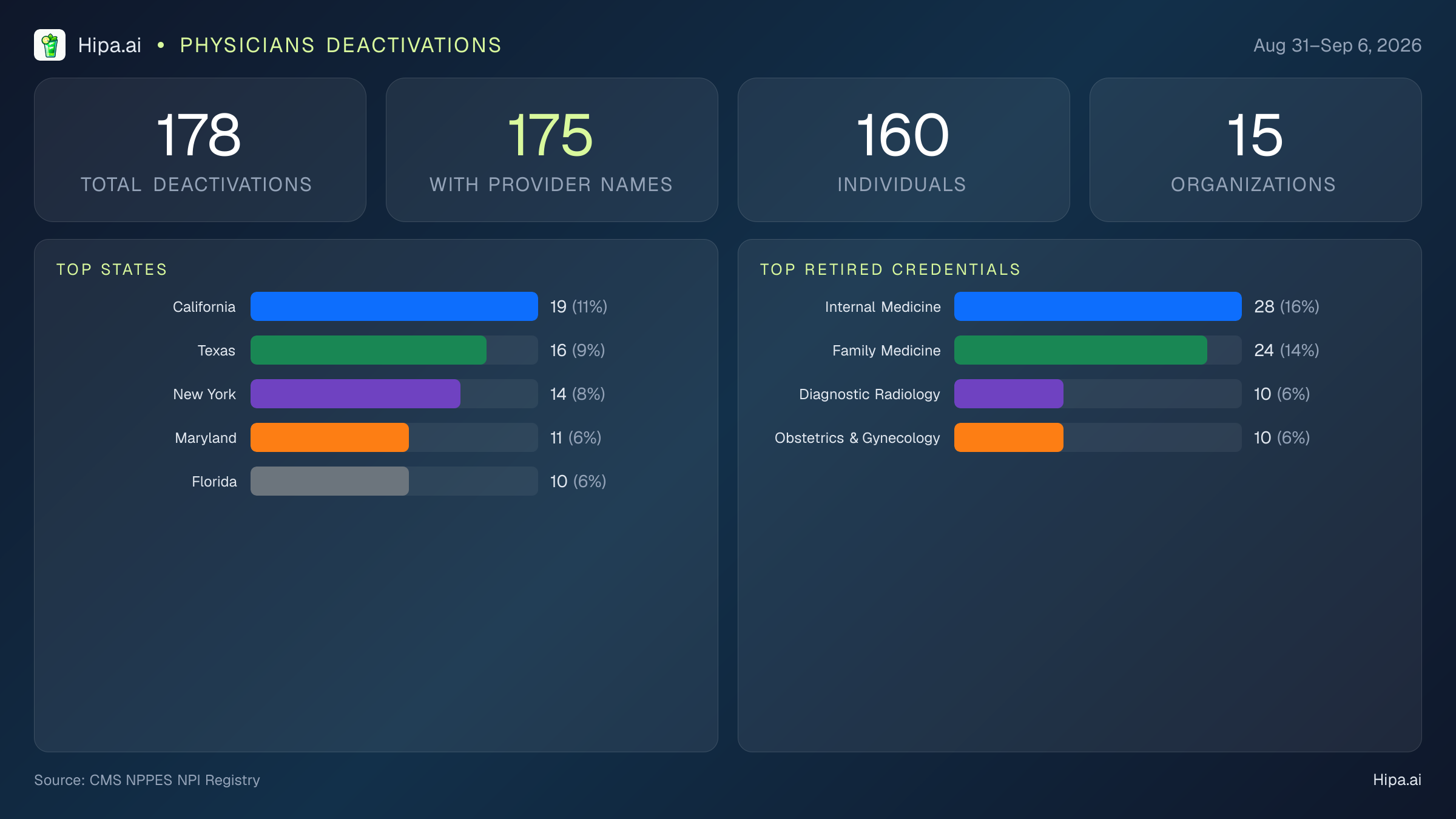
CMS NPPES recorded 178 deactivations in the Physicians segment during the week of August 31 through September 6, 2026. Hipa.ai’s name cache captured names for 175 of those records, meaning nearly all of the week’s deactivations had retrievable names. California led the country with 19 deactivations, followed by Texas and New York. CMS counted the full total, while the named subset reflects records Hipa.ai captured before CMS removed identifying information from deactivated records; three records were scrubbed before names could be retained.
California Leads a Broad Field
California accounted for 19 deactivations, or 11% of the weekly total. Texas followed with 16, or 9%, and New York recorded 14, or 8%. Maryland had 11, while Florida had 10. Pennsylvania posted 8, Michigan 7, Louisiana and Massachusetts 6 each, and Illinois, Ohio, Arizona, Georgia and Alabama each recorded 5. North Carolina rounded out the listed leaders with 4.
The distribution is broad rather than concentrated in one region. The leading states include large, populous healthcare markets as well as states with extensive hospital, outpatient and multispecialty networks. That pattern is consistent with registry activity spread across established systems, independent practices and organizational billing identities. The city data points to the same dispersion: San Antonio led with 4 records, while Boston, Chicago, Philadelphia, New York and Miami each had 3.
Primary Care Tops Taxonomy Mix
Among named providers, Internal Medicine was the leading retired taxonomy, with 28 records, or 16%. Family Medicine followed with 24 records, or 14%. Diagnostic Radiology and Obstetrics & Gynecology each accounted for 10 records, or 6%. Emergency Medicine, Anesthesiology and Psychiatry each recorded 8, or 5%.
Orthopaedic Surgery, Surgery and Pediatrics each appeared in 7 records, or 4%. The mix spans broad primary-care categories, procedural specialties and hospital-based services. Internal Medicine and Family Medicine together form the largest visible portion of the named records, while the presence of radiology, emergency medicine and anesthesiology reflects the range of physician organizations and individual practitioners represented in NPPES.
Administrative Status Needs Context
An NPI deactivation is an administrative change in the federal registry, not by itself evidence of a license action, malpractice or a provider leaving practice. Weekly records can reflect routine registry maintenance, retirement, practice changes, organizational consolidation or the use of a new NPI. Providers may also re-register under another identifier, so deactivation counts should be read as registry churn rather than a direct measure of physician departures from care.