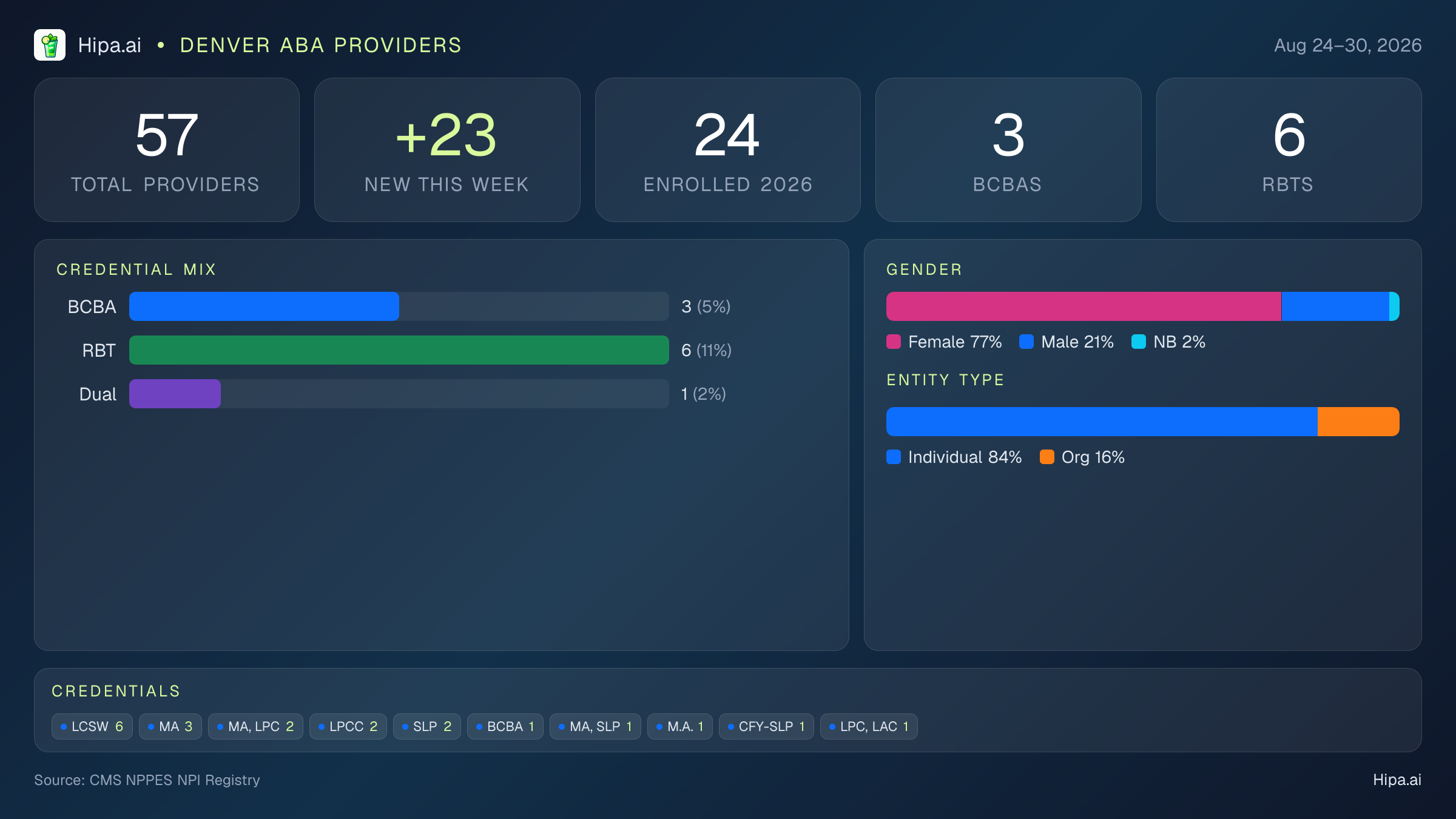
Denver recorded 57 providers in the latest CMS NPI registry weekly update, representing 1% of the national weekly total. The registry added 23 new providers this week, including 48 individuals and 9 organizations. That concentration signals a sizable behavioral health market in the city, although NPI records do not confirm active caseloads, staffed locations or appointment availability.
ABA Credential Mix
The registry lists 3 BCBA providers and 6 RBT providers, with 1 dual-credentialed provider holding both credentials. These categories overlap: the dual-credentialed provider is included in both the BCBA and RBT counts, so the categories are not mutually exclusive. The RBT-to-BCBA balance points to more direct-care capacity than identified supervisory capacity. In ABA operations, that structure can support service growth only if BCBAs have room to supervise RBTs and manage clinical caseloads. The dual credential also reflects a progression path from technician-level work toward behavior-analytic supervision, although the registry does not show current employment or supervisory assignments. The data reports 21 providers with multiple taxonomies; those classifications may overlap with credential categories and should not be added together.
Workforce Demographics
Among records with reported gender data, women account for 37 providers, or 77%. Men account for 10 providers, or 21%, and 1 provider is identified as nonbinary, or 2%. The gender counts cover 48 reported records rather than all 57 providers, which include organizations. No notable organization is identified as appearing multiple times in the update. Overall, Denver’s records suggest expanding behavioral health activity, but ABA access will depend on building BCBA supervision capacity alongside its RBT workforce.