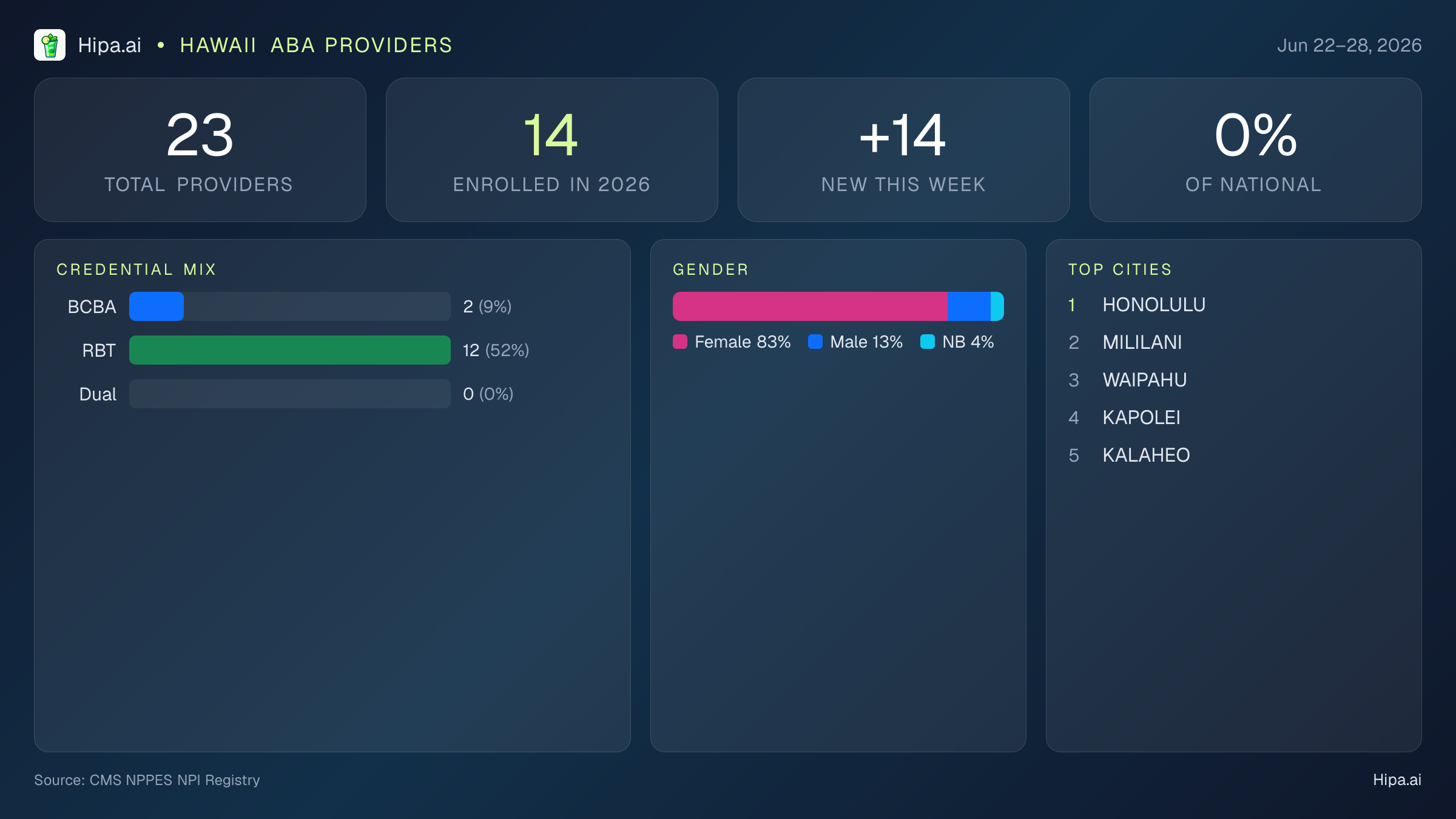
Hawaii recorded 23 new behavioral health providers in the latest CMS NPI registry weekly update. This represents 0% of the national total, a figure that, while numerically small, underscores the critical importance of each new professional in a geographically isolated state with a smaller overall population and unique access challenges.
ABA Workforce Composition and Supervision
Within the applied behavior analysis (ABA) sector, the data indicates 2 individuals with BCBA taxonomy and 12 individuals with RBT taxonomy. It is important to note that one of these BCBAs also holds an LBA state license, a crucial credential for practicing ABA in Hawaii. With no individuals holding dual BCBA and RBT credentials, the ratio of BCBAs to RBTs stands at 1:6. This ratio suggests a foundational capacity for supervision, essential for maintaining quality and ethical standards as direct service providers like RBTs enter the workforce, though the absolute numbers highlight the need for continued growth in supervisory roles.
Demographics and Provider Landscape
All 23 new providers are individuals, with no organizations appearing multiple times in this week's update, indicating a landscape driven by individual practitioners rather than large chains. The workforce shows a clear gender distribution: 19 providers (83%) identify as female, 3 providers (13%) as male, and 1 provider (4%) as nonbinary. This gender breakdown aligns with broader trends observed across the behavioral health field nationally.
The modest, yet consistent, addition of behavioral health professionals, particularly RBTs, is a positive sign for expanding direct ABA service capacity in Hawaii. However, the limited number of supervising BCBAs will remain a key factor in scaling access to comprehensive ABA services across the islands.