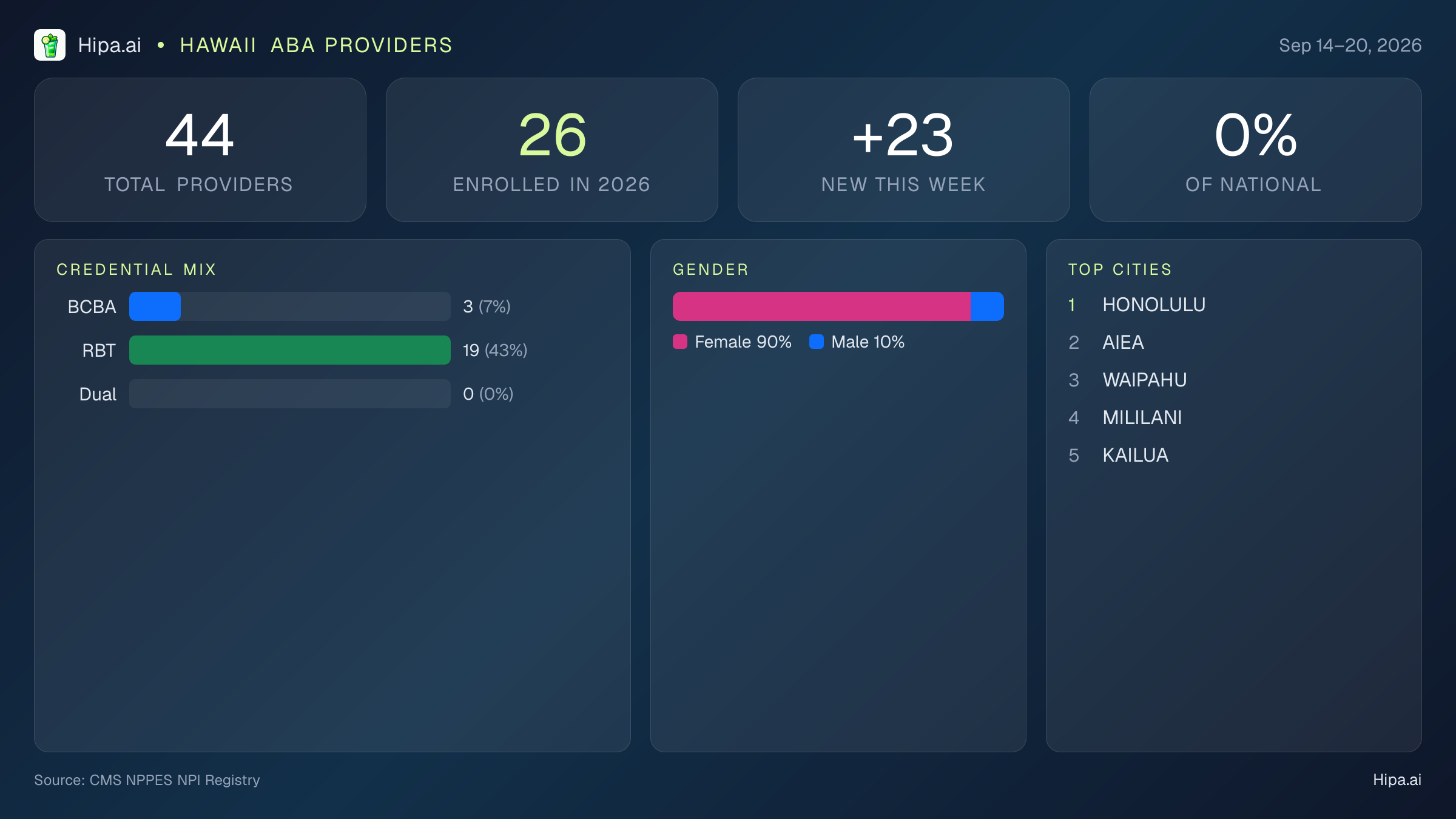
Hawaii had 44 providers in the latest CMS NPI registry weekly update, with a reported 0% share of the national weekly total. The file lists 23 additions this week and 26 this year, including 40 individuals and four organizations. The reported share indicates a very small national presence in this update, but it should not be read as a measure of service demand or available care: registry activity does not confirm hiring, active caseloads or appointment access.
ABA Workforce Mix
The credential summary lists 3 BCBAs and 19 RBTs, with no dual BCBA-RBT credentials reported. That is roughly six RBTs for each BCBA, a technician-heavy mix that may make supervision capacity a constraint as direct-service staffing grows. BCBAs provide clinical oversight for RBTs, so a small supervisor pool can limit how quickly organizations expand services. One listed BCBA also holds an LBA, a state license layered on top of the BCBA credential. The summary’s credential and taxonomy categories can overlap: nine providers have multiple taxonomies, and the credential list should not be treated as a set of mutually exclusive workforce groups.
Demographics and Organizations
Women make up 36 providers, or 90%; men account for four, or 10%; and no nonbinary providers are reported. The registry lists four organizations, but the notable-organizations field is empty, so no organization is identified as appearing repeatedly. Honolulu is among the listed leading cities, along with Aiea, Waipahu, Mililani and Kailua; the spread across communities offers geographic context but does not establish where services are available.
Overall, Hawaii’s update shows a larger RBT count than BCBA count, suggesting that expanding ABA access may depend on strengthening the state’s supervisory workforce.