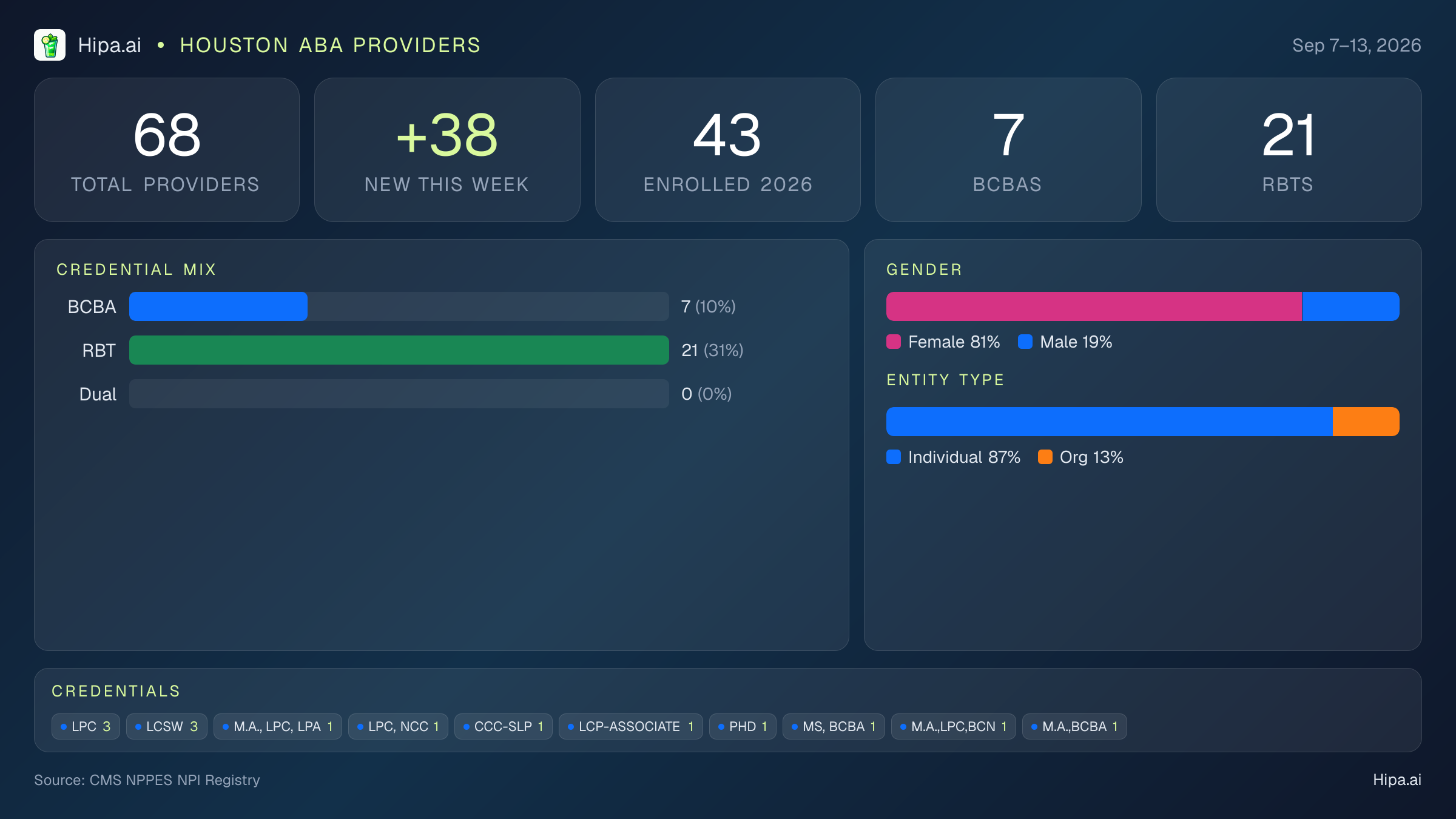
Houston recorded 68 providers in the latest CMS NPI registry weekly update, representing 1% of the national weekly total. The registry lists 38 new providers this week and 43 new providers this year. Records include 59 individuals and 9 organizations, indicating activity from both practitioners and provider entities. That concentration signals a sizable local behavioral health market, although NPI records do not establish whether a provider is actively practicing, accepting patients, staffing a site or offering ABA services.
ABA Credential Mix
The update identifies 7 BCBA providers and 21 RBT providers. No providers are listed with both BCBA and RBT credentials. These credential counts should not be treated as mutually exclusive with the broader registry: 13 providers have multiple taxonomies, and other clinicians may hold additional credentials alongside their primary classification. The larger RBT group points to more direct-care capacity than supervisory capacity. In ABA operations, that imbalance can constrain caseload growth when technician staffing expands faster than BCBA availability. The data also includes behavioral health professionals outside ABA, including LPCs, LCSWs, counselors, speech-language pathologists and case-management providers, showing that the Houston registry captures a broader care ecosystem.
Workforce Demographics
Women account for 48 providers, or 81% of the reported workforce. Men account for 11 providers, or 19%; no nonbinary providers are reported. The supplied data identifies no notable organizations appearing multiple times. Houston’s combination of substantial weekly registry activity, a larger RBT cohort and a smaller BCBA group suggests that ABA access may increasingly depend on expanding supervisory capacity alongside the local direct-care workforce.