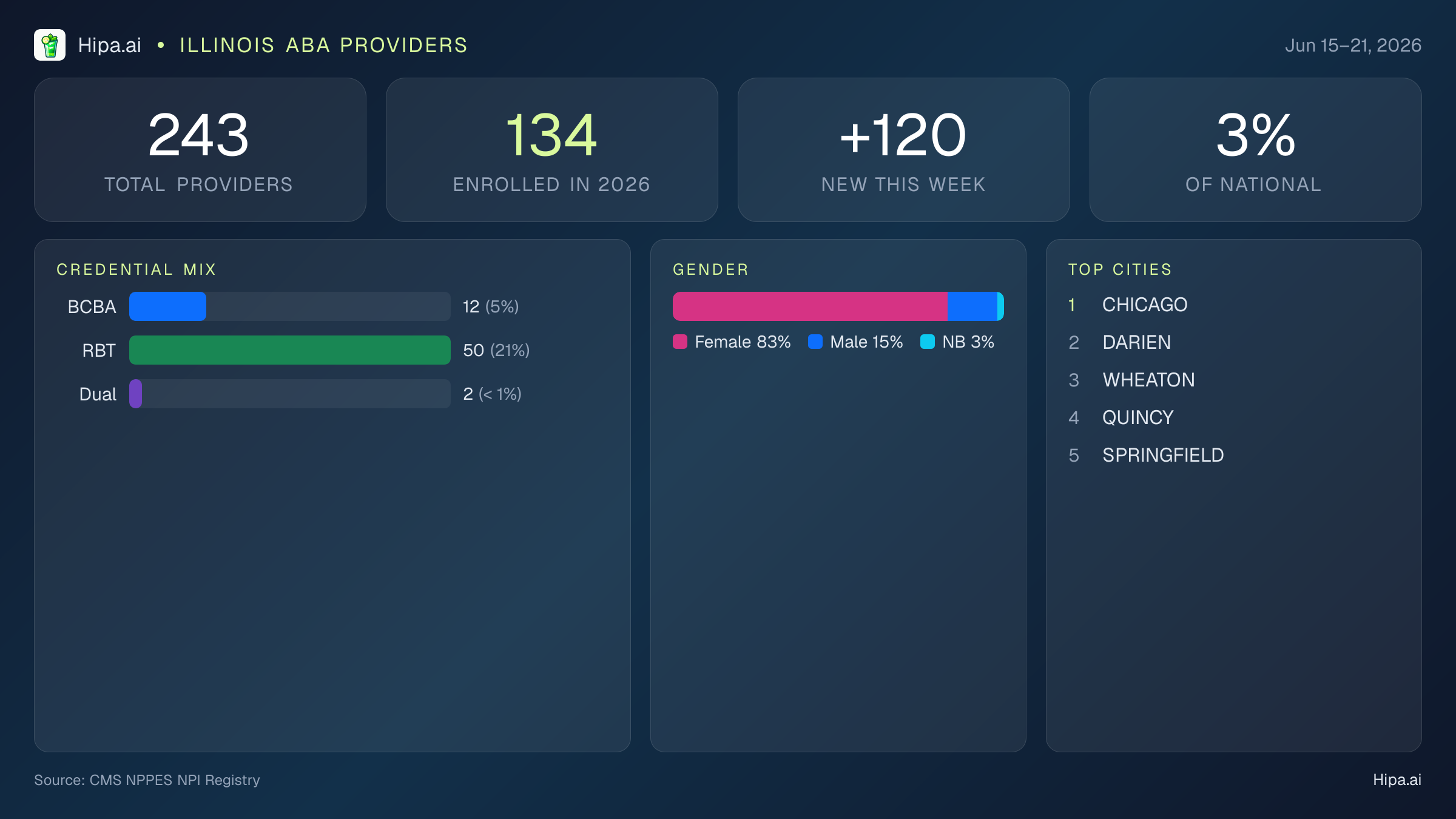
| A MEASURED MIND PLLCORG | NEW LENOX, IL | - | Clinical Social Worker | 12/12/2025 |
| A-NU HEALTH INCORG | CHICAGO, IL | - | Clinic/Center | 03/06/2025 |
| ABRAHAM, MIMAR | LINCOLNWOOD, IL | - | RBT | 06/16/2026 |
| ACCESS COMMUNITY WELLNESS ALLIANCEORG | BURR RIDGE, IL | - | Case Management Agency | 06/15/2026 |
| ALBA, ALICIA | TINLEY PARK, IL | - | Counselor | 06/16/2026 |
| ALCAIDE, ANAYELIT | AURORA, IL | LSW | Clinical Social Worker | 02/02/2024 |
| ALLEN, CLAUDE | MELROSE PARK, IL | BA | Mental Health Counselor | 06/16/2026 |
| ALTIORG | OAK FOREST, IL | - | Mental Health Counselor | 06/15/2026 |
| ANDRZEICIK, HOLLY | MOKENA, IL | M.S., BCBA | BCBA | 02/06/2022 |
| ASHLEY LARISEY SPEECH SERVICES PLLCORG | PALOS HEIGHTS, IL | - | Speech-Language Pathologist | 06/05/2024 |
| ATAC, KATELYN | NAPERVILLE, IL | M.ED. | Counselor | 06/19/2026 |
| BAILEY, LISA | ALTON, IL | CRSS | Case Manager/Care Coordinator | 06/16/2026 |
| BAKER, AURORA | JERSEYVILLE, IL | - | RBT | 06/15/2026 |
| BANU, ANISHMAH | HOFFMAN ESTATES, IL | - | Speech-Language Pathologist | 06/15/2026 |
| BLAUM, EMMA | TAYLORVILLE, IL | - | Speech-Language Pathologist | 06/15/2026 |
| BOULES, GRETCHEN | HINSDALE, IL | PSYD | Psychologist | 09/14/2006 |
| BOULOS, LIDYA | HOFFMAN ESTATES, IL | - | RBT | 06/15/2026 |
| BOZE, ALYSON | ST CHARLES, IL | - | RBT | 06/12/2024 |
| BRAN, CYNTHIA | NAPERVILLE, IL | LPC | Professional Counselor | 06/15/2026 |
| BRIDGE COUNSELING & WELLNESS PLLCORG | MOUNT VERNON, IL | - | Clinical Social Worker | 06/17/2026 |
| BRIDGE TO HOPE COUNSELING, LLCORG | NORMAL, IL | - | Clinical Social Worker | 01/09/2019 |
| BROWN, JANYA | O FALLON, IL | - | RBT | 06/15/2026 |
| BURKES, KARMIAH | TINLEY PARK, IL | - | Professional Counselor | 06/15/2026 |
| BUSWELL, EMILY | QUINCY, IL | - | Speech-Language Pathologist | 08/28/2024 |
| CALIENDO, REBECCA | CHICAGO, IL | - | Mental Health Counselor | 06/27/2023 |
| CAPOZZI, KAITLIN | WILMETTE, IL | - | Speech-Language Pathologist | 06/20/2026 |
| CARTER, JOCELYN | LISLE, IL | - | RBT | 06/18/2026 |
| CASTELLO, MORGAN | WHEATON, IL | - | Clinical Social Worker | 06/17/2026 |
| CELESTAINE, CRYSTAL | KANKAKEE, IL | - | Speech-Language Pathologist | 03/21/2019 |
| CERVANTES-GOMEZ, XIOMARA | CHICAGO, IL | - | Clinical Social Worker | 08/05/2025 |
| CHAVEZ, KATHRYN | CHICAGO, IL | - | RBT | 06/17/2026 |
| CIFTCI, FARAH | WINFIELD, IL | MD | Specialist | 12/09/2009 |
| COGNITIVE CLINIC P CORG | PALOS HILLS, IL | - | Professional Counselor | 07/16/2016 |
| COMMUNITY AFFAIRS COMMUNITY & HOME CARE SERVICES OF IORG | FRANKFORT, IL | - | Case Management Agency | 05/01/2026 |
| COOPER, KATHERINE | EDWARDSVILLE, IL | LCPC, LPCC | Professional Counselor | 02/27/2024 |
| CULLARS, KALA | CHICAGO, IL | LPC, CADC | Mental Health Counselor | 06/20/2026 |
| DALEY, JULIE | CHICAGO, IL | LCSW | Clinical Social Worker | 06/30/2023 |
| DANIELS, MEGAN | TROY, IL | BCBA | BCBA | 12/14/2017 |
| DAY, MCKENNA | AURORA, IL | - | BCBA | 09/27/2020 |
| DELOSSANTOS, YENISIS | ARLINGTON HEIGHTS, IL | - | Clinical Social Worker | 09/08/2020 |
| DI PALERMO, MARISSA | DOWNERS GROVE, IL | RBT | RBT | 06/17/2026 |
| DOMBROW, JULIA | LOCKPORT, IL | LCPC | Mental Health Counselor | 01/15/2020 |
| DOUKKY, RAMI | CHICAGO, IL | M.D. | Specialist | 05/26/2006 |
| DRAGMEIER, BRITTANY | ELWOOD, IL | LPC | Professional Counselor | 06/20/2026 |
| DRUMMOND, BRIAN | CHICAGO, IL | - | Mental Health Counselor | 06/15/2026 |
| DUARTE, SHANNON | FOX RIVER GROVE, IL | - | Clinical Social Worker | 06/15/2026 |
| DUFFY, LAUREN | CHICAGO, IL | - | Mental Health Counselor | 06/15/2026 |
| EDUN, OLUWASINA | ELGIN, IL | - | BCBA | 06/15/2026 |
| EGEBERG, GABRIELLE | DARIEN, IL | - | RBT | 06/15/2026 |
| ELGIN, DAN | WEST FRANKFORT, IL | - | Counselor | 09/04/2015 |
| EMERGING HEARTS COUNSELING LLCORG | CHICAGO, IL | - | Mental Health Counselor | 06/16/2026 |
| ENGLISH, ALEXANDRA | FOREST PARK, IL | - | Professional Counselor | 06/18/2026 |
| EVANS, ELLEN | O FALLON, IL | - | RBT | 06/15/2026 |
| EWING BLUE COUNSELING PLLCORG | SWANSEA, IL | - | Mental Health Counselor | 11/15/2021 |
| EWING, FELICIA | SWANSEA, IL | LCPC | Mental Health Counselor | 12/06/2018 |
| FACEN, JOURDAN | CHICAGO, IL | LPC | Professional Counselor | 04/24/2025 |
| FAJARDO, GEENA | FOREST PARK, IL | - | RBT | 06/16/2026 |
| FAULK, DANIEL | LINCOLNWOOD, IL | - | RBT | 06/19/2026 |
| FELLOWS, NAOMI | BARTLETT, IL | - | Case Manager/Care Coordinator | 06/15/2026 |
| FENCL, DARIAN | CHICAGO, IL | BCBA | BCBA | 12/11/2018 |
| FISHER, CAROL | BARRINGTON, IL | LCPC | Professional Counselor | 07/23/2007 |
| FRANK, JENNA | CRYSTAL LAKE, IL | - | Speech-Language Pathologist | 06/17/2026 |
| FRAZIER, FELICIA | CHICAGO, IL | LCSW | Mental Health Counselor | 02/04/2022 |
| FREEDOM INTERNATIONAL OUTREACH MINISTRIES, INC.ORG | CHICAGO, IL | - | Addiction (Substance Use Disorder) Counselor | 02/25/2026 |
| GADEKAR, ARYA | SPRINGFIELD, IL | - | Mental Health Counselor | 06/17/2026 |
| GALIHER, RACHEL | CHAMPAIGN, IL | LCSW | Clinical Social Worker | 06/05/2023 |
| GAMBOA, ELIZABETH | URBANA, IL | - | Clinical Social Worker | 06/19/2026 |
| GARDNER, ENA | CHICAGO, IL | - | Mental Health Counselor | 06/17/2026 |
| GIANNAKOURAS, DEMETRIA | BUFFALO GROVE, IL | - | Mental Health Counselor | 06/15/2026 |
| GOMEZ DELACASA, LETICIA | CHICAGO, IL | M.A. LPC | Professional Counselor | 09/28/2016 |
| GOMEZ, JAMES | CHICAGO, IL | LCPC, LMHC, NCC | Mental Health Counselor | 01/20/2022 |
| GONZALEZ, ITZEL | OAK LAWN, IL | - | Speech-Language Pathologist | 06/16/2026 |
| GRABLE, SHELDAN | SPRINGFIELD, IL | - | RBT | 05/01/2026 |
| GRIFFITH CARRICO, JAEDYN | WHEATON, IL | - | Mental Health Counselor | 05/18/2026 |
| GRZYB, DEXTER | LINCOLNWOOD, IL | - | BCBA | 06/15/2026 |
| HALL, BETHANY | CENTRALIA, IL | - | Counselor | 06/19/2026 |
| HALL, TRACI | CHICAGO, IL | LCSW | Clinical Social Worker | 11/04/2015 |
| HAMLYN, ANDREW | LIBERTYVILLE, IL | LCPC | Mental Health Counselor | 01/25/2022 |
| HANLEY, JULIA | WHEATON, IL | - | Speech-Language Pathologist | 06/18/2026 |
| HARRIS, ADRIANE | CHICAGO, IL | LCSW, CADC | Clinical Social Worker | 04/05/2016 |
| HASTINGS, SARA | TINLEY PARK, IL | CRC, LPC | Counselor | 06/16/2026 |
| HATCHEL, MARSHA | WESTVILLE, IL | - | Clinical Social Worker | 03/30/2023 |
| HEALTHPRO INNOVATION WORKFORCE SOLUTIONSORG | CHICAGO, IL | - | Case Management Agency | 06/17/2026 |
| HEARAN, DESTINY | ELMHURST, IL | - | RBT | 06/19/2026 |
| HEDMAN, LAUREN | GLEN ELLYN, IL | - | Mental Health Counselor | 10/27/2025 |
| HEITHMAR, JUDITH | CHICAGO, IL | MSW | Clinical Social Worker | 09/06/2018 |
| HODGES, ADRIANNE | OAK LAWN, IL | - | RBT | 06/15/2026 |
| HOFILENA, ARMANDO PAOLO | HOFFMAN ESTATES, IL | LPC | Professional Counselor | 06/19/2026 |
| HUNTER, ESTHER | CHICAGO, IL | LCSW | Clinical Social Worker | 06/18/2026 |
| INNER-CITY MUSLIM ACTION NETWORKORG | CHICAGO, IL | - | Mental Health Counselor | 06/08/2018 |
| INNER-CITY MUSLIM ACTION NETWORKORG | CHICAGO, IL | - | Clinical Social Worker | 10/21/2013 |
| IRBY, TIFFANY | CHICAGO, IL | - | Mental Health Counselor | 06/18/2026 |
| JACKSON, KAYLEE | O FALLON, IL | - | RBT | 06/15/2026 |
| JAKOVA, JANET | LISLE, IL | LPC | Mental Health Counselor | 04/24/2024 |
| JANUS, ELIZA | CRYSTAL LAKE, IL | - | Mental Health Counselor | 06/18/2026 |
| JOHNSON, RYAN | WHEATON, IL | - | Mental Health Counselor | 06/15/2026 |
| JONES, IRESEA | SPRINGFIELD, IL | - | RBT | 06/15/2026 |
| JOZWIAK, ISABELLA | ARLINGTON HEIGHTS, IL | MS | Speech-Language Pathologist | 06/16/2026 |
| KARYN L HORAN REFUGE MENTAL HEALTH COUNSELINGORG | LOCKPORT, IL | - | Professional Counselor | 04/15/2025 |
| KEIL-VINTILA, HANA | CHICAGO, IL | MSW, LSW | Clinical Social Worker | 05/26/2017 |
| KELLY, MEGAN | ELK GROVE VILLAGE, IL | - | Mental Health Counselor | 07/26/2021 |
| KELOW, JAKE | MAYWOOD, IL | LSW/CADC/ATE/COPD I | Clinical Social Worker | 10/24/2023 |
| KELSEY STOTT LCSW LLCORG | O FALLON, IL | - | Clinical Social Worker | 05/01/2026 |
| KHAMESIEH, ALMA | WHEATON, IL | - | Mental Health Counselor | 05/03/2024 |
| KIERNAN, LAURA | CHICAGO, IL | LSW | Clinical Social Worker | 07/01/2025 |
| KIMES, MELISSA | MARYVILLE, IL | - | Speech-Language Pathologist | 08/25/2014 |
| KITE, MERSADI | QUINCY, IL | LSW | Clinical Social Worker | 03/30/2026 |
| KUHNY, BETH | FRANKFORT, IL | - | Clinical Social Worker | 03/11/2022 |
| KUZNICKI, ASHLEY | ROCKFORD, IL | LCSW | Clinical Social Worker | 12/07/2022 |
| LARA L. WOLFF, LCPC, PLLCORG | CHICAGO, IL | - | Professional Counselor | 04/07/2021 |
| LAURA LISTENS, LLCORG | NAPERVILLE, IL | - | Mental Health Counselor | 01/16/2019 |
| LEE, ALANNAGH | EAST MOLINE, IL | - | RBT | 06/16/2026 |
| LEE, KELSEY | CHICAGO, IL | - | Clinical Social Worker | 09/01/2022 |
| LEE, YAEJI | CHICAGO, IL | MSW | Clinical Social Worker | 05/01/2023 |
| LEIVANG, VASTY | ARLINGTON HEIGHTS, IL | - | Mental Health Counselor | 06/15/2026 |
| LIA, ANNE | LOMBARD, IL | - | Professional Counselor | 06/17/2026 |
| LIM, HELEENA | LINCOLNWOOD, IL | - | RBT | 06/18/2026 |
| LIPP, CLYDE | MOLINE, IL | LCPC | Mental Health Counselor | 10/25/2006 |
| LO, TIMOTHY | NAPERVILLE, IL | - | Clinical Social Worker | 04/08/2016 |
| LOCHIRCO, NICOLE | PROSPECT HEIGHTS, IL | LCPC, LMFT | Mental Health Counselor | 07/17/2019 |
| LOGAN, LOI | WHEELING, IL | LSW | Clinical Social Worker | 02/15/2013 |
| LORENZ, SAMANTHA | DARIEN, IL | - | RBT | 06/15/2026 |
| LOW, KARISSA | ORLAND PARK, IL | MSW | Clinical Social Worker | 06/11/2025 |
| LUDWIG, JOHN | CHICAGO, IL | LSW | Clinical Social Worker | 08/22/2024 |
| LUNDE, SAMANTHA | SPRINGFIELD, IL | LCSW | Clinical Social Worker | 11/09/2020 |
| MAGHUYOP, CAMILLEANNE | CHICAGO, IL | - | Mental Health Counselor | 06/18/2026 |
| MAGLIONE, NICOLE | ELK GROVE VILLAGE, IL | - | Speech-Language Pathologist | 06/19/2026 |
| MARTIN, CODY | WEST PEORIA, IL | LCSW | Clinical Social Worker | 12/09/2015 |
| MARTIN, DASIA | CHICAGO, IL | RBT | RBT | 06/15/2026 |
| MASON, EMILY | CHICAGO, IL | - | Speech-Language Pathologist | 02/24/2013 |
| MASON, MEL | CHICAGO, IL | PH.D., LPC | Mental Health Counselor | 12/19/2025 |
| MATARAZZO, KARAH | CHICAGO, IL | LCSW | Clinical Social Worker | 08/15/2007 |
| MATHEWSON COUNSELING PLLCORG | URBANA, IL | - | Mental Health Counselor | 06/15/2026 |
| MCBOOM, JANELL | JOLIET, IL | LCSW | Clinical Social Worker | 11/06/2019 |
| MCCARTHY, ALEAH | CHICAGO, IL | - | BCBA | 11/10/2022 |
| MCCONVILLE, DESTINI | ORLAND PARK, IL | - | BCBA | 12/18/2024 |
| MEDINA, HECTOR | DECATUR, IL | - | RBT | 06/16/2026 |
| MEDINA, KASSANDRA | DEERFIELD, IL | - | RBT | 06/18/2026 |
| MEERS, KYLE | CRETE, IL | MA | Counselor | 06/18/2026 |
| MEGAN HANSON SPEECH THERAPY PLLCORG | WESTERN SPRINGS, IL | - | Speech-Language Pathologist | 06/28/2024 |
| MENDEZ, JENNIFER | DARIEN, IL | - | RBT | 06/15/2026 |
| MICELI, NICOLE | LOMBARD, IL | - | BCBA | 04/24/2023 |
| MILLER, IYANNA | BENSENVILLE, IL | - | RBT | 06/16/2026 |
| MILLER, JUSTIN | GRAYSLAKE, IL | - | Professional Counselor | 06/17/2026 |
| MIQLEWIS LLC DBA THE BRIGHT IDEA GROUP, INC.ORG | CHICAGO, IL | - | Mental Health Counselor | 06/17/2026 |
| MODERN INSIGHT THERAPY PLLCORG | CHICAGO, IL | - | Professional Counselor | 01/28/2020 |
| MOLLY MCLAY COUNSELING & CONSULTATION SERVICES, PLLCORG | URBANA, IL | - | Clinical Social Worker | 11/17/2023 |
| MOSES, MOONEE | CHICAGO, IL | LSW | Clinical Social Worker | 09/05/2024 |
| MOVING ON UP SUPPORTIVE HOUSING NFPORG | CHICAGO, IL | - | Community/Behavioral Health Agency | 06/15/2026 |
| MURPHY, TRINITY | DIXON, IL | RBT | RBT | 06/17/2026 |
| MUSK, JOSHUA | KANKAKEE, IL | - | RBT | 06/17/2026 |
| MYERS, MICHAEL | QUINCY, IL | LPC | Mental Health Counselor | 06/17/2026 |
| NATIONAL YOUTH ADVOCATE PROGRAMORG | HOMEWOOD, IL | - | Community/Behavioral Health Agency | 01/14/2025 |
| NAVA, SOFIA | EVANSTON, IL | - | Speech-Language Pathologist | 06/17/2026 |
| NEHRT, MCKENZIE | CENTRALIA, IL | - | Counselor | 06/19/2026 |
| NELSON-CARRILLO, IZABELLE | YORKVILLE, IL | - | RBT | 06/16/2026 |
| NEXT LEVEL THERAPY AND SUPERVISION, LLCORG | CHICAGO, IL | - | Mental Health Counselor | 03/04/2025 |
| NGUYEN, SAMANTHA | CHICAGO, IL | LCPC | Mental Health Counselor | 03/27/2025 |
| NOVELO, JULIANNA | LIBERTYVILLE, IL | - | Professional Counselor | 06/16/2026 |
| NUMATRX MEDICAL PLLCORG | MAYWOOD, IL | - | Clinic/Center | 01/31/2026 |
| O'ROURKE, LAUREN | LEMONT, IL | - | RBT | 06/19/2026 |
| ON BARREN HEIGHTS, PLLCORG | MORTON, IL | - | Mental Health Counselor | 06/15/2026 |
| ON POINT COUNSELING INCORG | EVANSTON, IL | - | Mental Health Counselor | 04/18/2025 |
| OSTRANDER, COLLEEN | CHICAGO, IL | LCPC | Professional Counselor | 06/15/2026 |
| PAGLIA, TATE | FOREST PARK, IL | - | RBT | 06/17/2026 |
| PANDYA, PEARL | DES PLAINES, IL | - | RBT | 06/18/2026 |
| PATTERSON, DANIELLE | CICERO, IL | - | RBT | 02/05/2025 |
| PAYNE, REBECCA | WASHINGTON, IL | M.A., L.C.P.C. | Mental Health Counselor | 06/12/2012 |
| PENA, ROSA | ELGIN, IL | - | RBT | 06/15/2026 |
| PENDLAY, SHANNON | NEWTON, IL | - | RBT | 06/17/2026 |
| PETRONE, HANNAH | CHICAGO, IL | MS SLP | Speech-Language Pathologist | 06/15/2026 |
| PHILIP, JENNIFER | OAK LAWN, IL | SLP-L | Speech-Language Pathologist | 01/02/2008 |
| PINEDA, YASMINE | DARIEN, IL | - | RBT | 06/15/2026 |
| PMC COUNSELING COACHING AND CONSULTING SERVICESORG | SCHAUMBERG, IL | - | Professional Counselor | 05/30/2026 |
| PONDER MENTAL WELLNESS, PLLCORG | CHICAGO, IL | - | Psychologist | 01/28/2026 |
| POPEK, ALLISON | LEMONT, IL | RBT | RBT | 06/16/2026 |
| PRESLAR, ERICA | EAST MOLINE, IL | - | RBT | 04/30/2026 |
| QUINTANILLA PSYCHOTHERAPY PLLCORG | CHICAGO, IL | - | Clinical Social Worker | 06/17/2026 |
| RACHEL DUBROW LCSW PLLCORG | NORTHFIELD, IL | - | Clinical Social Worker | 12/26/2017 |
| RAI, ROSE | YORKVILLE, IL | - | RBT | 06/16/2026 |
| RAINBOW CAFE LGBTQ CENTERORG | CARBONDALE, IL | - | Speech-Language Pathologist | 08/04/2023 |
| REBOOT THERAPY PLLCORG | CHICAGO, IL | - | Clinical Social Worker | 06/17/2026 |
| REFLEXIVE COUNSELING, PLLCORG | WESTVILLE, IL | - | Clinical Social Worker | 06/17/2026 |
| RETURNING 2 WELLNESS, LLCORG | HOMEWOOD, IL | - | Counselor | 06/16/2026 |
| RIOS MALDONADO, LAURA | ELMHURST, IL | - | Speech-Language Pathologist | 08/05/2022 |
| ROMERO, GISELLE | CHICAGO, IL | - | RBT | 06/16/2026 |
| ROSENBERG-HERMAN, NANCI | ALGONQUIN, IL | M.S., LPC | Professional Counselor | 06/16/2026 |
| ROWAN TREE COUNSELINGORG | CHICAGO, IL | - | Mental Health Counselor | 09/12/2019 |
| RYAN, ALEC | CHICAGO, IL | - | RBT | 06/19/2026 |
| SABATH, JONATHAN | SPRINGFIELD, IL | - | RBT | 06/17/2026 |
| SANCHEZ, MANUEL | OLYMPIA FIELDS, IL | MD | Specialist | 07/04/2006 |
| SANDERMAN, SARA | HIGHLAND PARK, IL | LCSW | Clinical Social Worker | 06/19/2026 |
| SARA SANDERMAN LCSW PLLCORG | HIGHLAND PARK, IL | - | Clinical Social Worker | 06/19/2026 |
| SARHENE, RIOCHANEL | LIBERTYVILLE, IL | - | Clinical Social Worker | 05/02/2017 |
| SCHERER, AUDREY | LOMBARD, IL | - | Professional Counselor | 05/19/2023 |
| SCHREIBER, JILL | EDWARDSVILLE, IL | MSW, LCSW, PHD | Clinical Social Worker | 06/02/2022 |
| SCHROEDER, LISA | OTTAWA, IL | LCSW, CTTP-1 | Mental Health Counselor | 06/19/2026 |
| SEBREE, REBECCA | CHICAGO, IL | LCSW | Clinical Social Worker | 09/30/2021 |
| SHELBY, SIERRA | CALUMET CITY, IL | LPC | Professional Counselor | 06/15/2026 |
| SHRULL, MADELEINE | NORTHBROOK, IL | MSW | Clinical Social Worker | 06/18/2026 |
| SILVER, SUSAN | CHICAGO, IL | LCPC | Professional Counselor | 05/13/2014 |
| SIMON, CAMILLE | ST CHARLES, IL | - | Clinical Social Worker | 07/16/2021 |
| SIMON, MICHAELA | CHICAGO, IL | - | Counselor | 05/31/2024 |
| SMITH, RACHEL | NORTHFIELD, IL | LCSW | Clinical Social Worker | 08/31/2012 |
| SOL Y LUNA COUNSELING PLLCORG | CHICAGO, IL | - | Mental Health Counselor | 05/02/2026 |
| SOLLIDAY, KELLIE | CHICAGO, IL | - | Clinical Social Worker | 03/27/2022 |
| SOMBERG, LAURA | CHICAGO, IL | - | Clinical Social Worker | 06/16/2026 |
| SPROUT THERAPY SERVICESORG | QUINCY, IL | - | Speech-Language Pathologist | 06/09/2025 |
| STALEY, ANGELA | ROSELLE, IL | - | Speech-Language Pathologist | 04/06/2011 |
| STANLEY, MARY | CHICAGO, IL | - | Speech-Language Pathologist | 09/04/2024 |
| STUART, DANIEL | CHICAGO, IL | - | Professional Counselor | 06/15/2026 |
| SUCHECKI, VANESSA | ORLAND PARK, IL | - | Mental Health Counselor | 06/15/2026 |
| SWAGGTHORNE, EMERSON | CHICAGO, IL | - | Mental Health Counselor | 06/16/2026 |
| SWEAS, CAROLYN | FRANKFORT, IL | LCPC, APRN | Mental Health Counselor | 08/13/2025 |
| SWK SOLUTIONS LLCORG | CHICAGO, IL | - | Clinical Social Worker | 06/20/2026 |
| T.LINDAHL THERAPIST PLLCORG | FOX LAKE, IL | - | Mental Health Counselor | 06/18/2026 |
| TAFOYA, ROXXY | NORTHFIELD, IL | - | RBT | 06/11/2026 |
| THE BOARD OF TRUSTEES OF THE UNIVERSITY OF ILLINOISORG | CHICAGO, IL | - | Clinical Social Worker | 07/06/2006 |
| THE MINDFUOL METHOD, PLLCORG | PARK RIDGE, IL | - | Mental Health Counselor | 06/13/2026 |
| THE PEDIATRIC CLINIC FOR BEHAVIORAL HEALTH, PLLCORG | COLLINSVILLE, IL | - | Mental Health Counselor | 09/07/2024 |
| THOLE, ANISHA | CENTRALIA, IL | - | Counselor | 06/19/2026 |
| THOMPSON-HILL, NICOLA | LIBERTYVILLE, IL | - | Professional Counselor | 06/15/2026 |
| TOWNSLEY MARTINEZ, YASMINE | MARION, IL | LCSW | Clinical Social Worker | 08/31/2021 |
| TRUELL, PETER | VERNON HILLS, IL | LCPC | Addiction (Substance Use Disorder) Counselor | 09/23/2016 |
| TURNER, AMORI | ALTON, IL | MS | Counselor | 06/17/2026 |
| TURTLE BLOOM THERAPY, PLLCORG | MINOOKA, IL | - | Clinical Social Worker | 06/16/2026 |
| TYE, CAROLINE | CHICAGO, IL | LCPC, ATR-BC | Professional Counselor | 09/04/2016 |
| UNALOME PSYCHOLOGYORG | CHICAGO, IL | - | Counselor | 04/03/2026 |
| VANCAMP, ASHLEY | QUINCY, IL | LPC | Professional Counselor | 06/15/2026 |
| VEGA, ADELAIDA | MARION, IL | - | Clinical Social Worker | 09/17/2016 |
| VELA, MIA | DES PLAINES, IL | - | RBT | 06/15/2026 |
| VIEL, KELLY | LOVES PARK, IL | LPC, PEL-SC | Professional Counselor | 06/17/2026 |
| VITAL LINK PHYSICIAN GROUP PLLCORG | NILES, IL | - | Case Manager/Care Coordinator | 07/17/2024 |
| VON DOHLEN, MAGGIE | NORTHBROOK, IL | - | RBT | 06/16/2026 |
| WAGNER, MICHELLE | PRINCEVILLE, IL | L.M.H.C., L.C.P.C. | Mental Health Counselor | 02/09/2007 |
| WEIK, LAUREN | GLENVIEW, IL | - | BCBA | 06/17/2026 |
| WHITE, JANYYA | GLEN CARBON, IL | - | RBT | 06/16/2026 |
| WILES, SAMANTHA | MOKENA, IL | - | RBT | 06/18/2021 |
| WILLIAMS, KEEVA | VERNON HILLS, IL | MSW, LCSW | Clinical Social Worker | 01/08/2024 |
| WINTER, HAVEN | ELGIN, IL | LCSW | Clinical Social Worker | 04/26/2023 |
| WINTERSMITH, BRITNEY | DARIEN, IL | - | RBT | 06/15/2026 |
| WOLFF, LARA | CHICAGO, IL | LCPC | Professional Counselor | 08/27/2015 |
| YANEZ PSYCHOTHERAPY PLLCORG | CHICAGO, IL | - | Clinical Social Worker | 06/19/2026 |