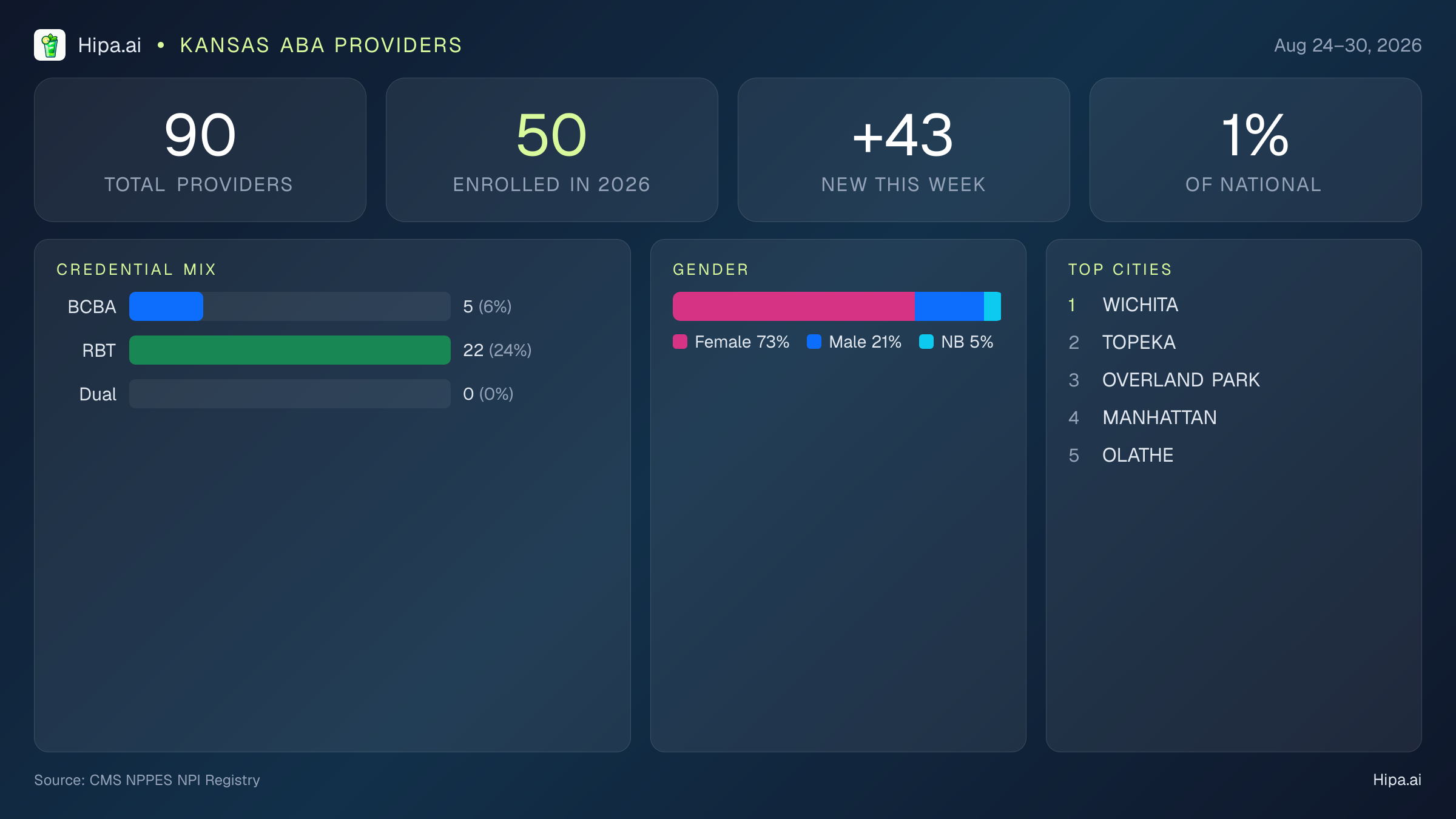
Kansas recorded 90 providers in the latest CMS NPI registry weekly update, representing 1% of the national weekly total. The registry lists 43 providers new this week and 50 new this year, including 75 individuals and 15 organizations. Kansas’s small share points to a more limited provider market than states with heavier registry activity, while the weekly additions show continued movement in behavioral health enrollment. NPI activity does not confirm active caseloads, hiring status or appointment availability.
ABA Workforce Mix
The data lists 5 BCBA credentials and 22 RBT credentials, with no dual BCBA-RBT credentials reported. These figures overlap with taxonomy and other credential fields, so they are not mutually exclusive shares of the 90-provider total. The RBT-to-BCBA gap indicates a workforce weighted toward direct implementation rather than clinical supervision. Because BCBAs supervise RBTs, design treatment programs and monitor outcomes, the smaller BCBA pool could limit how quickly Kansas clinics expand services, even as technician enrollment grows. The absence of dual credentials also suggests no visible concentration of providers combining the supervisory and direct-service designations in this update.
Demographics and Organizations
Gender data identifies 55 female providers, 16 male providers and 4 nonbinary providers, corresponding to 73%, 21% and 5%. Percentages do not sum to 100% because the registry’s reported categories leave part of the provider total outside these listed groups. The leading cities are Wichita, Topeka, Overland Park, Manhattan and Olathe, indicating activity across major metropolitan and regional centers. No notable organization appears multiple times in the supplied organization summary; repeated names should not be treated as separate employers or measures of service capacity.
Kansas’s RBT-heavy mix suggests potential growth in ABA direct-service capacity, but the limited BCBA count makes supervision availability a key constraint on access.