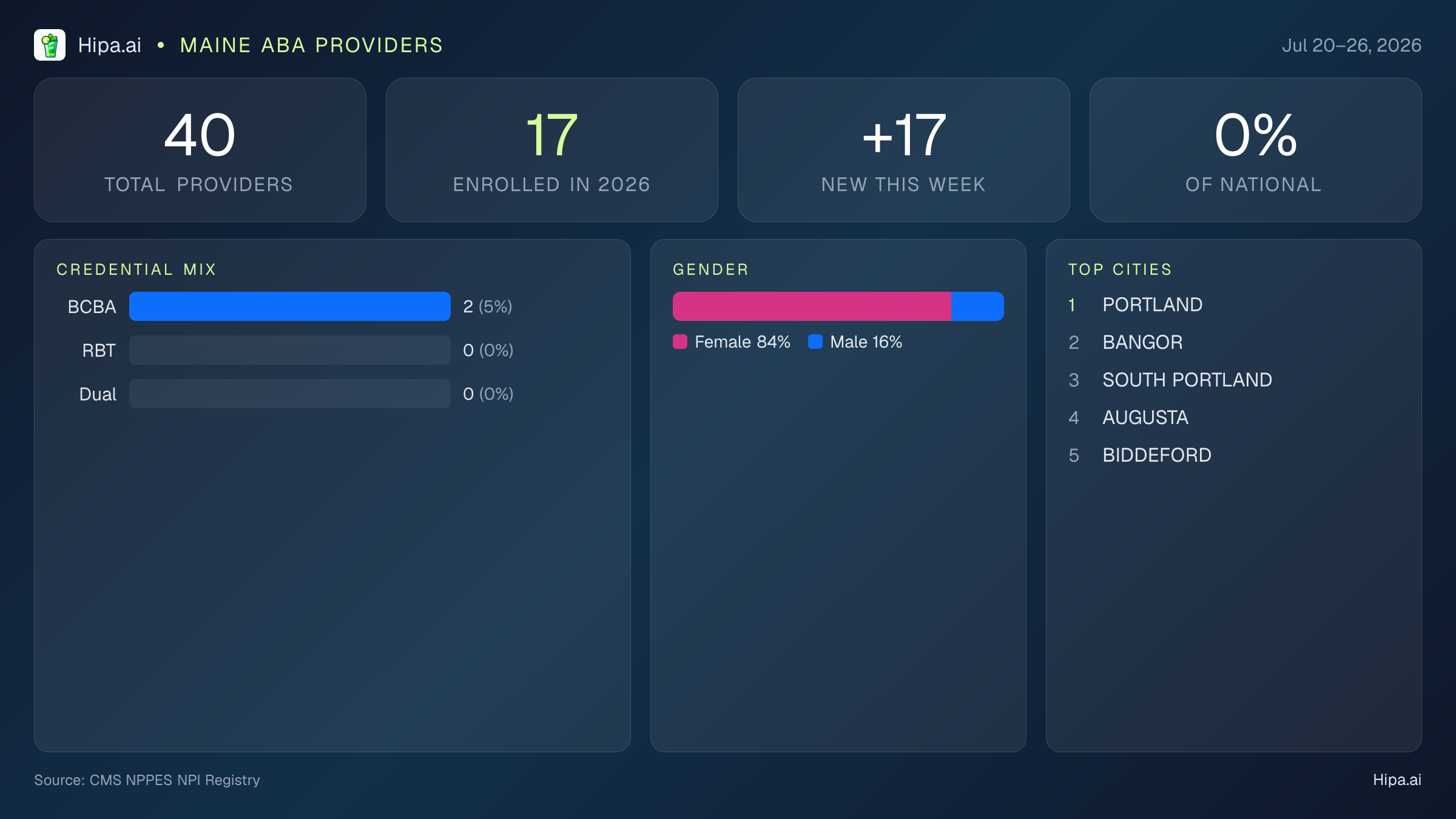
Maine recorded 40 behavioral health providers in the latest CMS NPI registry update, representing 0% of the national weekly total. Of these, 17 were new this week and this year, indicating a modest but active entry of new professionals. The total comprises 32 individual providers and 8 organizations. This negligible share suggests Maine's behavioral health workforce additions are a very minor portion of national growth, which could impact access to care in a less densely populated state.
ABA Workforce Dynamics
Within the applied behavior analysis (ABA) sector, the data indicates 2 providers with a BCBA designation (either through credential or taxonomy), though only one explicitly lists BCBA as their credential. There were 0 RBT credentials and 0 individuals holding both BCBA and RBT credentials. The absence of RBTs in this update, coupled with only two BCBAs, points to a significant gap in the ABA workforce pipeline, particularly for direct service providers and the supervisory capacity needed to support them. Beyond ABA, other prominent credentials include 8 LCSWs and 2 LMSW-CCs, indicating a broader reliance on clinical social workers in the state's behavioral health landscape.
Provider Demographics
Among the 32 individual providers, the workforce is predominantly female, with 27 (84%) identifying as female and 5 (16%) as male. No nonbinary providers were reported in this update. This gender distribution is consistent with national trends in behavioral health. Notably, Spurwink Services appeared multiple times, with "SPURWINK SERVICES" listed 3 times and "SPURWINK SERVICES INCORPORATED" 2 times, suggesting a significant presence of this organization in Maine's behavioral health ecosystem.
The limited number of new ABA professionals, particularly RBTs, suggests ongoing challenges for expanding access to ABA services in Maine, highlighting a critical need for workforce development initiatives in the state.