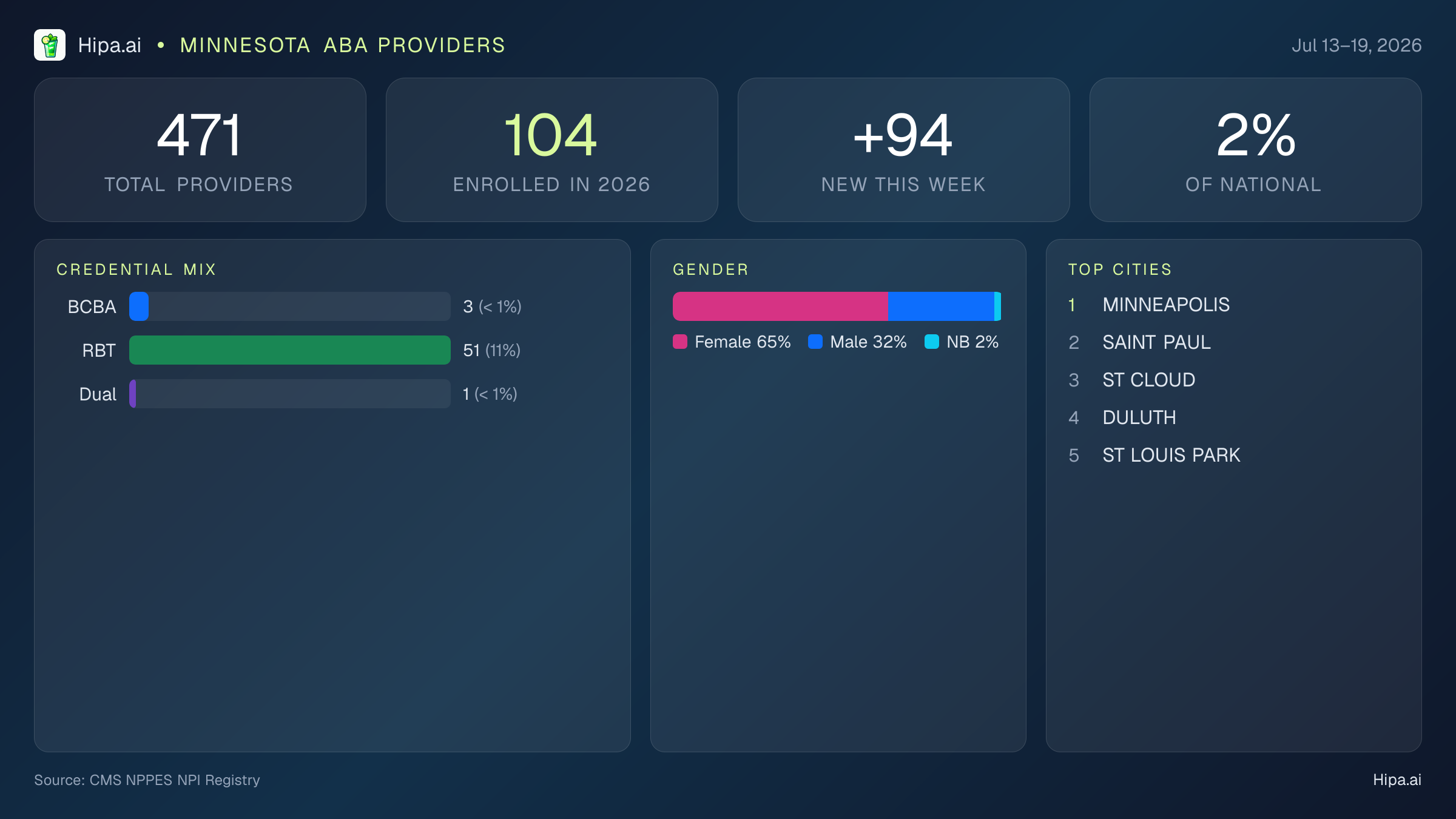
| ABBOTT, GEOFFREY | MINNEAPOLIS, MN | LICSW | Clinical Social Worker | 06/15/2006 |
| ABDI, MARYAN | MENDOTA HEIGHTS, MN | - | RBT | 07/13/2026 |
| ABDISALAN, NAJMA | BURNSVILLE, MN | - | RBT | 11/24/2025 |
| ACCORDORG | SAINT PAUL, MN | - | Community/Behavioral Health Agency | 01/03/2007 |
| ACKARD, DIANN | GOLDEN VALLEY, MN | PH.D. | Psychologist | 06/04/2006 |
| ADAMS, IDA | NEW PRAGUE, MN | MS-CCC/SLP | Speech-Language Pathologist | 02/06/2006 |
| ADAMS, KATHRYN | WINONA, MN | MA, LPCC | Professional Counselor | 07/16/2026 |
| AGNER, ISABELL | RICHFIELD, MN | - | RBT | 07/13/2026 |
| AIGNER, CYNTHIA | RICHFIELD, MN | MA, LP LIC SW LPC | Psychologist | 03/31/2006 |
| AL'ABSI, MUSTAFA | DULUTH, MN | PH. D | Psychologist | 10/13/2005 |
| ALBERTA, RICHARD | MINNEAPOLIS, MN | PSYD, LP | Psychologist | 04/27/2006 |
| ANCHOR CARE SERVICES INC.ORG | MINNEAPOLIS, MN | - | Mental Health Counselor | 07/15/2026 |
| ANDERSEN, CAROLE | BURNSVILLE, MN | M.A., L.P. | Psychologist | 12/23/2005 |
| ANDERSON-KRULL, TERESA | ALBERT LEA, MN | MSW LICSW | Clinical Social Worker | 05/23/2005 |
| ANDERSON, AMY | MANKATO, MN | - | Speech-Language Pathologist | 01/30/2006 |
| ANDERSON, BRENDA | CROOKSTON, MN | LICSW | Clinical Social Worker | 03/18/2006 |
| ANDERSON, CATHERINE | HIBBING, MN | MA, LICSW | Clinical Social Worker | 06/03/2006 |
| ANDERSON, LAUREL | INVER GROVE HEIGHTS, MN | M.D. | Specialist | 07/28/2005 |
| ANDERSON, MICHAEL | CROOKSTON, MN | LICSW | Clinical Social Worker | 03/18/2006 |
| ANDERSON, SARAH | SAINT PAUL, MN | LICSW | Clinical Social Worker | 03/14/2006 |
| ANDREWS, KATHRYN | ST CLOUD, MN | MS LP | Psychologist | 06/15/2006 |
| ATEN, REBECCA | OWATONNA, MN | M.P.T. | Specialist | 04/04/2006 |
| ATKINSON, WENDY | ST CLOUD, MN | MS LP | Mental Health Counselor | 05/08/2006 |
| AYLWARD, HUGH | RICHFIELD, MN | LP | Psychologist | 03/10/2006 |
| BABOILA, GEORGE | ST LOUIS PARK, MN | MSW, LICSW | Clinical Social Worker | 12/27/2005 |
| BAILEY, JOHN | NORTHFIELD, MN | PHD, LP | Psychologist | 04/10/2006 |
| BAKER THORN, MIKAYLA | FRIDLEY, MN | LPCC, LADC | Addiction (Substance Use Disorder) Counselor | 06/02/2026 |
| BAKER, JACQUELYN | PLYMOUTH, MN | MA, LP, LMFT | Psychologist | 04/10/2006 |
| BAKKE, BETTE | ST CLOUD, MN | PHD LP | Psychologist | 05/11/2006 |
| BAKKEN, JESSICA | WILLMAR, MN | MS | Mental Health Counselor | 04/13/2020 |
| BAKKER, SARA | WHITE BEAR LAKE, MN | - | Speech-Language Pathologist | 07/17/2026 |
| BARETT, LISA | MINNEAPOLIS, MN | LICSW | Clinical Social Worker | 06/03/2006 |
| BARNETT, ELIZABETH | EDEN PRAIRIE, MN | - | Professional Counselor | 02/15/2023 |
| BARRETT, RENEE | EAGAN, MN | MS, CCC-SLP | Speech-Language Pathologist | 04/10/2018 |
| BARTELS, BRYAN | CAMBRIDGE, MN | PHD,LP | Psychologist | 05/16/2006 |
| BARTLETT, ERIN | WOODBURY, MN | - | Clinical Social Worker | 03/09/2022 |
| BATTLES, DEBORAH | SHAKOPEE, MN | MA, LP | Psychologist | 08/03/2005 |
| BAUNE, LINDA | SAINT CLOUD, MN | M.S., CCC-SLP | Speech-Language Pathologist | 11/29/2005 |
| BEARDSLEY, CLARE | OAKDALE, MN | LPCC | Mental Health Counselor | 04/18/2024 |
| BEDNARCZYK, KARI | EDINA, MN | OTR/L | Specialist | 08/04/2005 |
| BENIES LLCORG | OWATONNA, MN | - | Case Management Agency | 07/02/2026 |
| BERG, CAROLYN | CROOKSTON, MN | LICSW | Clinical Social Worker | 03/18/2006 |
| BERGER, MICHAEL | ST LOUIS PARK, MN | PHD, L.P. | Psychologist | 11/02/2005 |
| BICEK, ALISON | NEW HOPE, MN | OTR/L | Specialist | 08/09/2005 |
| BIERS, SARAH | EDINA, MN | OTR/L | Specialist | 08/16/2005 |
| BINGER, ROBERT | SAINT PAUL, MN | M.A.,L.P.C. | Professional Counselor | 06/07/2006 |
| BLACKMAN, JOAN | MINNEAPOLIS, MN | LICSW | Clinical Social Worker | 08/13/2009 |
| BLEDSOE, LEASIA | COON RAPIDS, MN | - | RBT | 07/13/2026 |
| BLONIGEN, JULIA | ST CLOUD, MN | M.S., CCC-SLP | Speech-Language Pathologist | 07/14/2005 |
| BOGALE, SARON | SAVAGE, MN | - | RBT | 07/13/2026 |
| BOOTH, GRANT | SAINT PAUL, MN | MSW, LICSW, ACSW | Clinical Social Worker | 08/02/2005 |
| BOYD, JOAN | NEW HOPE, MN | OTR/L | Specialist | 08/09/2005 |
| BOYS, CHRISTOPHER | MINNEAPOLIS, MN | PHD, LP | Psychologist | 05/26/2006 |
| BRANDENHOFF, PETER | WOODBURY, MN | MSW LICSW | Clinical Social Worker | 02/10/2006 |
| BRESLIN, MARGARET | INVER GROVE HEIGHTS, MN | MA LP | Psychologist | 02/02/2006 |
| BRETHORST, JASON | WEST ST PAUL, MN | MA, LADC | Addiction (Substance Use Disorder) Counselor | 07/17/2026 |
| BRODIE, JANE | ST PAUL, MN | PHD | Psychologist | 04/19/2006 |
| BROWN, MEGHAN | ROCHESTER, MN | LICSW | Clinical Social Worker | 07/16/2026 |
| BROWN, SHERYL | MINNEAPOLIS, MN | MSW, LICSW | Clinical Social Worker | 12/29/2005 |
| BROXTERMAN, ROBERT | ROBBINSDALE, MN | MS, ATC/R | Specialist | 05/09/2006 |
| BRUNNER, CAROLYN | MINNEAPOLIS, MN | LICSW | Clinical Social Worker | 04/26/2006 |
| BURKHART, REGINA | MANKATO, MN | PH.D., L.P. | Psychologist | 07/19/2005 |
| BYE, NIKOLINA | SAINT PAUL, MN | - | Clinical Social Worker | 06/05/2023 |
| BYRNE, SHARON | GOLDEN VALLEY, MN | MS CCC SLP | Speech-Language Pathologist | 05/03/2006 |
| CALVERT, ELLEN | ST CLOUD, MN | MS LP LICSW LADC | Clinical Social Worker | 05/08/2006 |
| CAMMACK, TIMOTHY | GOLDEN VALLEY, MN | LICSW | Clinical Social Worker | 05/12/2006 |
| CARLSEN, KAREN | ST LOUIS PARK, MN | LGSW | Clinical Social Worker | 03/17/2006 |
| CARLSON, MARK | DULUTH, MN | M.D. | Specialist | 06/21/2005 |
| CASEY, LYSLE | DULUTH, MN | MA LP | Psychologist | 03/18/2006 |
| CASHMAN, CLAIRE | MINNETONKA, MN | - | RBT | 10/07/2025 |
| CHINERY, BETH | NEW HOPE, MN | SLP | Speech-Language Pathologist | 08/10/2005 |
| CHING, PAUL | SAINT PAUL, MN | MA, PHD | Mental Health Counselor | 07/14/2026 |
| CHOVANEC, MICHAEL | SHAKOPEE, MN | LMFT, LICSW, PHD | Clinical Social Worker | 07/18/2005 |
| CLARK, MISTY | COON RAPIDS, MN | - | RBT | 07/13/2026 |
| CLEAR SKY WELLNESS, PLLCORG | DETROIT LAKES, MN | - | Professional Counselor | 03/13/2026 |
| CLEVELAND, JAVON | MINNEAPOLIS, MN | PSYD | Psychologist | 12/27/2005 |
| CLUBB, JOSEPH | SAINT PAUL, MN | LICSW | Clinical Social Worker | 03/30/2006 |
| COFFIELD, NICHOLAS | ANDOVER, MN | LADC | Addiction (Substance Use Disorder) Counselor | 07/13/2026 |
| COLLECTIVE HOME CARE SERVICES LLPORG | MOORHEAD, MN | - | Community/Behavioral Health Agency | 07/01/2025 |
| COLLIER, AMANDA | SAINT PAUL, MN | MSW, BA | Clinical Social Worker | 08/19/2010 |
| COOK, REBECCA | MINNEAPOLIS, MN | PSYD, LP | Psychologist | 04/03/2006 |
| COOKS, YUKERSHALA | SPRING PARK, MN | LICSW | Clinical Social Worker | 07/14/2026 |
| COPE AND DREAM THERAPY LLCORG | SAINT PAUL, MN | - | Clinical Social Worker | 07/17/2026 |
| COUNTRYSIDE MEDICAL CLINIC P.L.L.CORG | CLARKFIELD, MN | - | Clinic/Center | 06/03/2025 |
| CRIMMINS, GERALD | SAINT PAUL, MN | PSYD CP | Psychologist | 12/28/2005 |
| CRISPIN BALLESTEROS, ANALI | SAINT PAUL, MN | - | Clinical Social Worker | 07/09/2024 |
| CURRY, JENNIE | COON RAPIDS, MN | MS, LPCC | Mental Health Counselor | 07/14/2026 |
| DAFFINRUD, STEVEN | SAINT CLOUD, MN | MA LP | Psychologist | 11/18/2005 |
| DAHNKE, JANICE | ST LOUIS PARK, MN | M.S.W., L.I.C.S.W | Clinical Social Worker | 06/04/2006 |
| DAUD QUALITY CARE LLCORG | MINNEAPOLIS, MN | - | Clinic/Center | 09/03/2021 |
| DAVIDSON, CHARME | MINNEAPOLIS, MN | PH.D., ABPP | Psychologist | 05/18/2006 |
| DAY, SAMANTHA | ROCHESTER, MN | - | Clinical Social Worker | 11/13/2023 |
| DEBEAU, RICHARD | SHAKOPEE, MN | LICSW | Clinical Social Worker | 07/05/2005 |
| DECKERT, KAYLA | SAINT PAUL, MN | - | Mental Health Counselor | 07/17/2026 |
| DEMANTS, ANITA | BLOOMINGTON, MN | - | Clinical Social Worker | 12/21/2005 |
| DENOMA-OLSON, ALANA | MOORHEAD, MN | MSW, LGSW | Clinical Social Worker | 07/13/2026 |
| DEROCHER, DALE | DULUTH, MN | MS | Counselor | 05/15/2006 |
| DIMOND, TERI | RICHFIELD, MN | LICSW | Clinical Social Worker | 11/18/2005 |
| DINSMORE, JUDY | FERGUS FALLS, MN | MSW | Clinical Social Worker | 05/27/2006 |
| DONALDSON, GARY | WACONIA, MN | MSED | Psychologist | 08/10/2005 |
| DONNELLY-HICKS, JEAN | GOLDEN VALLEY, MN | MA CCC SLP | Speech-Language Pathologist | 05/03/2006 |
| DONNELLY, ROBERT | GOLDEN VALLEY, MN | M.S.W. | Clinical Social Worker | 01/22/2006 |
| DONOVAN, NANCY | MINNEAPOLIS, MN | MSSW | Clinical Social Worker | 05/20/2006 |
| DOUGHTY, JEFFREY | PLYMOUTH, MN | DPT | Specialist | 02/28/2006 |
| DUCE, JACQUES | MINNEAPOLIS, MN | LPCC | Addiction (Substance Use Disorder) Counselor | 02/24/2012 |
| DUHAIME, LINDA | DULUTH, MN | M.S.W. | Clinical Social Worker | 10/04/2005 |
| DUMMER, CONSTANCE | BROOKLYN CENTER, MN | LP, LMFT, RPT-S | Psychologist | 04/10/2006 |
| DUNBAR, SASLLY | ROCHESTER, MN | - | Mental Health Counselor | 07/15/2026 |
| DUNLAP, JODY | STILLWATER, MN | LICSW | Clinical Social Worker | 01/19/2006 |
| DURBEN, STEVEN | GOLDEN VALLEY, MN | LP | Psychologist | 06/14/2006 |
| EFON, NADIA | MOORHEAD, MN | - | Specialist | 07/17/2026 |
| EICHMAN, MARY ANN | ROCHESTER, MN | M.S., L.P. | Psychologist | 06/28/2005 |
| ENGDAHL, SHARON | STILLWATER, MN | MSW LICSW | Clinical Social Worker | 02/13/2006 |
| ENGLAND, MICHAEL | MAPLEWOOD, MN | M.D. | Specialist | 06/05/2006 |
| ERDMANN, RUTH | MINNETONKA, MN | MSCCC/SLP | Speech-Language Pathologist | 12/10/2005 |
| EVANS, BLAKE | ALEXANDRIA, MN | PHD,LP | Psychologist | 04/08/2006 |
| EVERGREEN CARE CLINIC LLCORG | MINNETRISTA, MN | - | BCBA | 07/15/2026 |
| FARNAM, GREGG | MINNEAPOLIS, MN | - | Specialist | 02/13/2006 |
| FASCHING, KATELYN | NEW BRIGHTON, MN | MA | Mental Health Counselor | 07/14/2026 |
| FENLASON, CATHERINE | EDINA, MN | SLP | Speech-Language Pathologist | 08/16/2005 |
| FENSKE, LORETTA | WILLMAR, MN | L.P. | Psychologist | 02/23/2006 |
| FINCHAM, DOUGLAS | EDINA, MN | HIS | Specialist | 09/19/2005 |
| FINDING NORTH COUNSELLINGORG | OAKDALE, MN | - | Professional Counselor | 06/02/2022 |
| FISCHER, NANCY | NORTHFIELD, MN | MS LP | Psychologist | 11/11/2005 |
| FLAVELL, ELIZABETH | ST PAUL, MN | MSW LICSW | Clinical Social Worker | 03/31/2006 |
| FLORES, JAIME | MINNETONKA, MN | - | RBT | 07/13/2026 |
| FOGAL, KENNETH | CROSBY, MN | MS VP | Psychologist | 12/05/2005 |
| FOLEY, JAMES | SAINT PAUL, MN | M.D. | Specialist | 05/18/2006 |
| FOREST, LAUREN | ST CLOUD, MN | MA LP | Psychologist | 05/09/2006 |
| FORSTING, JAMES | ST CLOUD, MN | MS ACATA LISW | Mental Health Counselor | 05/10/2006 |
| FOSSUM, MERLE | EDINA, MN | MSW | Clinical Social Worker | 06/06/2006 |
| FOX, DOUGLAS | NEW ULM, MN | MD | Psychologist | 03/24/2006 |
| FRIER, AURORA | MOORHEAD, MN | - | RBT | 07/13/2026 |
| FRISCH, MELVIN | MINNEAPOLIS, MN | M.D. | Specialist | 05/11/2006 |
| GALLAGHER, MORIA | MINNETONKA, MN | OTR | Speech-Language Pathologist | 03/16/2006 |
| GALLIVAN, HEATHER | MINNEAPOLIS, MN | - | Psychologist | 12/14/2005 |
| GANDHI, CHRISTINA | LAKE ELMO, MN | - | Psychologist | 02/14/2006 |
| GARCIA, CLAIRE | SAINT CLOUD, MN | MSSW | Clinical Social Worker | 05/13/2006 |
| GARCIA, MICHAEL | ROSEVILLE, MN | LICSW | Clinical Social Worker | 05/04/2026 |
| GARZA, JUDY | MINNEAPOLIS, MN | M.S. | Specialist | 05/27/2005 |
| GATTO, CATHERINE | SAINT PAUL, MN | MD | Specialist | 03/21/2006 |
| GELLE, NASRA | WEST ST PAUL, MN | - | RBT | 07/16/2026 |
| GERBER, PAMELA | MINNEAPOLIS, MN | LICSW | Clinical Social Worker | 06/16/2006 |
| GISH, JENNIFER | MINNETONKA, MN | LICSW | Clinical Social Worker | 05/25/2006 |
| GLADE, BILLIE | ALEXANDRIA, MN | MD | Specialist | 01/23/2006 |
| GLENN, ALEXANDRA | DULUTH, MN | - | RBT | 07/13/2026 |
| GOEDKEN, DANIEL | MINNEAPOLIS, MN | - | Clinical Social Worker | 06/14/2006 |
| GOLDEN, DEIRDRE | MINNEAPOLIS, MN | PHD LP | Psychologist | 05/01/2006 |
| GOLDSCHMIDT, PETER | DULUTH, MN | M.D. | Specialist | 06/20/2005 |
| GREGERSEN, GERALD | FARIBAULT, MN | PHD, LP | Psychologist | 04/05/2006 |
| GREUNKE, JULIE | HASTINGS, MN | - | Clinical Social Worker | 07/14/2026 |
| GRIBAS, STEVEN | ST CLOUD, MN | MSW LICSW | Clinical Social Worker | 03/08/2006 |
| GRIFFIS, AMY | SAINT LOUIS PARK, MN | - | Mental Health Counselor | 07/15/2026 |
| GRONNEBERG, PAUL | MANKATO, MN | M.A., L.P. | Psychologist | 07/18/2005 |
| GROUNDED MIND THERAPY LLCORG | SHAKOPEE, MN | - | Clinical Social Worker | 07/15/2026 |
| GUERRERO, JUDY | ST LOUIS PARK, MN | PSYD LP | Psychologist | 12/19/2005 |
| GUNDERSON, SULLIVAN | HUGO, MN | - | RBT | 07/14/2026 |
| GUYMON, MICHAEL | BROOKLYN CENTER, MN | MSW LCSW | Clinical Social Worker | 06/09/2006 |
| HAAS, REBECCA | ELK RIVER, MN | - | Mental Health Counselor | 07/14/2026 |
| HAGEN, BREANNA | EDEN PRAIRIE, MN | - | RBT | 07/15/2026 |
| HAGEN, ERIK | SAINT PAUL, MN | MD | Specialist | 03/23/2006 |
| HALL, DIANA | FERGUS FALLS, MN | MSW | Clinical Social Worker | 06/10/2006 |
| HALVORSON, MORGAN | MOORHEAD, MN | - | Specialist | 07/17/2026 |
| HANSEN, MARK | AUSTIN, MN | M.A.,L.P. | Psychologist | 11/10/2005 |
| HANSON, PEGGY | NORTHFIELD, MN | PSYD | Psychologist | 04/03/2006 |
| HANUS, LAWRENCE | BEMIDJI, MN | MA LP | Psychologist | 12/28/2005 |
| HASSAN, NUURO | SAINT PAUL, MN | - | RBT | 07/15/2026 |
| HAUGEN, WYATT | CLARKFIELD, MN | - | Specialist | 06/17/2022 |
| HAUSER, DESTINY HAUSER | BROOKLYN CENTER, MN | - | RBT | 07/13/2026 |
| HAWKINSON, ELIZABETH | MANKATO, MN | LICSW | Clinical Social Worker | 12/15/2005 |
| HEDBERG, JOHN | MINNEAPOLIS, MN | LP, LMFT | Psychologist | 11/29/2005 |
| HEIM, LUANN | COON RAPIDS, MN | MS LP | Psychologist | 12/01/2005 |
| HEIMSNESS, JOAN | CLOQUET, MN | LICSW | Clinical Social Worker | 06/23/2006 |
| HELLAND, NICOLE | WEST ST PAUL, MN | LICSW | Clinical Social Worker | 04/06/2006 |
| HEMMING, VERONICA | MENDOTA HEIGHTS, MN | - | RBT | 07/13/2026 |
| HENDERSON, PAMELA | SAINT PAUL, MN | PSYD, LP | Psychologist | 07/29/2005 |
| HENDRICKS, ROBIN | DULUTH, MN | M.D. | Specialist | 06/20/2005 |
| HENNING, DOUGLAS | ALEXANDRIA, MN | MS, LP | Psychologist | 04/10/2006 |
| HENRY, ARMANTI | BLAINE, MN | - | RBT | 07/13/2026 |
| HERMES, JAMIE | STILLWATER, MN | M.A., LPCC | Mental Health Counselor | 01/20/2026 |
| HICKS, THOMAS | BLOOMINGTON, MN | PH.D., L.P. | Psychologist | 05/25/2006 |
| HIRD, JAYNA | WOODBURY, MN | - | Speech-Language Pathologist | 07/16/2026 |
| HODGES, NIKYA | HUGO, MN | - | RBT | 07/13/2026 |
| HOFFMANN, ANN | GOLDEN VALLEY, MN | MS CCC SLP | Speech-Language Pathologist | 04/28/2006 |
| HOKENSTAD, RACHEL | WINONA, MN | - | RBT | 07/13/2026 |
| HOLDEN, LANE | MINNEAPOLIS, MN | LPCC | Mental Health Counselor | 07/13/2026 |
| HOMORODY, DAVID | WACONIA, MN | M ED LP | Psychologist | 08/15/2005 |
| HOUSE, FAYE | EDINA, MN | PT | Specialist | 08/09/2005 |
| HUGHES PSYCHOTHERAPYORG | NORTHFIELD, MN | - | Clinical Social Worker | 07/13/2026 |
| HUGHES, BARBARA | ST LOUIS PARK, MN | M.A., L.I.C.S.W | Psychologist | 01/10/2006 |
| HUNG, JOHN | SAINT PAUL, MN | PHD, LP | Psychologist | 05/16/2006 |
| HUSSEIN, NADIA | MINNETONKA, MN | - | RBT | 07/14/2026 |
| JAKUBOWSKI, DANI | ST CLOUD, MN | PHD LP | Psychologist | 05/11/2006 |
| JALONEN, DONNA | MAPLEWOOD, MN | MSW LICSW | Clinical Social Worker | 02/07/2006 |
| JAMES, SUZANNE | SAINT CLOUD, MN | PHD LP | Psychologist | 11/18/2005 |
| JAMIE RUTH COUNSELING LLCORG | CARVER, MN | - | Mental Health Counselor | 07/03/2026 |
| JENKINS, PATTI | DULUTH, MN | MA | Counselor | 05/15/2006 |
| JOHNSEN, ERICA | SAINT PAUL, MN | PHD, LP | Psychologist | 04/20/2006 |
| JOHNSON, HEATHER | ROCHESTER, MN | M.A., L.P. | Psychologist | 06/30/2005 |
| JOHNSON, KIMBERLY | LITCHFIELD, MN | MA CCCSP | Speech-Language Pathologist | 03/23/2006 |
| JOHNSON, LYNDALL | EAGAN, MN | MA LP | Psychologist | 11/17/2005 |
| JOHNSON, THERESA | WOODBURY, MN | - | RBT | 07/13/2026 |
| KAHLER, RONALD | MANKATO, MN | LP | Psychologist | 05/16/2006 |
| KANDIK, KAREN | SHAKOPEE, MN | MSW, LICSW | Clinical Social Worker | 07/13/2005 |
| KEEFE, DANIEL | MINNEAPOLIS, MN | LICSW | Clinical Social Worker | 03/09/2006 |
| KEERY, HELENE | ST LOUIS PARK, MN | PH.D. | Psychologist | 12/05/2005 |
| KELLER, EILEEN | NORTHFIELD, MN | M ED, LP | Psychologist | 04/10/2006 |
| KELLEY, MARIANNE | ST PAUL, MN | PSYD LP | Psychologist | 04/22/2006 |
| KELLOGG, KRISTEN | NEW HOPE, MN | OTR/L | Specialist | 08/09/2005 |
| KEMMET, LOIS | BURNSVILLE, MN | LICSW | Clinical Social Worker | 12/06/2005 |
| KERSTEN, THOMAS | SAINT PAUL, MN | M.D. | Specialist | 02/16/2006 |
| KIND HEARTS FOUNDATIONORG | MINNETONKA, MN | - | Case Management Agency | 07/14/2026 |
| KLEICH, CHRISTINE | SAINT PAUL, MN | MSW LICSW | Clinical Social Worker | 03/02/2006 |
| KLEIS, WILLIAM | ROCHESTER, MN | MS, LP, LLC | Psychologist | 10/08/2005 |
| KOLL, JON | MONTICELLO, MN | MS CP | Psychologist | 06/19/2006 |
| KOSEK, TAMMY | SAINT CLOUD, MN | CCC-SLP | Speech-Language Pathologist | 11/29/2005 |
| KOSTOPOULOS, CHRISTINA | EAGAN, MN | LPCC | Professional Counselor | 07/13/2026 |
| KRATCHA, APRIL | MOORHEAD, MN | - | Mental Health Counselor | 07/13/2026 |
| KRONLUND, SHANNON | CROOKSTON, MN | LICSW | Clinical Social Worker | 03/16/2006 |
| LAGOW, CATHERINE | ST CLOUD, MN | MS LP | Psychologist | 06/15/2006 |
| LAINHART, NICOLE | GOLDEN VALLEY, MN | MS CCC SLP | Speech-Language Pathologist | 04/27/2006 |
| LAMPI, NICOLE | NEW HOPE, MN | SLP | Speech-Language Pathologist | 08/09/2005 |
| LEACH, SUSAN | ST LOUIS PARK, MN | PH.D. | Psychologist | 12/08/2005 |
| LEMAIRE, JIANNA | SAINT LOUIS PARK, MN | - | Clinical Social Worker | 07/01/2025 |
| LESLIE, KAREN | GOLDEN VALLEY, MN | LICSW | Clinical Social Worker | 08/26/2005 |
| LEVINSON, STEVEN | THIEF RIVER FALLS, MN | PHD | Psychologist | 05/04/2006 |
| LEWANDOWSKI, THOMAS | DULUTH, MN | - | Counselor | 05/13/2006 |
| LEWIS, VERNON | AUSTIN, MN | PH.D.,L.P. | Psychologist | 11/09/2005 |
| LIBERTAE YOUR MIND LLCORG | MINNEAPOLIS, MN | - | Mental Health Counselor | 07/17/2026 |
| LIDDLE, BRENDA | EDINA, MN | SLP | Speech-Language Pathologist | 08/09/2005 |
| LILLY-TAYLOR, WINIFRED | MINNEAPOLIS, MN | PHD, LP | Psychologist | 11/17/2005 |
| LINDBERG, LESLIE | WOODBURY, MN | LPCC | Mental Health Counselor | 07/16/2026 |
| LINDENFELD COUNSELING PLLCORG | ROCHESTER, MN | - | Mental Health Counselor | 01/19/2022 |
| LIST, ANNE | MINNEAPOLIS, MN | - | Clinical Social Worker | 06/20/2006 |
| LIVERMORE, GARY | MINNEAPOLIS, MN | PHD | Psychologist | 04/22/2006 |
| LIVING WELL AND HEALING THERAPY SERVICES PLLCORG | BLAINE, MN | - | Clinical Social Worker | 04/28/2026 |
| LOCH, JUDITH | ST CLOUD, MN | RN MS LP | Mental Health Counselor | 05/11/2006 |
| LOCKYEAR, PATRICIA | STILLWATER, MN | PSYD LP | Psychologist | 06/16/2006 |
| LODERMEIER, LARRY | OWATONNA, MN | MS LP LMFT | Psychologist | 04/18/2006 |
| LOEFFLER, HALEY | MINNETONKA, MN | - | RBT | 07/13/2026 |
| LOGEAIS, SYDNEY | MOORHEAD, MN | - | Case Manager/Care Coordinator | 06/10/2026 |
| LONG, SHELTON | MINNEAPOLIS, MN | - | Mental Health Counselor | 07/15/2026 |
| LORENTZEN, ELIZABETH | RED WING, MN | PSYD | Psychologist | 02/22/2006 |
| LOWINSKI, SARA | DULUTH, MN | - | Clinical Social Worker | 01/27/2014 |
| LUDWIGSON, HOLLY | WHITE BEAR LAKE, MN | M.A., CCC-SLP | Speech-Language Pathologist | 09/12/2005 |
| LUMRY, ANN | SAINT PAUL, MN | PH.D. | Psychologist | 06/03/2006 |
| LYMAN, ROBERT | DULUTH, MN | MSED | Counselor | 05/15/2006 |
| MACK, BROWNELL | MINNEAPOLIS, MN | PSYD | Psychologist | 12/27/2005 |
| MADEY, NASTEHO | MOORHEAD, MN | - | Case Manager/Care Coordinator | 07/17/2026 |
| MADIGAN, JAMES | BEMIDJI, MN | LADC | Addiction (Substance Use Disorder) Counselor | 07/13/2026 |
| MAHAMUD, AALIYA | MINNETONKA, MN | - | RBT | 07/13/2026 |
| MAHONEY, TIMOTHY | RED WING, MN | MSW, LICSW | Clinical Social Worker | 06/15/2006 |
| MAKALINAO, FERDINAND | ALEXANDRIA, MN | MD | Specialist | 01/27/2006 |
| MALMBERG, AMANDA | ROCHESTER, MN | - | RBT | 07/13/2026 |
| MAMMEL, MARK | SAINT PAUL, MN | MD | Specialist | 03/21/2006 |
| MANTELL, ROBERT | SAINT PAUL, MN | PHD, L.P. | Psychologist | 08/01/2005 |
| MARAVENT HEALTH LLCORG | MAPLE GROVE, MN | - | Clinical Social Worker | 07/15/2026 |
| MARKHART, VICKI | BURNSVILLE, MN | SLP MS CCC SLP | Speech-Language Pathologist | 04/27/2006 |
| MARSIN HOME CARE LLCORG | EDEN PRAIRIE, MN | - | Case Manager/Care Coordinator | 07/14/2026 |
| MARTINSON, PAULETTE | ST CLOUD, MN | MS LP LICSW | Clinical Social Worker | 05/12/2006 |
| MASON, PEGGY | FAIRMONT, MN | CRNA | Specialist | 10/24/2005 |
| MAY, MARY | ST CLOUD, MN | MS LICSW | Clinical Social Worker | 05/11/2006 |
| MBANGAMOH, ERICA | GOLDEN VALLEY, MN | SLP | Speech-Language Pathologist | 04/21/2006 |
| MCASKILL, ALICE | MOORHEAD, MN | MD | Specialist | 03/28/2006 |
| MCCAULEY, MARY | MINNEAPOLIS, MN | MS LICSW | Clinical Social Worker | 02/28/2006 |
| MCCLAY, JOHN | MINNEAPOLIS, MN | ED.D. | Psychologist | 07/19/2005 |
| MCGEARY, RENEE | SAINT PAUL, MN | LICSW | Clinical Social Worker | 04/04/2006 |
| MCGREEVY, JOHN | ST LOUIS PARK, MN | - | Psychologist | 12/16/2005 |
| MCGUIRE, TIMOTHY | ROSEVILLE, MN | LICSW, BCD | Clinical Social Worker | 07/05/2005 |
| MCKEE, HOWARD | SAINT PAUL, MN | - | Addiction (Substance Use Disorder) Counselor | 07/13/2026 |
| MCKINZIE, CHARLES | ALEXANDRIA, MN | MD | Specialist | 01/23/2006 |
| MCLARNAN, THOMAS | CHASKA, MN | MSW, LICSW | Clinical Social Worker | 06/22/2006 |
| MCNERNEY, FLORENCE | SAINT PAUL, MN | RN CS LICSW | Clinical Social Worker | 10/06/2005 |
| MCVAY, ABIGAIL | BROOKLYN CENTER, MN | - | RBT | 07/13/2026 |
| MEERS, KYLER | COLD SPRING, MN | MSW LICSW | Clinical Social Worker | 03/11/2006 |
| MEHR THERAPY AND WELLNESS PLLCORG | MINNETONKA, MN | - | Psychologist | 07/15/2026 |
| MELBY, DANA | MOORHEAD, MN | - | Specialist | 07/17/2026 |
| MELNYCHENKO, THERESA | NORTHFIELD, MN | MA, LP | Psychologist | 04/11/2006 |
| MESS, ALEX | EDEN PRAIRIE, MN | - | RBT | 02/20/2019 |
| MEULEBROECK, SUSANNE | BURNSVILLE, MN | SLP | Speech-Language Pathologist | 05/04/2006 |
| MEYER, LESLIE | GOLDEN VALLEY, MN | MA LP | Psychologist | 05/03/2006 |
| MIELKE, SHERRILEE | MANKATO, MN | LICSW | Clinical Social Worker | 11/30/2005 |
| MIKULSKI, NANCY | MINNEAPOLIS, MN | MSW, LICSW | Clinical Social Worker | 05/23/2006 |
| MILES, DORIT | ST LOUIS PARK, MN | - | Psychologist | 12/29/2005 |
| MILES, JADE | ROCHESTER, MN | - | Mental Health Counselor | 10/28/2020 |
| MILLER, MARK | MINNEAPOLIS, MN | PSY.D., L.P. | Psychologist | 06/09/2006 |
| MILLER, STANLEY | AUSTIN, MN | PSY.D.,L.P. | Psychologist | 11/10/2005 |
| MILLS, THOMAS | BROOKLYN CENTER, MN | MA, LPP | Psychologist | 04/13/2006 |
| MITCHELL, JEANETTE | WACONIA, MN | MEQ LP | Psychologist | 08/09/2005 |
| MJOS, CATHERINE | RICHFIELD, MN | LP | Psychologist | 03/10/2006 |
| MOHAMUD, NIMO | SAUK RAPIDS, MN | - | RBT | 07/14/2026 |
| MOREY, CINDY | SAINT PAUL, MN | PSYD | Psychologist | 04/26/2006 |
| MORIARTY, MARY | GOLDEN VALLEY, MN | LICSW, MFT | Clinical Social Worker | 10/19/2005 |
| MORRIS, KIMBERLY | NORTHFIELD, MN | - | RBT | 07/13/2026 |
| MOUANOUTOUA, MADALYN | BLOOMINGTON, MN | MSW, LICSW | Clinical Social Worker | 09/14/2022 |
| MUELLER, HAYDEN | WOODBURY, MN | - | RBT | 07/13/2026 |
| MUELLER, KIRK | AUSTIN, MN | PH.D., L.P. | Psychologist | 12/21/2005 |
| MUHIDIN, BILAL | MENDOTA HEIGHTS, MN | - | RBT | 07/13/2026 |
| MUNDY, CIARA | MENDOTA HEIGHTS, MN | - | RBT | 07/13/2026 |
| MYLONAKI, MARIA | SAINT PAUL, MN | - | Professional Counselor | 04/18/2024 |
| NADEAU, JANICE | MINNEAPOLIS, MN | PH.D., L.P | Psychologist | 05/05/2006 |
| NADEAU, JOHN | EDINA, MN | M.D. | Specialist | 06/09/2005 |
| NARJES, JACQUELINE | MINNEAPOLIS, MN | MSW, LICSW | Clinical Social Worker | 05/18/2006 |
| NASH, SALLY | BLOOMINGTON, MN | - | Psychologist | 12/30/2005 |
| NELSON-MITCHELL, JESSICA | EDINA, MN | LAMFT, LADC | Addiction (Substance Use Disorder) Counselor | 06/04/2019 |
| NELSON, JAMIE | NORTH BRANCH, MN | MA, LPCC, LADC | Addiction (Substance Use Disorder) Counselor | 12/09/2025 |
| NELSON, JOHN | ST LOUIS PARK, MN | - | Psychologist | 12/29/2005 |
| NELSON, JOSEPH | ST LOUIS PARK, MN | - | Psychologist | 12/30/2005 |
| NELSON, THERESA | MINNEAPOLIS, MN | MS,LP | Psychologist | 04/12/2006 |
| NICKLAY, AMANDA | ROCHESTER, MN | - | Clinical Social Worker | 07/13/2026 |
| NIEHAUS, EILEEN | ELK RIVER, MN | MS LP | Psychologist | 06/17/2006 |
| NIENABER, CAROLE | MINNEAPOLIS, MN | - | Psychologist | 06/21/2006 |
| NIMS, DENNIS | FERGUS FALLS, MN | MSW | Clinical Social Worker | 06/03/2006 |
| NOLLER, GAIL | COON RAPIDS, MN | PSYD, LP | Psychologist | 05/15/2006 |
| NORDANG, DONNA | ST CLOUD, MN | MS LP | Mental Health Counselor | 05/11/2006 |
| NUSBAUM, PATRICK | SAINT CLOUD, MN | - | Professional Counselor | 04/28/2020 |
| O BRIEN, MICHAEL | ROCHESTER, MN | - | Clinical Social Worker | 02/08/2006 |
| O'LAUGHLIN, PATRICK | MINNEAPOLIS, MN | PHD | Psychologist | 02/15/2006 |
| OHARA, SHEILA | MINNEAPOLIS, MN | LICSW | Clinical Social Worker | 02/07/2006 |
| OKOYE, BELLA | SAINT CLOUD, MN | - | RBT | 07/14/2026 |
| OLSON, CARLA | BURNSVILLE, MN | - | Psychologist | 12/30/2005 |
| OLSON, PAUL | ST LOUIS PARK, MN | - | Psychologist | 12/30/2005 |
| OLSON, ROSS | INVER GROVE HEIGHTS, MN | M.D. | Specialist | 07/29/2005 |
| OMAR, FAHAT | SHOREVIEW, MN | - | RBT | 07/14/2026 |
| ORELLANA, SARAH | COON RAPIDS, MN | LPCC | Mental Health Counselor | 07/14/2026 |
| OVERVOORDE, CHARLYNN | MINNEAPOLIS, MN | MSW | Clinical Social Worker | 06/24/2006 |
| PAKYUREK, CYNDEE | AUSTIN, MN | PHD | Psychologist | 12/23/2005 |
| PARKER, STEPHEN | SAINT PAUL, MN | PSYD LP | Psychologist | 02/23/2006 |
| PATHAK, REENA | ST. PAUL, MN | PSYD LP | Psychologist | 12/27/2005 |
| PAW, DAH | SAINT PAUL, MN | - | RBT | 07/15/2026 |
| PEASE, GAIL | ROCHESTER, MN | LICSW | Clinical Social Worker | 02/07/2006 |
| PELLETIER, ELLEN | ST CLOUD, MN | MA LP LICSW | Clinical Social Worker | 05/09/2006 |
| PERKINS, THEODORE | ST LOUIS PARK, MN | - | Psychologist | 11/30/2005 |
| PETERS, SUSAN | BURNSVILLE, MN | PSYD, LP | Psychologist | 11/15/2005 |
| PETERSON, CHRISTIAN | BEMIDJI, MN | M.D. | Specialist | 05/27/2006 |
| PETERSON, NADINE | NORTH SAINT PAUL, MN | LP | Psychologist | 10/19/2005 |
| PETERSON, RONALD | MINNEAPOLIS, MN | M.D. | Specialist | 05/13/2006 |
| PETERSON, SANDRA | THIEF RIVER FALLS, MN | LICSW | Clinical Social Worker | 09/23/2005 |
| PITTMAN, ROBIN | SHAKOPEE, MN | - | Counselor | 07/19/2005 |
| PLUMMER, TERESA | MINNEAPOLIS, MN | - | Psychologist | 12/06/2005 |
| POTTEBAUM, RANDALL | BURNSVILLE, MN | - | Psychologist | 12/06/2005 |
| PREAP, SAVAN | SAINT PAUL, MN | LADC | Addiction (Substance Use Disorder) Counselor | 07/13/2026 |
| PREMIUM SOCIAL SERVICES, LLCORG | OTSEGO, MN | - | Case Management Agency | 07/16/2026 |
| PRESSLEIN, HEIDI | STILLWATER, MN | MSW, LICSW | Clinical Social Worker | 07/07/2005 |
| PRETTNER SOLON, YVONNE | DULUTH, MN | MA | Counselor | 05/11/2006 |
| PROMISING PATHWAYS PLLCORG | OWATONNA, MN | - | Mental Health Counselor | 07/15/2026 |
| RAASCH, LINDA | EAGAN, MN | ED.D., L.P. | Psychologist | 07/29/2005 |
| RAHMAN, AYGUN | LAKEVILLE, MN | - | RBT | 07/13/2026 |
| REAGLES, KATHLEEN | MINNEAPOLIS, MN | CRNA | Specialist | 05/31/2005 |
| RECTENWALD, NANCY | DULUTH, MN | MSED | Counselor | 05/11/2006 |
| REDMOND-CIERNIA, KATHERINE | WOODBURY, MN | - | BCBA | 02/16/2021 |
| REED, CYNTHIA | MINNEAPOLIS, MN | MS LP | Psychologist | 03/10/2006 |
| REID, RILEY | HERMANTOWN, MN | - | RBT | 07/16/2026 |
| RICHARDSON, RACHEL | SAINT PAUL, MN | LICSW | Clinical Social Worker | 07/19/2005 |
| RILEY-SCHMIDA, ALISON | EAGAN, MN | PSY.D., LP, LADC | Psychologist | 07/13/2026 |
| RILEY, BARBARA | ROCHESTER, MN | LICSW | Clinical Social Worker | 02/08/2006 |
| RIVERS, LYNN | MINNEAPOLIS, MN | CRNA | Specialist | 05/27/2005 |
| ROA, MARK | MINNEAPOLIS, MN | MA, LP | Psychologist | 04/12/2006 |
| ROBINSON, REBECCA | NEW HOPE, MN | SLP | Speech-Language Pathologist | 04/20/2006 |
| ROONEY, COURTNEY | DETROIT LAKES, MN | MSW | Clinical Social Worker | 06/12/2006 |
| ROSEEN, DAVID | RED WING, MN | PHD, LP | Psychologist | 02/21/2006 |
| ROTHSTEIN, ROBERT | WOODBURY, MN | MS, LP | Mental Health Counselor | 04/25/2006 |
| ROWAN, TERESA | SAINT PAUL, MN | LICSW | Clinical Social Worker | 03/29/2006 |
| RUTH, JAMIE | CARVER, MN | LPCC | Professional Counselor | 08/13/2024 |
| SALISBURY, BRECK | MINNEAPOLIS, MN | MSW LICSW | Clinical Social Worker | 02/02/2006 |
| SANDER, SARAH | EDEN PRAIRIE, MN | - | Psychologist | 12/22/2005 |
| SANKEY, CLAYTON | NORTH SAINT PAUL, MN | LICSW | Clinical Social Worker | 05/30/2006 |
| SANTANA, MERCEDES | MINNEAPOLIS, MN | PHD, LP | Psychologist | 10/24/2012 |
| SARA STALLMAN PLLCORG | MOORHEAD, MN | - | Clinical Social Worker | 01/20/2021 |
| SATHER, DAVID | ST CLOUD, MN | LICSW | Clinical Social Worker | 05/12/2006 |
| SAUNDERS, SUSAN | EDEN PRAIRIE, MN | - | Clinical Social Worker | 12/22/2005 |
| SAYER, NINA | ST. PAUL, MN | PHD LP | Psychologist | 01/06/2006 |
| SCANLON, RICHARD | EDEN PRAIRIE, MN | M.A., L.P. | Psychologist | 09/01/2005 |
| SCHEID, JENNIFER | EDEN PRAIRIE, MN | - | RBT | 05/14/2021 |
| SCHIAPPACASSE, MARC | INVER GROVE HEIGHTS, MN | MA LP | Psychologist | 02/28/2006 |
| SCHMITT, MELISSA | SHAKOPEE, MN | - | Mental Health Counselor | 07/18/2005 |
| SCHNORR, JOHN | NORTHFIELD, MN | CCC/SLP | Speech-Language Pathologist | 04/05/2006 |
| SCHOBORG, JULIA | GOLDEN VALLEY, MN | MS CCC SLP | Speech-Language Pathologist | 05/23/2006 |
| SCHOENFELDER, PATRICK | BEMIDJI, MN | M.D. | Specialist | 06/08/2006 |
| SCHUELLER, LUCI | ROCHESTER, MN | M.S., L.P. | Psychologist | 06/28/2005 |
| SCHUSTER STATTMILLER, KATHERINE | SAINT PAUL, MN | MSW | Clinical Social Worker | 11/18/2011 |
| SCHWARTZ, SUSAN | SAINT PAUL, MN | LICSW | Clinical Social Worker | 03/28/2006 |
| SEGAL, NORMAN | ST PAUL, MN | LICSW | Clinical Social Worker | 09/05/2007 |
| SEIFRIED, LINDA | SAINT PAUL, MN | LICSW | Clinical Social Worker | 04/04/2006 |
| SELBY, SAUL | LAKE ELMO, MN | - | Addiction (Substance Use Disorder) Counselor | 10/20/2005 |
| SENGSAVANG INC.ORG | BLOOMINGTON, MN | - | Professional Counselor | 07/20/2021 |
| SETHNA, SUSAN | SAINT PAUL, MN | LICSW | Clinical Social Worker | 07/21/2005 |
| SEVERINO GARCIA, WALGELIS | MANKATO, MN | - | BCBA | 07/17/2026 |
| SHACK, ALISHA | RED WING, MN | - | RBT | 07/17/2026 |
| SHAFFER, JOHN | MINNEAPOLIS, MN | - | Clinical Social Worker | 05/16/2006 |
| SHIPPY, SARAH | NORTHFIELD, MN | LICSW | Mental Health Counselor | 06/25/2006 |
| SHIRREFF, NEIL | PELICAN RAPIDS, MN | LICENSED PSYCHOLOGIS | Psychologist | 05/02/2006 |
| SIEGAL, JANE | SAINT PAUL, MN | PSYD, LP | Psychologist | 04/20/2006 |
| SIME, CARMODY | MINNEAPOLIS, MN | LPCC, LADC | Professional Counselor | 10/18/2022 |
| SIMMONS, BRANDON | OWATONNA, MN | O.T.R. | Specialist | 03/09/2006 |
| SKYTTA-GURKANLAR, ANNA | WACONIA, MN | MA, LP | Psychologist | 08/09/2005 |
| SLOTHOWER, NANCY | PLYMOUTH, MN | PHD | Psychologist | 04/10/2006 |
| SMITH, BOBBI | SAINT CLOUD, MN | SLP | Speech-Language Pathologist | 11/29/2005 |
| SMITH, SUSAN | ST. CLOUD, MN | MSW, LICSW | Clinical Social Worker | 06/12/2006 |
| SOZO RECOVERY CAREORG | ANDOVER, MN | - | Community/Behavioral Health Agency | 07/13/2026 |
| SPADING, KEVIN | LAKE ELMO, MN | - | Addiction (Substance Use Disorder) Counselor | 10/20/2005 |
| SPARE, JULIE | SAINT CLOUD, MN | MS | Psychologist | 11/18/2005 |
| SPEARS, REECE | MINNETONKA, MN | - | RBT | 07/13/2026 |
| SPECTHRIVE WELLNESS & BEHAVIORAL HEALTH LLCORG | BROOKLYN PARK, MN | - | Professional Counselor | 11/29/2025 |
| ST LOUIS COUNTY PHHS DEPTORG | DULUTH, MN | - | Case Management Agency | 07/15/2026 |
| ST LOUIS COUNTY PHHS DEPTORG | DULUTH, MN | - | Case Management Agency | 07/15/2026 |
| STALLMAN, SARA | MOORHEAD, MN | LICSW | Case Manager/Care Coordinator | 02/23/2011 |
| STARK, ELIZABETH | BLOOMINGTON, MN | LICSW | Clinical Social Worker | 08/26/2024 |
| STASSART, JACQUES | WOODBURY, MN | - | Specialist | 12/15/2005 |
| STEINKAMP, BRENDA | RICHFIELD, MN | MA, LP, LICSW | Psychologist | 05/17/2006 |
| STEMBER, BETH | FARIBAULT, MN | - | Specialist | 02/21/2006 |
| STIEHM, MATTHEW | MINNEAPOLIS, MN | MA | Professional Counselor | 05/03/2023 |
| STOBAUGH, WALTER | ROCHESTER, MN | LICSW | Clinical Social Worker | 02/07/2006 |
| STOKES, BARBARA | SAINT CLOUD, MN | - | Psychologist | 07/08/2026 |
| STUMPF, GABRIELLA | ARDEN HILLS, MN | - | Clinical Social Worker | 08/14/2013 |
| SUGARMAN, ERIC | EDEN PRAIRIE, MN | A.T.,C. | Specialist | 04/26/2006 |
| SULLIVAN, ROBERT | COON RAPIDS, MN | LICSW | Clinical Social Worker | 04/17/2006 |
| SVEEN, STANLEY | WINONA, MN | BS LADC | Addiction (Substance Use Disorder) Counselor | 11/08/2005 |
| SWANSON-HAAPALA, SHARON | ALBERT LEA, MN | PSYD | Psychologist | 01/16/2006 |
| SWANSON, CHELSY | SAINT LOUIS PARK, MN | - | Clinical Social Worker | 07/15/2026 |
| SWANSON, JANICE | ROCHESTER, MN | PSYD | Psychologist | 01/20/2006 |
| TANGUAY, MICHAEL | WACONIA, MN | MA LP | Psychologist | 08/15/2005 |
| TEMPLETON, JAMES | SHOREVIEW, MN | MSW | Clinical Social Worker | 10/03/2005 |
| THAO, KOUA | BURNSVILLE, MN | - | RBT | 07/13/2026 |
| THAO, LYLAH | MANKATO, MN | - | Mental Health Counselor | 07/13/2026 |
| THEISEN, JAY | MINNEAPOLIS, MN | MSW LICSW | Clinical Social Worker | 04/08/2006 |
| THERIEN, JILL | SAINT PAUL, MN | MD | Specialist | 03/21/2006 |
| THOMAS, SHEILA | SAINT PAUL, MN | L.P. | Mental Health Counselor | 01/03/2006 |
| THOMPSON, MARJORE | MINNEAPOLIS, MN | LICSW | Clinical Social Worker | 01/23/2006 |
| THORNTON, KAI | BLOOMINGTON, MN | - | RBT | 07/13/2026 |
| TONGRIT-GREEN, KARIMAH-NENRIT | RICHFIELD, MN | - | RBT | 07/13/2026 |
| TOUGAS, FRANCIS | RICHFIELD, MN | LP | Psychologist | 03/09/2006 |
| TRICKEY, NANCY | CROOKSTON, MN | LICSW | Clinical Social Worker | 03/18/2006 |
| VANDERLOOP, MARY | ST LOUIS PARK, MN | - | Psychologist | 12/15/2005 |
| VANSELOW, JONI | EDINA, MN | PT | Specialist | 08/09/2005 |
| VAUDT, TOM | ST CLOUD, MN | MS LP LICSW | Clinical Social Worker | 05/11/2006 |
| VAUGHAN, DAVID | MINNEAPOLIS, MN | MS LICSW | Clinical Social Worker | 02/07/2006 |
| VIEHWEG, ELIZABETH | MINNETONKA, MN | M.A., CCC-SLP | Speech-Language Pathologist | 08/17/2016 |
| VOGEL, VIRGINIA | SAINT PAUL, MN | PSYD, LP | Psychologist | 07/15/2005 |
| VONRUEDEN, THOMAS | SAINT PAUL, MN | M.D. | Specialist | 02/16/2006 |
| VOSS, MARY | MINNEAPOLIS, MN | - | Clinical Social Worker | 12/22/2005 |
| WAHLBERG, MARY | SAINT PAUL, MN | LICSW | Clinical Social Worker | 07/19/2005 |
| WAHLSTROM, GREGG | BURNSVILLE, MN | - | Clinical Social Worker | 01/04/2006 |
| WAITE, DEBRA | SAINT LOUIS PARK, MN | LICSW | Clinical Social Worker | 02/27/2006 |
| WAITT, ROBERT | ST CLOUD, MN | MS LP | Mental Health Counselor | 05/11/2006 |
| WALKER, LARAINE | HASTINGS, MN | PHD, LP | Mental Health Counselor | 04/17/2006 |
| WANDERSEE, RICHARD | COON RAPIDS, MN | MSW LICSW | Clinical Social Worker | 02/17/2006 |
| WARNER, MARIAH | HUGO, MN | - | RBT | 07/13/2026 |
| WARREN, SVEA | BROOKLYN CENTER, MN | - | RBT | 07/13/2026 |
| WARSHAW, ERIN | MINNEAPOLIS, MN | MD | Specialist | 05/17/2006 |
| WEBSTER, JORDYN | RICHFIELD, MN | - | RBT | 07/13/2026 |
| WEISE-BROWN, DANA | HOPKINS, MN | M.S. | Speech-Language Pathologist | 03/20/2007 |
| WEISS, JENNIFER | ST LOUIS PARK, MN | - | Psychologist | 12/22/2005 |
| WELLNITZ, PAYTON | HUGO, MN | - | RBT | 07/13/2026 |
| WHITE, DAVID | GOLDEN VALLEY, MN | SLP | Speech-Language Pathologist | 05/03/2006 |
| WHITE, RONDA | DULUTH, MN | LMFT LPP TP MA | Psychologist | 03/30/2006 |
| WILD CREA, MARY | INVER GROVE HEIGHTS, MN | M.D. | Specialist | 07/29/2005 |
| WILSON, DANIEL | CROOKSTON, MN | LICSW | Clinical Social Worker | 03/18/2006 |
| WILSON, DENISE | FERGUS FALLS, MN | ED.S. | Psychologist | 06/12/2006 |
| WINHOLTZ, MARK | ANDOVER, MN | - | Specialist | 05/20/2006 |
| WINSOR, DARCY | CAMBRIDGE, MN | MSW, LICSW | Clinical Social Worker | 02/24/2021 |
| WOLF, JAYDE | SAINT LOUIS PARK, MN | - | Mental Health Counselor | 04/04/2026 |
| WOODRUFF, ANN | GOLDEN VALLEY, MN | LICSW | Clinical Social Worker | 05/08/2006 |
| WOODWARD, JILL | BUFFALO, MN | MA LPC | Professional Counselor | 06/20/2006 |
| WRIGHT, SARA | SAINT PAUL, MN | PH.D, LP, LMFT | Psychologist | 05/15/2006 |
| WROGE, AMANDA | MINNEAPOLIS, MN | MSW, LICSW | Clinical Social Worker | 09/20/2022 |
| YANG, AIR | LAUDERDALE, MN | - | RBT | 05/22/2023 |
| YASSIN, JUWERIYA | BLOOMINGTON, MN | - | RBT | 07/13/2026 |
| YOUNG, BARBARA | FERGUS FALLS, MN | M.S. | Counselor | 06/06/2006 |
| YUSUF, MUNA | SAINT PAUL, MN | - | RBT | 07/13/2026 |
| ZEIDLER, VIENNA | ST LOUIS PARK, MN | - | RBT | 07/13/2026 |