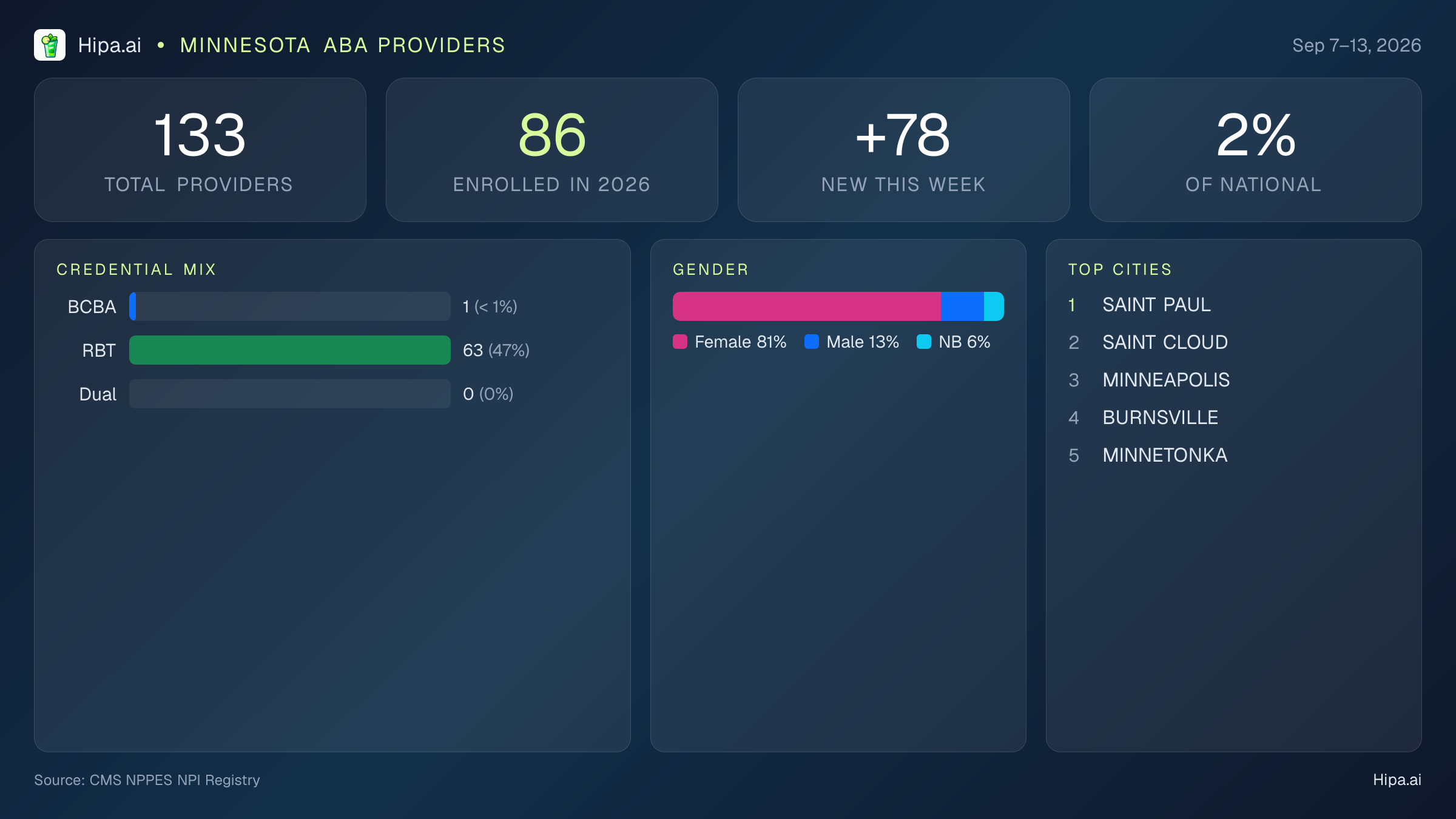
Minnesota recorded 133 providers in the latest CMS NPI registry weekly update, representing 2% of the national weekly total. The update includes 78 providers added this week and 86 added this year, with 119 individuals and 14 organizations. Minnesota’s presence in the national snapshot signals sustained behavioral health activity, although NPI records do not confirm staffing levels, active caseloads or appointment availability. The volume also reflects a broad provider base spanning the Twin Cities, Saint Cloud, Mankato, Rochester and other markets.
ABA Workforce Mix
The credential summary lists 1 BCBA, 63 RBTs and no dual BCBA-RBT credentials. These credential and taxonomy fields should not be read as mutually exclusive workforce categories: providers can carry multiple taxonomies, and the registry reports 18 providers with multiple taxonomies. The RBT-heavy pattern indicates substantially more documented technician capacity than supervisory capacity. In ABA operations, RBTs deliver direct services under BCBA supervision, so the limited BCBA count could constrain treatment-plan development, clinical oversight and expansion unless additional supervisors are present but recorded under other classifications. The data therefore points to a workforce pipeline that is stronger on direct-service roles than on clearly identified clinical leadership.
Demographics and Organizations
Gender data identifies 96 female providers, 16 male providers and 7 nonbinary providers, corresponding to 81%, 13% and 6%. No notable organization appears multiple times in the supplied update. The registry includes organizations across behavioral health, counseling, speech-language services and other specialties, but the dataset does not establish common ownership or a dominant employer. Saint Paul, Saint Cloud, Minneapolis, Burnsville and Minnetonka are the leading listed cities.
Minnesota’s update suggests expanding behavioral health participation with a particularly deep RBT presence, while the small documented BCBA pool remains a potential pressure point for ABA access and supervision.