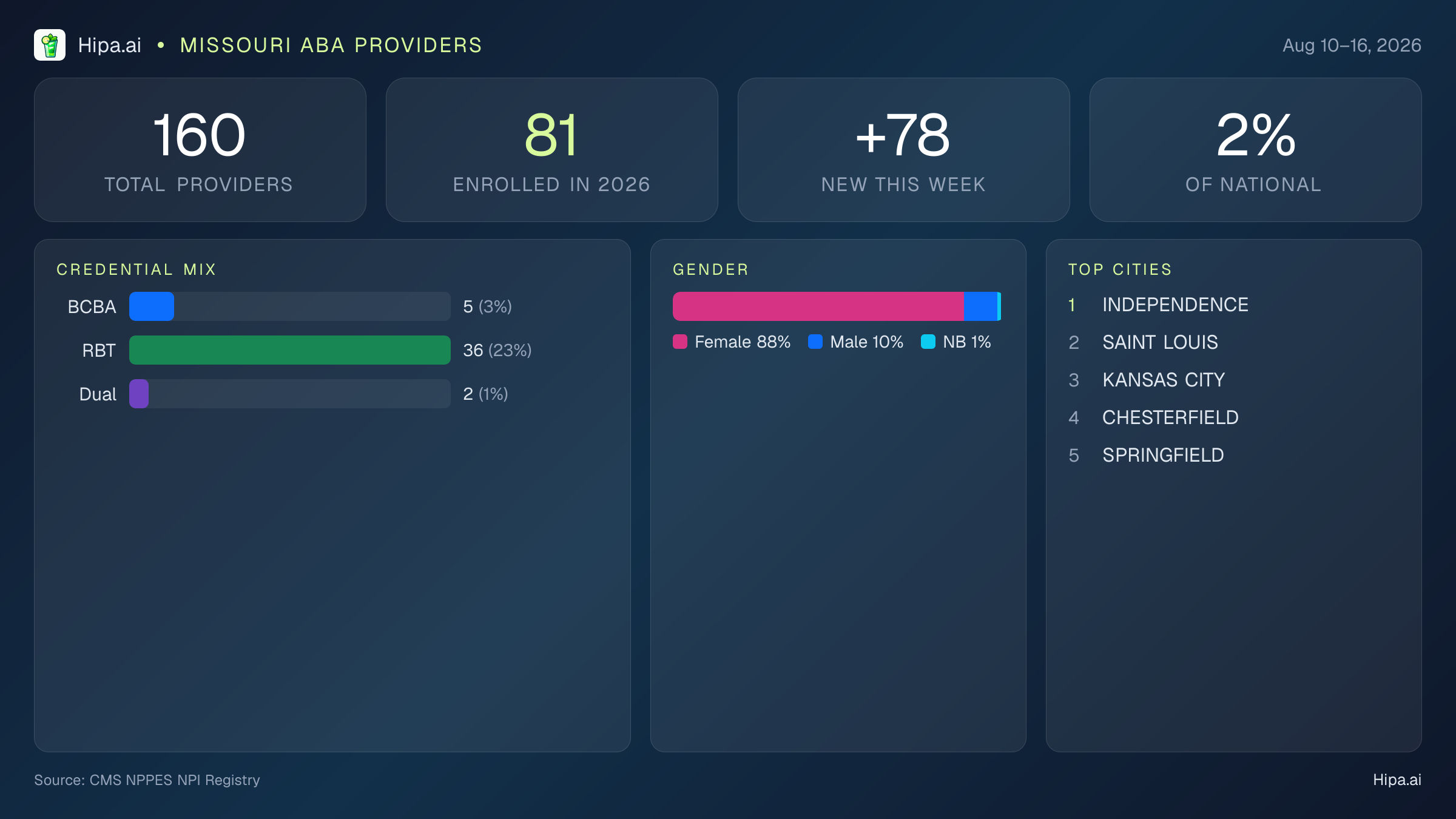
Missouri recorded 160 providers in the latest CMS NPI registry weekly update, representing 2% of the national weekly total. The registry added 78 new providers this week, indicating a substantial wave of activity in the state. Missouri’s share signals that it is a meaningful, though not dominant, contributor to national behavioral health provider growth.
ABA Workforce Mix
The registry reports 5 BCBA credentials and 36 RBT credentials, including 2 dual BCBA-RBT credentials. These categories overlap and are not mutually exclusive; the dual-credential providers are included in both credential groups, and the full provider count also includes other behavioral health professionals and organizations. Even with that caveat, the RBT-to-BCBA pattern shows a much larger direct-service workforce than supervisory workforce. Because BCBAs oversee RBTs and guide treatment planning, the mix suggests that supervisory capacity could limit how quickly Missouri converts workforce growth into expanded ABA services.
Demographics and Provider Activity
Individuals account for 146 providers, while organizations account for 14 providers. Gender data identifies 129 female providers, 15 male providers and 1 nonbinary provider; the registry lists these as 88%, 10% and 1%, respectively. The reported gender counts do not equal the full Missouri provider total, reflecting that gender data is not available for every record. Independence, Saint Louis, Kansas City, Chesterfield and Springfield are the leading cities listed for provider activity.
ASTRA MO BHE LLC appears twice in the notable-organizations field, with records in Harrisonville and Ellisville. Overall, Missouri’s strong RBT presence, limited BCBA count and concentrated activity in major population centers suggest growing ABA capacity, but continued pressure on supervision and geographic access.