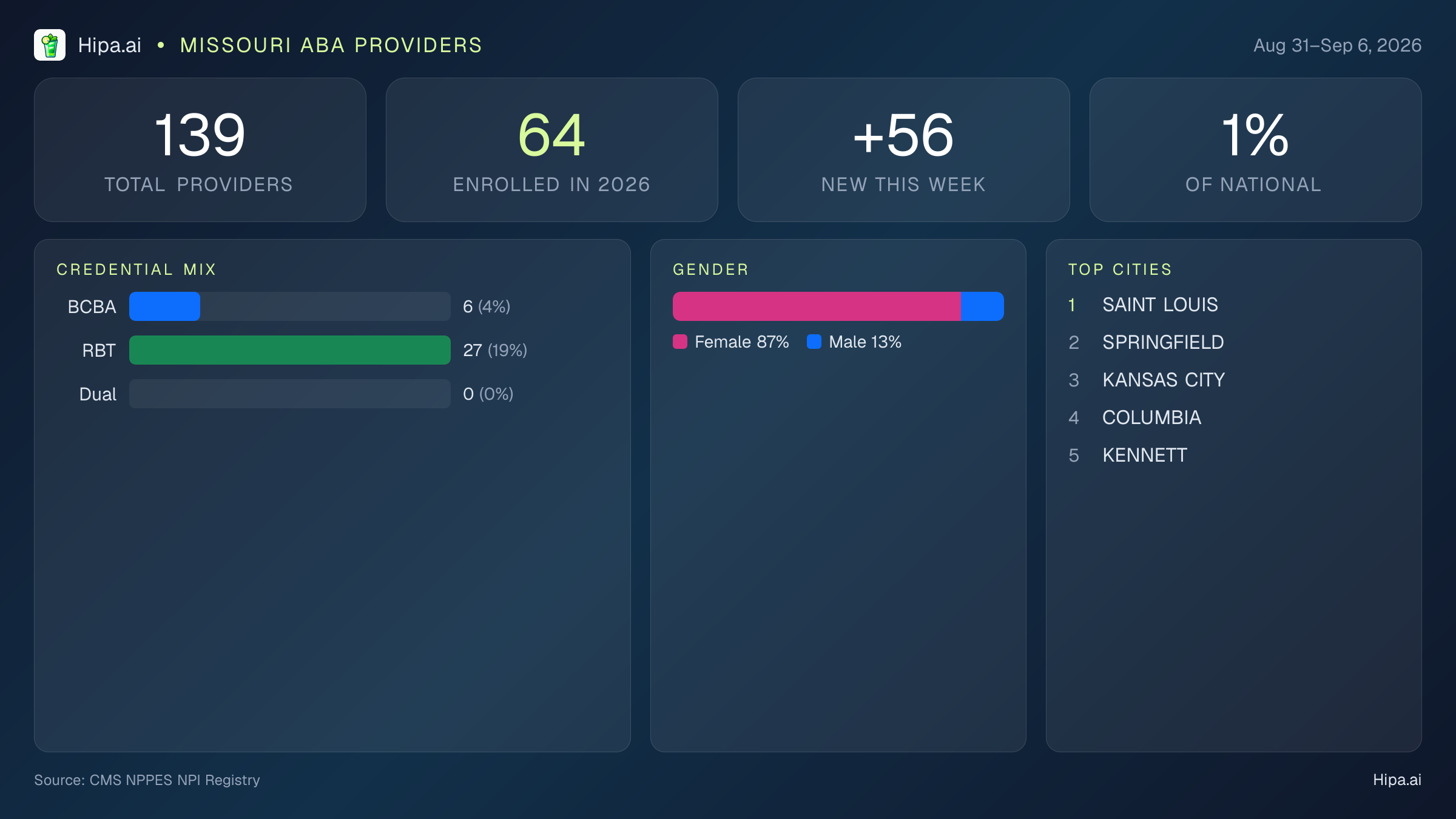
Missouri recorded 139 providers in the latest CMS NPI registry weekly update, representing 1% of the national weekly total. The registry added 56 new providers this week and lists 119 individuals and 20 organizations. Missouri’s modest national share points to a regional behavioral health market rather than a major center of national provider activity, although the weekly influx indicates continued registration activity. NPI records do not confirm active caseloads, staffing levels or appointment availability.
ABA Workforce Mix
The credential summary lists 6 BCBAs and 27 RBTs, with no dual BCBA-RBT credentials. The registry also includes one provider with a BCBA, LBA credential, and several ABA organization records using the BCBA taxonomy. Credential and taxonomy fields can overlap, so these counts are not mutually exclusive shares of Missouri’s provider total. The credential-text summary reports 2 RBTs, illustrating why the fields should not be combined or treated as a single count. The imbalance between technician-level RBT records and BCBA records suggests limited documented supervisory capacity relative to the potential technician workforce. Because BCBAs supervise RBTs and oversee treatment planning and clinical quality, that ratio may constrain how quickly new technician registrations translate into service access.
Demographics and Organizations
Among the 119 individual records, 104 are female and 15 are male; no nonbinary providers are listed. That gender profile is consistent with a behavioral health workforce that is predominantly female. Saint Louis, Springfield, Kansas City, Columbia and Kennett are the leading cities, indicating activity across major population centers and smaller regional markets. Lester E Cox Medical Centers appears three times, the only notable organization listed repeatedly. Sixteen providers carry multiple taxonomies, another overlap that reflects broader service roles rather than additional providers.
Missouri’s update suggests expanding registration activity but a comparatively thin BCBA supervisory layer, a combination that could leave ABA access dependent on recruitment and service expansion by existing organizations.