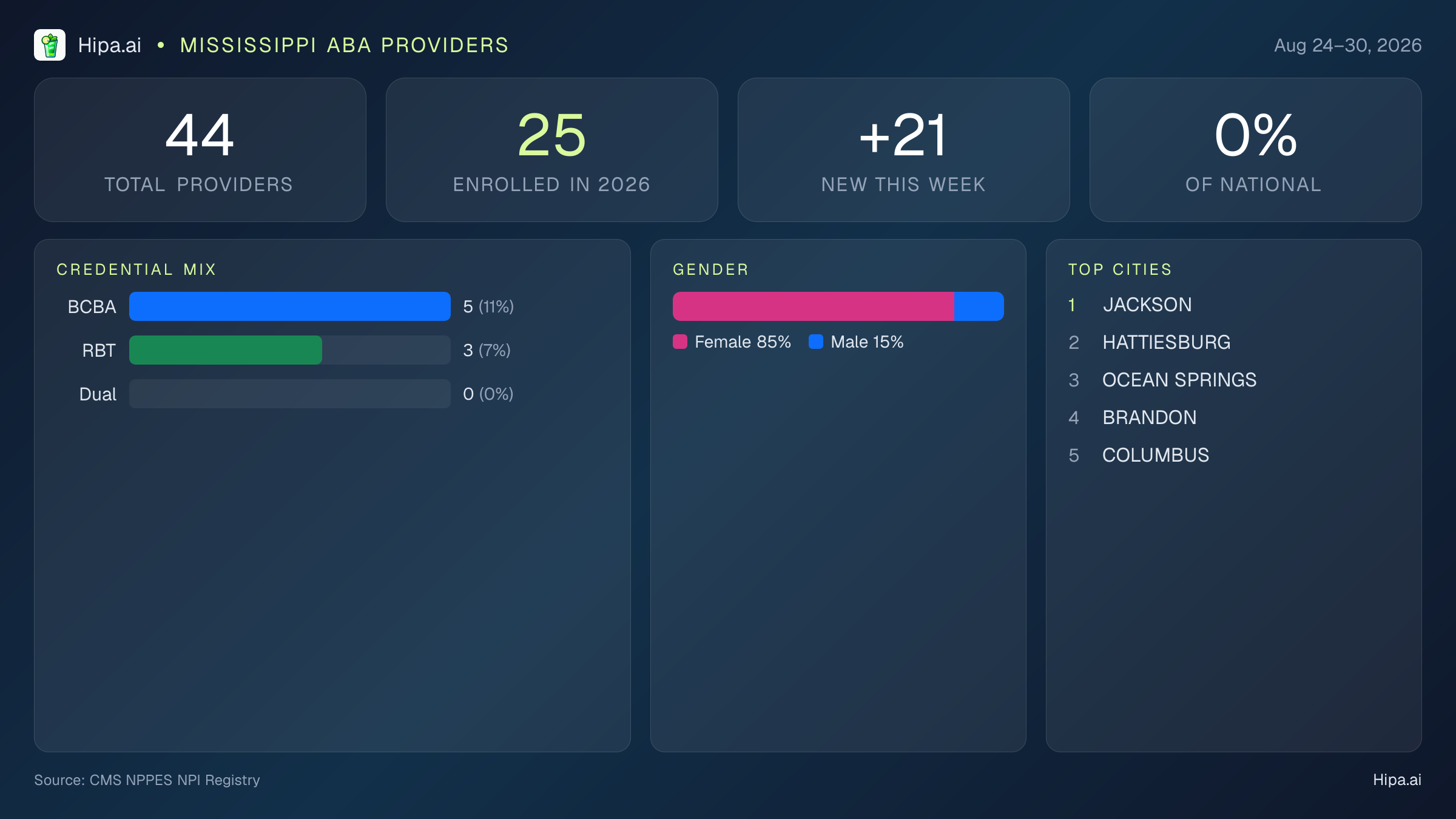
Mississippi recorded 44 providers in the latest CMS NPI registry weekly update, representing 0% of the national weekly total. The registry lists 21 new providers this week and 25 added this year, including 33 individuals and 11 organizations. The state’s minimal share signals that Mississippi remains a small contributor to national behavioral health provider activity in this update, although NPI registrations do not confirm active caseloads, hiring levels or available appointments.
ABA Workforce Mix
The credential data lists 5 BCBAs and 3 RBTs, with no dual BCBA-RBT credentials recorded. These categories are not mutually exclusive shares of the provider total: credential and taxonomy fields can overlap or describe the same provider in different ways. The registry also records 8 providers with multiple taxonomies. The relatively small BCBA count indicates limited identified supervisory capacity compared with the RBT pool. Because BCBAs supervise RBTs, oversee treatment plans and monitor clinical quality, a constrained supervisor base can limit how quickly direct-service ABA staffing translates into expanded access. The absence of dual credentials suggests no visible concentration of providers simultaneously identified as advancing from technician work into BCBA-level practice in this weekly file.
Demographics and Organizations
Gender data identifies 28 female providers, 5 male providers and no nonbinary providers, corresponding to 85%, 15% and 0%. The listed cities are Jackson, Hattiesburg, Ocean Springs, Brandon and Columbus, indicating activity across several Mississippi markets rather than a single city. The update does not identify notable organizations appearing multiple times. Its organization entries include ABA, behavioral health, counseling and clinic providers, but repeated NPI activity should not be treated as equivalent clinical capacity.
Mississippi’s limited BCBA pool and modest RBT presence suggest that supervisory depth, rather than technician supply alone, may remain a key constraint on ABA access and workforce growth.