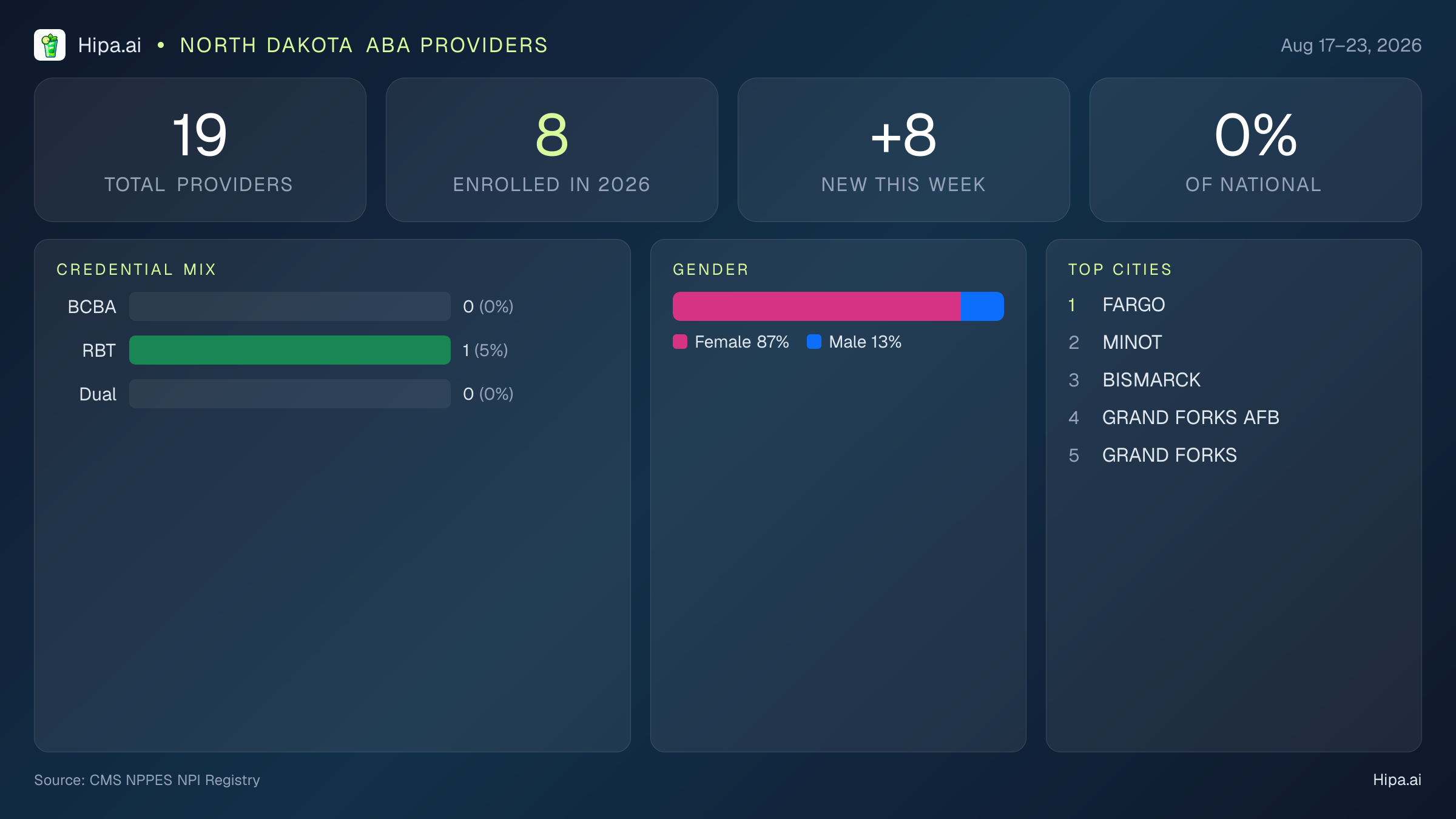
North Dakota recorded 19 providers in the latest CMS NPI registry weekly update, accounting for 0% of the national weekly total. The state added 8 new providers this week, all of its additions for the year so far. The zero-percent share indicates that North Dakota represents a very small portion of the registry activity captured nationally, although NPI records do not necessarily equal active clinical capacity, open appointments or completed service availability. The registry includes 15 individuals and 4 organizations, with activity spanning Fargo, Minot, Bismarck, Grand Forks and Grand Forks Air Force Base.
ABA Workforce Mix
The credential data lists no BCBA credentials, 1 RBT credential and no dual BCBA-RBT credentials. The categories can overlap with other credential or taxonomy fields and should not be treated as mutually exclusive shares of the provider total. Still, the absence of a listed BCBA alongside one RBT points to minimal documented ABA staffing in this update and no visible supervisory capacity within the BCBA field. Because BCBAs supervise RBTs, direct treatment activity generally depends on access to qualified clinical oversight; the registry snapshot therefore suggests that ABA expansion in North Dakota may remain constrained by the small number of identified ABA professionals.
Demographics and Provider Activity
Among the individual providers, 13 are female and 2 are male; the registry reports 87% female and 13% male, with no nonbinary providers listed. Five providers have multiple taxonomy entries, so taxonomy counts may overlap and should not be read as separate workforce totals. No organization appears repeatedly among the notable organizations field. The broader mix includes social workers, speech-language pathologists, case managers, counselors and an addiction counselor, showing that the weekly activity is concentrated in behavioral health disciplines outside ABA.
North Dakota’s update suggests limited documented ABA access and a broader behavioral health workforce that may need additional BCBA recruitment before RBT capacity can expand sustainably.