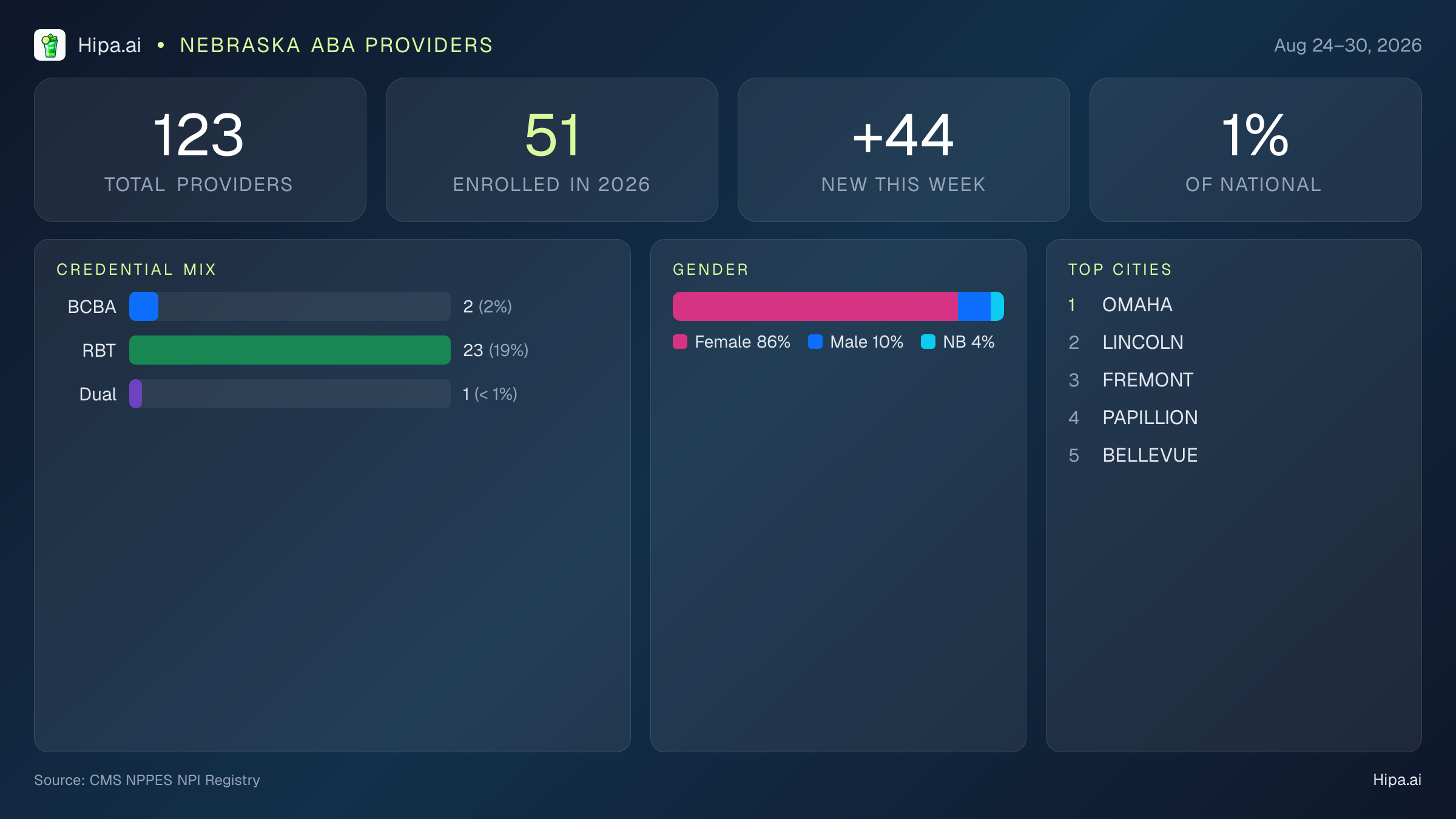
Nebraska recorded 123 providers in the latest CMS NPI registry weekly update, representing 1% of the national weekly total. The registry lists 44 new providers this week, with 114 individuals and 9 organizations. That activity gives Nebraska a visible, if modest, share of national behavioral health growth and points to ongoing workforce and service development. NPI activity does not confirm that a provider is accepting patients, carrying an active caseload or operating a staffed clinic.
ABA Workforce Mix
The registry identifies 2 BCBAs, 23 RBTs and 1 dual BCBA-RBT credential. These counts overlap: the dual credential is included in the credential data and should not be treated as a separate, mutually exclusive category or as shares of the total provider count. The sharp difference between BCBAs and RBTs suggests a workforce weighted toward direct implementation rather than clinical supervision. Since BCBAs supervise RBTs, design and update treatment plans, and monitor care quality, a small supervisor pool can limit how quickly Nebraska clinics expand services. The single dual credential indicates that combined technician and advanced clinical credentials remain uncommon in this update.
Demographics and Organizations
Gender data lists 98 female providers, 11 male providers and 5 nonbinary providers, corresponding to 86%, 10% and 4%. The registry’s listed leading cities are Omaha, Lincoln, Fremont, Papillion and Bellevue, showing activity concentrated in established population centers while also reaching communities such as North Platte, Columbus and Sidney. No notable organization appears multiple times in the supplied data. The 43 providers with multiple taxonomies further signal that registry records may span several professional roles rather than represent distinct workforce segments.
Nebraska’s RBT-heavy activity suggests potential ABA workforce growth, but limited BCBA representation may keep supervision capacity—and access—under pressure.