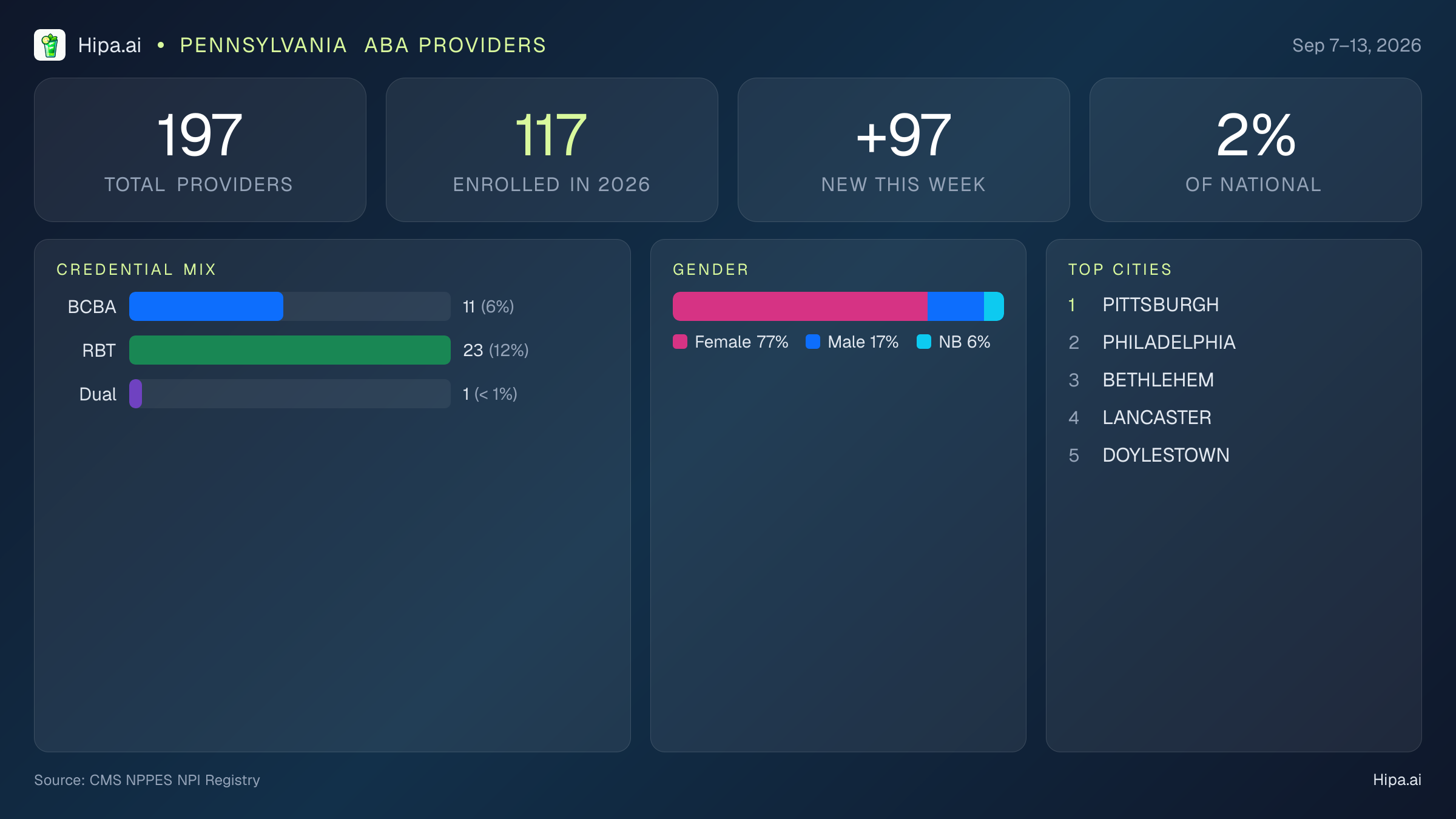
Pennsylvania recorded 197 providers in the latest CMS NPI registry weekly update, representing 2% of the national weekly total. The file includes 97 providers added this week, with 163 individuals and 34 organizations overall. That activity places Pennsylvania among the larger state contributors in this snapshot and signals a broad, active behavioral health provider market, although NPI records do not confirm staffing levels, caseloads or appointment availability.
ABA Workforce Mix
The credential summary lists 11 BCBAs and 23 RBTs, plus 1 dual credential spanning BCBA and RBT. These categories overlap: the dual-credential provider is included in the broader credential counts and should not be treated as a separate workforce group. The registry also identifies 26 providers with multiple taxonomies, another sign that NPI classifications can describe overlapping roles. The technician-heavy mix suggests more potential direct-service capacity than supervisory capacity. For ABA operators, that places a premium on recruiting and retaining BCBAs who can supervise RBTs, oversee treatment plans and support service quality. The counts should be read as registry signals rather than a complete measure of Pennsylvania’s practicing ABA workforce.
Demographics and Organizations
Gender data identifies 126 female providers, 27 male providers and 10 nonbinary providers, or 77%, 17% and 6%, respectively. Pittsburgh and Philadelphia lead the listed city activity, followed by Bethlehem, Lancaster and Doylestown. The update names no notable organizations appearing multiple times, so it does not show a clear concentration around a repeated corporate provider or PE-backed ABA chain.
Pennsylvania’s update suggests growing behavioral health participation, but expanding ABA access will depend on converting a technician-heavy registry profile into a deeper, geographically distributed BCBA supervisory workforce.