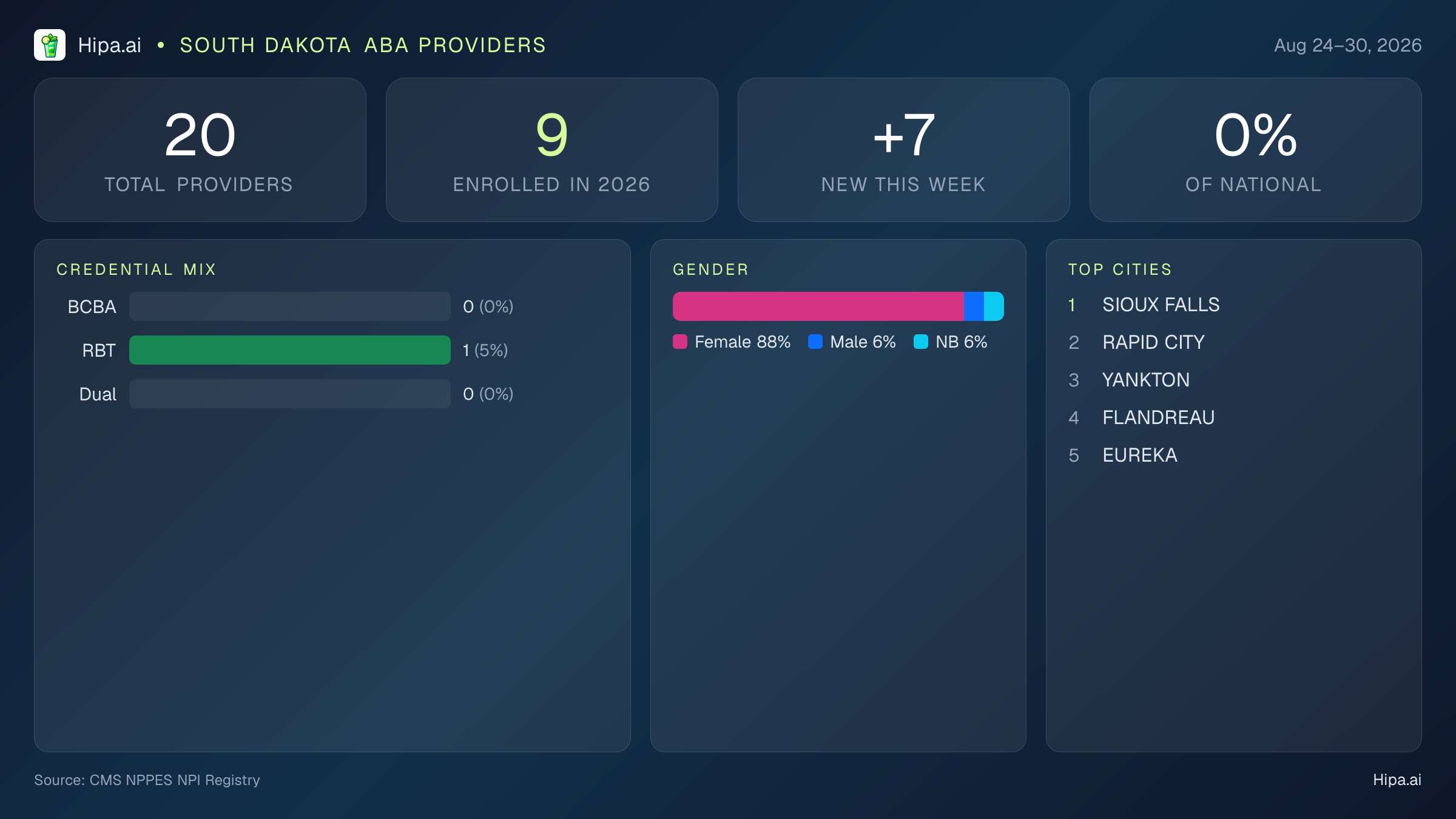
South Dakota recorded 20 providers in the latest CMS NPI registry weekly update, representing 0% of the national weekly total. The registry added 7 new providers this week, bringing the year-to-date count to 9. The update includes 16 individuals and 4 organizations. South Dakota’s negligible share signals a small, dispersed behavioral health market in the national registry, where modest changes can matter locally but do not indicate broad national expansion. NPI activity does not confirm active caseloads, staffing levels or appointment availability.
ABA Workforce Mix
The registry lists no BCBA credentials and 1 RBT credential, with no dual BCBA-RBT credentials. The RBT appears under the RBT taxonomy, while the credential summary also reports one RBT; these fields can overlap and should not be treated as mutually exclusive shares of the provider total. The absence of a BCBA record points to limited documented ABA supervisory capacity in this update. Because BCBAs supervise RBTs, design treatment plans and monitor clinical quality, a thin supervisor pool can restrict how quickly technician-level services translate into expanded access. The broader credential mix includes speech-language, psychology and social work credentials, reflecting a behavioral health registry that extends beyond ABA.
Demographics and Organizations
Gender data identifies 14 female providers, 1 male provider and 1 nonbinary provider, corresponding to 88%, 6% and 6%. The remaining provider records are not assigned a gender in the summary. Sioux Falls, Rapid City, Yankton, Flandreau and Eureka are the listed leading cities, with Sioux Falls appearing most prominently among individual records. No notable organization appears multiple times in the update. Six providers carry multiple taxonomies, a classification overlap that may reflect broader service roles rather than six additional providers.
South Dakota’s update suggests limited documented ABA depth and a distributed behavioral health workforce, making BCBA recruitment and cross-disciplinary coordination important for future access.