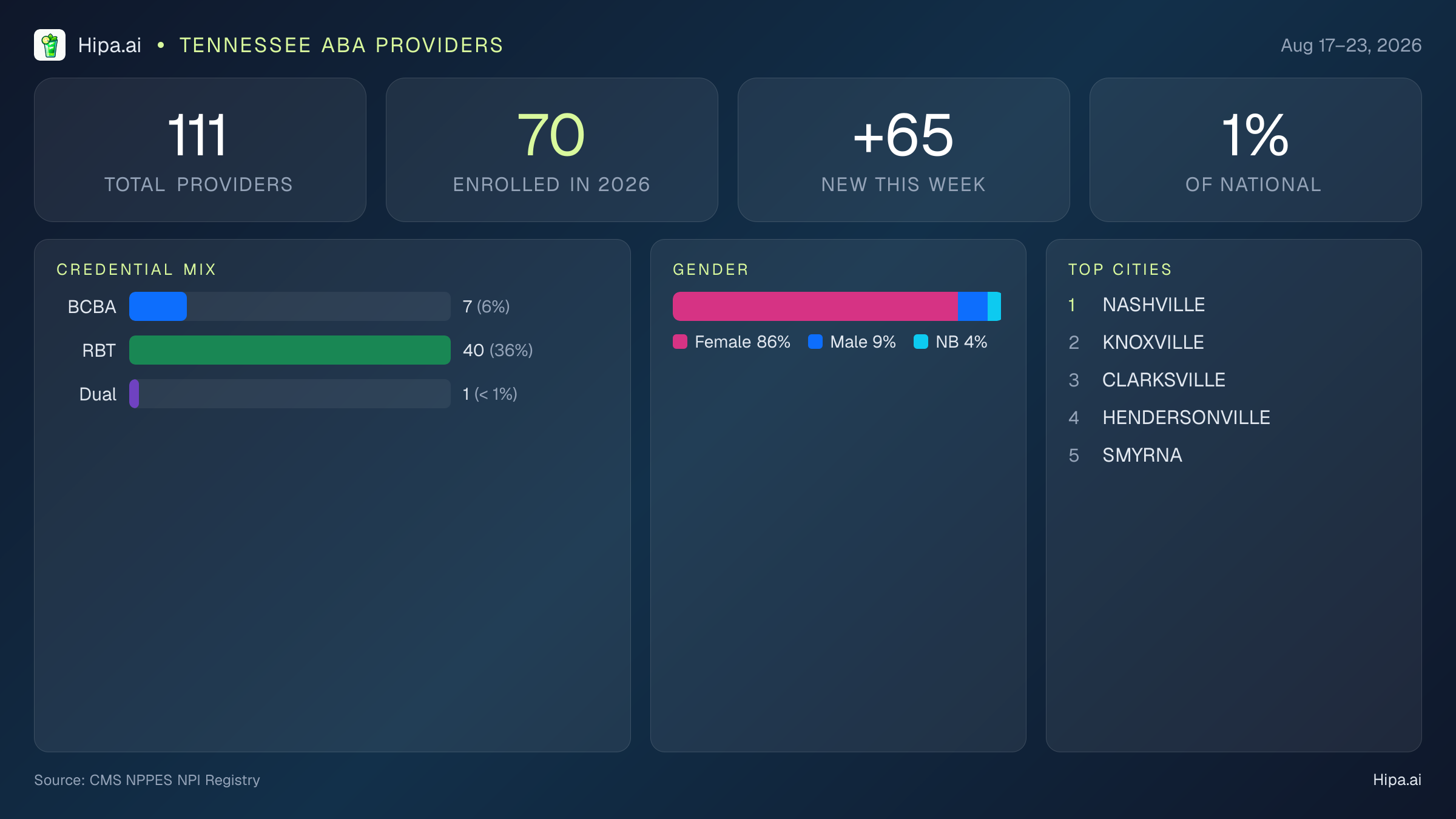
Tennessee recorded 111 providers in the latest CMS NPI registry weekly update, representing 1% of the national weekly total. The registry lists 65 new providers this week, including 95 individuals and 16 organizations. That share indicates Tennessee is a smaller portion of national provider activity, but the pace of new entries shows continuing behavioral health expansion across the state. Nashville, Knoxville, Clarksville, Hendersonville and Smyrna are among the leading cities represented.
ABA Workforce Mix
The registry identifies 7 BCBA credentials and 40 RBT credentials, along with 1 dual BCBA-RBT credential. These categories overlap and are not mutually exclusive shares of the 111-provider total; taxonomy and credential fields can describe the same provider, and some providers carry multiple credentials. The pattern still points to a substantially larger direct-service RBT workforce than BCBA supervisory workforce. Because BCBAs supervise RBTs, develop treatment plans and oversee clinical quality, the gap may limit how quickly newly listed technicians can be integrated into ABA services. Other listed credentials include LCSW, LPC-MHSP, MA, CCC-SLP and BT, reflecting a broader behavioral health workforce beyond ABA.
Demographics and Provider Activity
Gender data lists 82 female providers, 9 male providers and 4 nonbinary providers, corresponding to 86%, 9% and 4%. The percentages do not sum to 100% because of rounding and because the registry’s gender fields do not account for every listed provider. The update does not identify notable organizations appearing multiple times. Organization activity spans behavioral health agencies, counseling practices, case management entities and speech-language providers, while individual entries are concentrated across urban and suburban markets.
Tennessee’s RBT-heavy activity suggests growing direct-service capacity, while the smaller BCBA pool makes supervision availability a key factor in expanding ABA access.