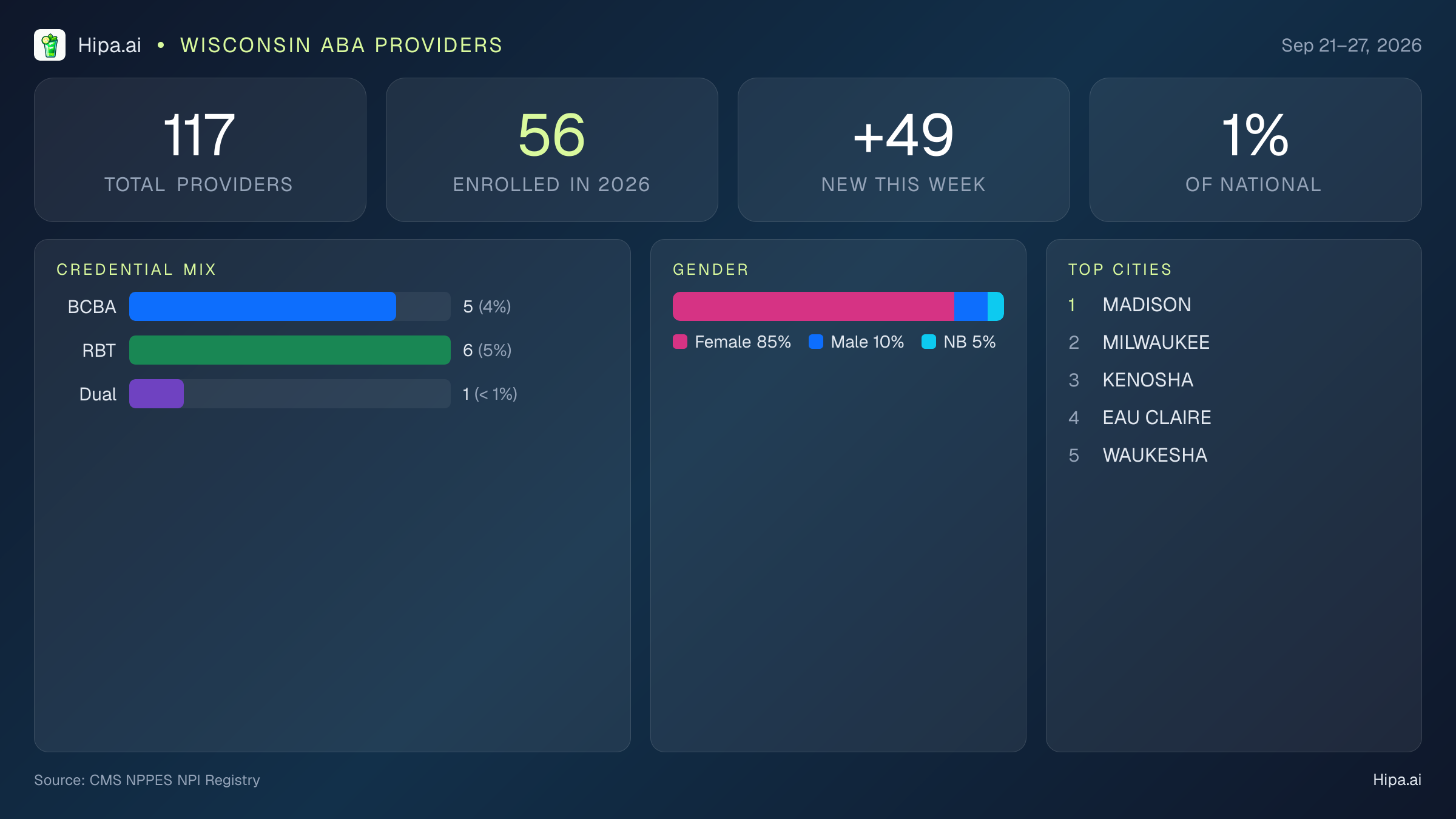
Wisconsin recorded 117 providers in the latest CMS NPI registry weekly update, equal to 1% of the national weekly total. That share indicates Wisconsin accounts for a small portion of reported activity nationally, though the registry captures provider records rather than confirmed hiring, staffing levels or service availability. The state’s total includes 49 providers added this week and 56 added this year.
ABA Workforce Mix
The credential summary lists 5 BCBAs and 6 RBTs, including 1 provider with dual BCBA-RBT credentials. These categories overlap: the dual-credential provider may be represented in both credential totals, so the counts should not be treated as separate groups. The near balance between listed BCBAs and RBTs differs from a technician-heavy workforce profile, but the small counts are only a snapshot of registry records and do not establish actual staffing or caseload capacity. Because BCBAs supervise RBTs, the records suggest a limited pool of identified ABA credentials relative to the broader behavioral health provider count. Fourteen providers have multiple taxonomies, another reason classifications may overlap.
Demographics and Organizations
Women account for 86 listed providers, or 85%; men account for 10, or 10%; and nonbinary providers account for 5, or 5%. These figures describe the full registry population, not ABA providers specifically. The update lists 101 individuals and 16 organizations. County of Grant DBA Unified Community Services appears twice among notable organizations, with records in Lancaster and Dodgeville. Madison, Milwaukee, Kenosha, Eau Claire and Waukesha are the listed leading cities.
Wisconsin’s records show broad behavioral health activity but few identified ABA credentials, underscoring that access depends on whether BCBA supervision and RBT capacity are available where families need services.