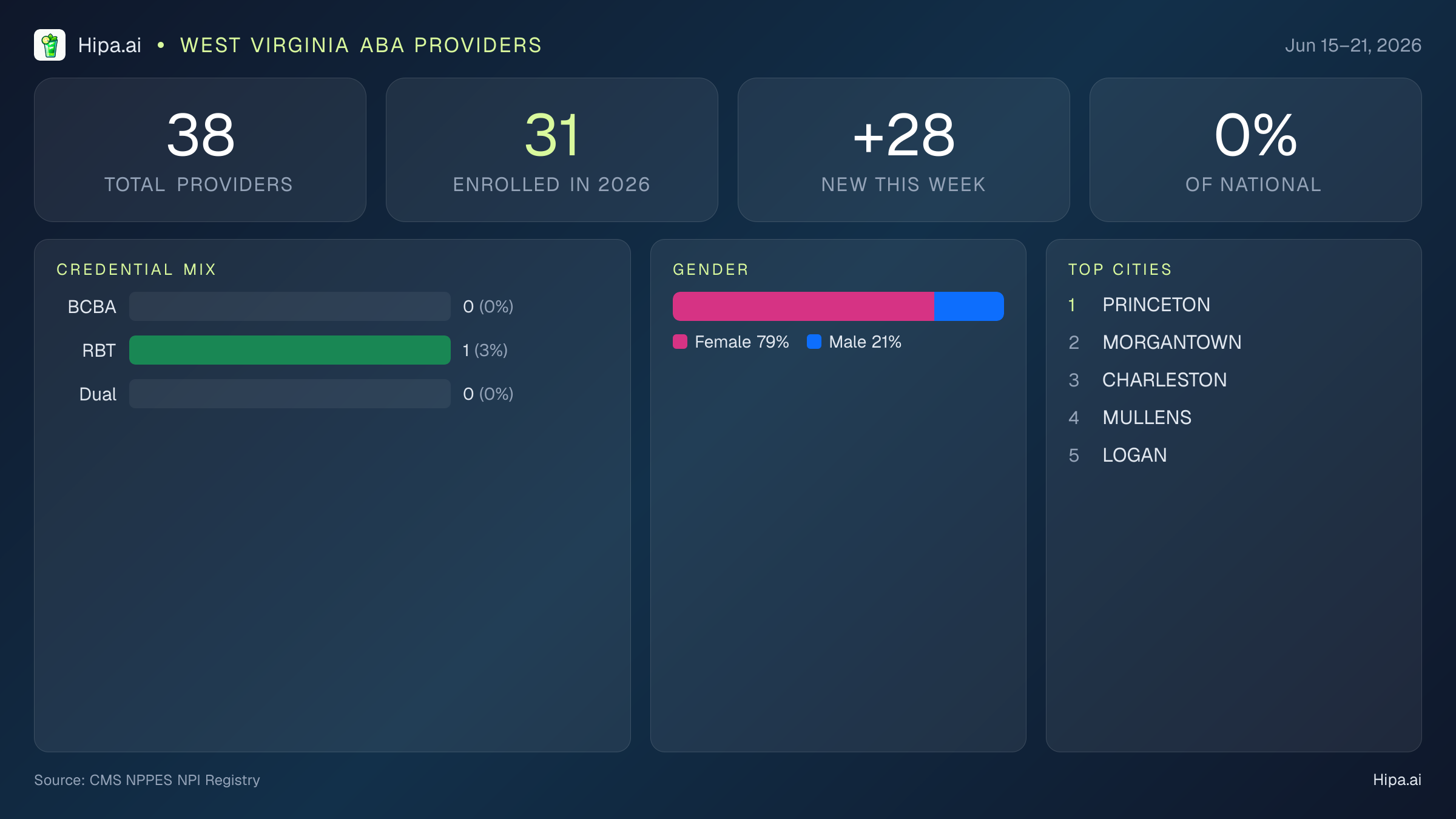
West Virginia registered 38 behavioral health providers in the latest CMS NPI registry weekly update. While this represents less than 1% of the national total for the week, it indicates a steady, albeit smaller, influx of professionals into the state's behavioral health landscape, with 28 new providers added this week alone. All new registrants were individual practitioners, suggesting a focus on direct service provision rather than new organizational entities, which is common in states without dominant PE-backed ABA chains.
ABA Workforce Composition and Other Credentials
The credential mix reveals a critical gap in ABA-specific professionals among these new registrants. There were 0 BCBA credentials and only 1 RBT credential reported. This severe lack of BCBAs, who are essential for supervising RBTs and designing ABA programs, suggests a significant bottleneck for expanding high-quality ABA services in West Virginia. The absence of dual BCBA+RBT credentials further highlights limited career progression for new registrants within the state's ABA sector. The majority of other credentials include 4 individuals with a BS, 2 with a BA, and 2 with an LSW, indicating a broader focus on case management and counseling roles.
Provider Demographics and State Trends
The workforce demographics show a strong female representation, with 30 individuals (79%) identifying as female and 8 individuals (21%) as male. No nonbinary providers were reported. The data did not identify any notable organizations appearing multiple times, suggesting these new individual providers are likely joining existing practices or operating independently. This continued influx of general behavioral health professionals is positive, but the acute shortage of BCBAs could significantly hinder the growth and accessibility of high-quality, evidence-based ABA services for individuals with autism and related disorders in West Virginia.