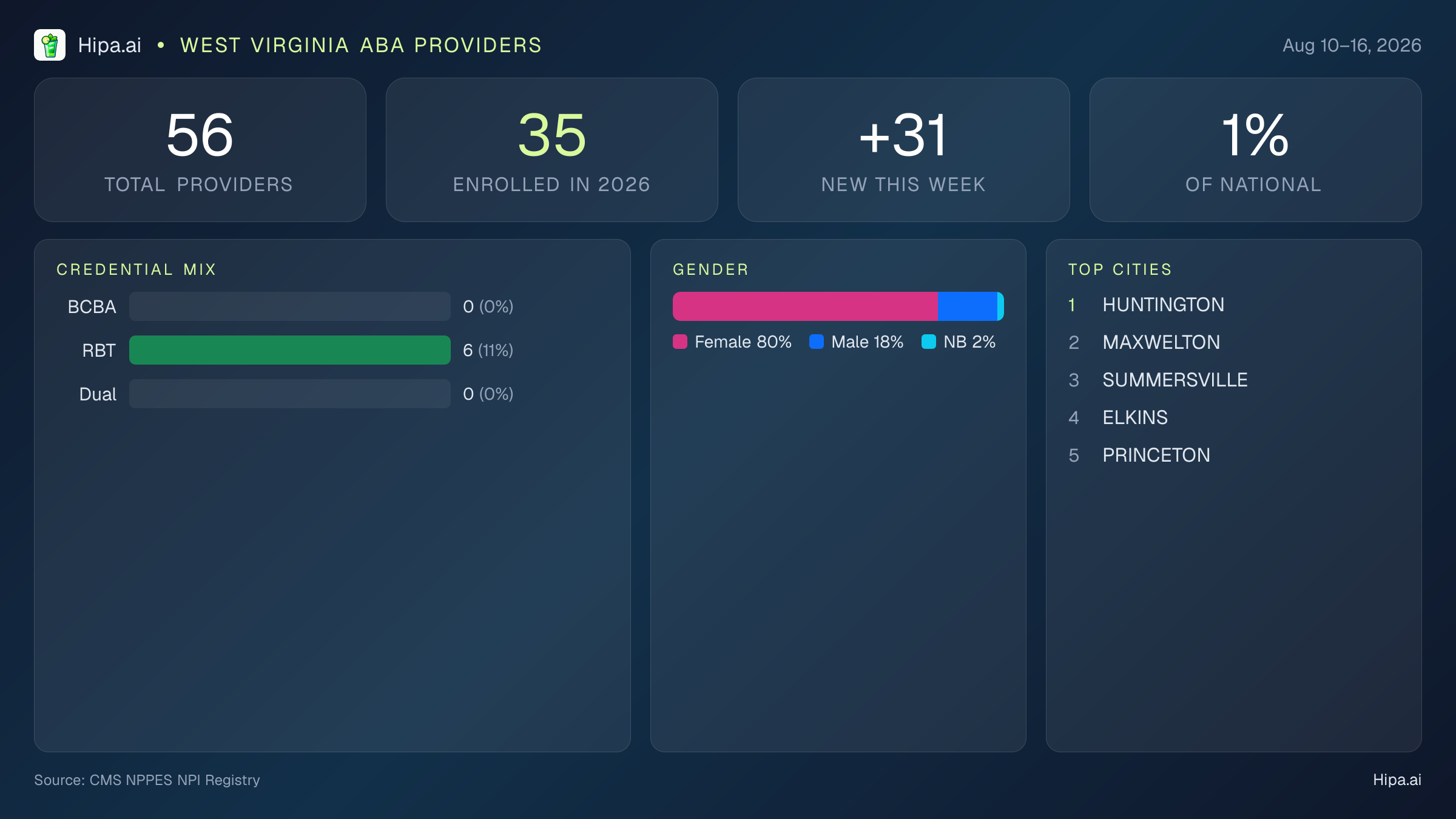
West Virginia recorded 56 providers in the latest CMS NPI registry weekly update, representing 1% of the national weekly total. The state added 31 providers this week, meaning a substantial share of its reported activity is recent. That concentration signals an active registration cycle, but West Virginia remains a small component of nationwide behavioral health provider growth.
ABA Workforce Mix
The registry reports no BCBA credentials and 6 RBT credentials, with no dual BCBA-RBT credentials. These categories are not mutually exclusive with the broader provider total or with other credential and taxonomy fields; the registry also includes counselors, case managers, social workers and other behavioral health professionals. The absence of BCBAs alongside six RBTs points to limited recorded supervisory capacity for ABA services. Because BCBAs oversee RBTs, develop treatment plans and guide clinical decision-making, this mix could constrain the ability of RBTs to deliver services at scale, even where direct-service workers are entering the registry.
Demographics and Provider Activity
Individuals account for 50 providers, while organizations account for 6 providers. Gender data identifies 40 female providers, 9 male providers and 1 nonbinary provider, corresponding to 80%, 18% and 2%. The counts align with the individual-provider total. The registry identifies Huntington, Maxwelton, Summersville, Elkins and Princeton among the leading cities for activity. University Physicians & Surgeons, Inc. appears twice in the notable-organizations field, indicating repeated organizational presence rather than two separate organizations.
West Virginia’s surge in registrations, paired with RBT representation but no reported BCBAs, suggests ABA access may expand unevenly unless the state also develops its supervisory workforce.