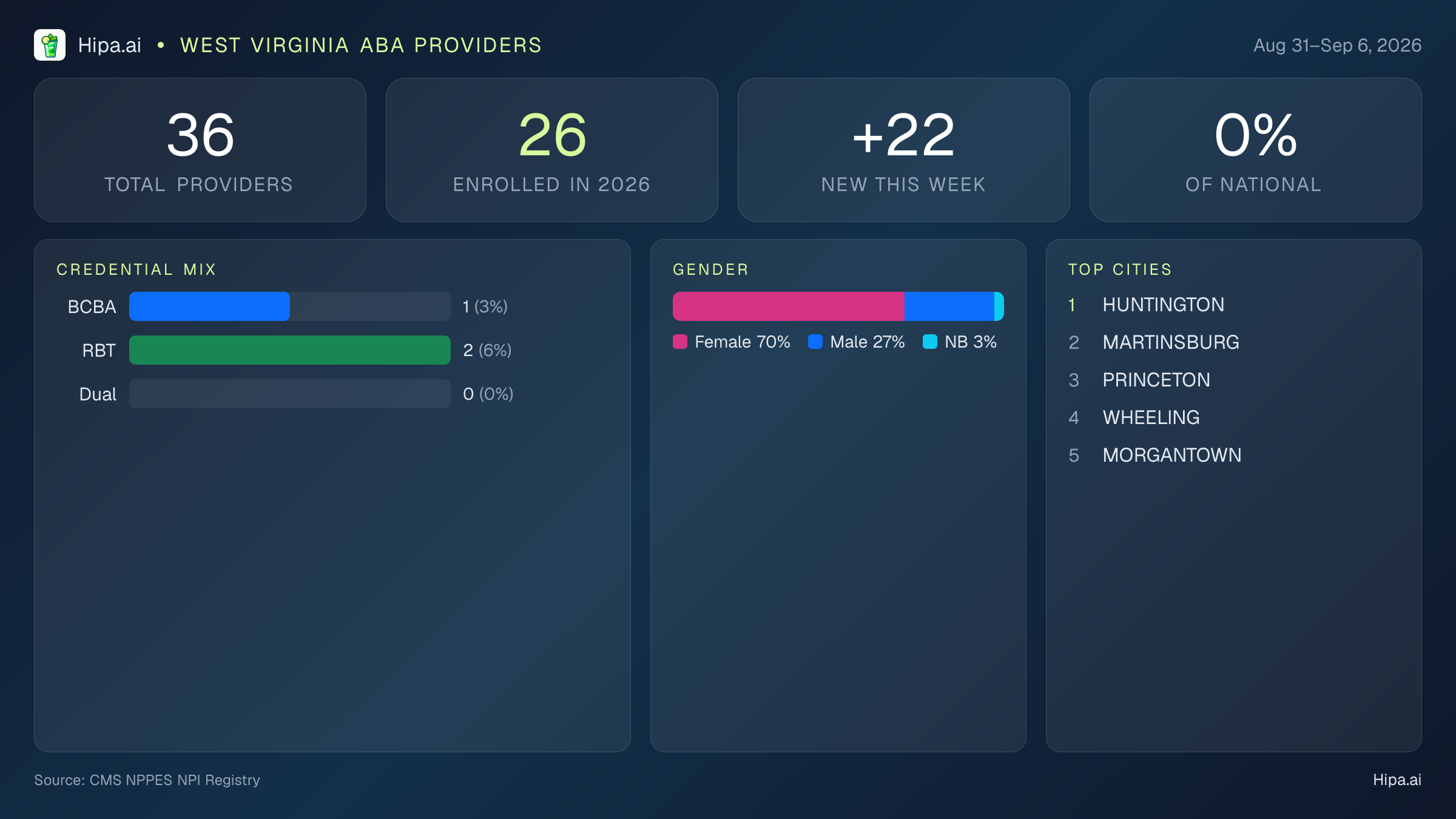
West Virginia recorded 36 providers in the latest CMS NPI registry weekly update, representing 0% of the national weekly total. The registry includes 30 individuals and 6 organizations. That zero-percent share indicates West Virginia’s activity is small relative to the national weekly volume, although NPI records do not establish active caseloads, staffing levels or appointment availability. The update reflects a broad behavioral health market rather than an ABA-only workforce.
ABA Workforce Mix
The registry lists 1 BCBA and 2 RBTs, with no dual BCBA-RBT credentials. Because BCBAs supervise RBTs, develop treatment plans and oversee clinical quality, the recorded ratio points to limited documented supervisory capacity relative to technician-level staffing. The credential categories and taxonomy fields can overlap, so they should not be treated as mutually exclusive shares of the provider total. The remaining credential entries include social work, counseling, behavioral support and other professional designations, underscoring the multidisciplinary nature of the update.
Demographics and Organizations
Gender data identifies 21 female providers, or 70%, alongside 8 male providers, or 27%, and 1 nonbinary provider, or 3%. No notable organization appears multiple times in the update. The listed leading cities are Huntington, Martinsburg, Princeton, Wheeling and Morgantown, suggesting activity across several population centers rather than a single dominant hub. Nine providers have multiple taxonomies; those classifications may describe overlapping roles and do not represent nine additional providers.
West Virginia’s update suggests a dispersed behavioral health workforce with a thin documented ABA supervisory base, potentially limiting how quickly RBT capacity can translate into expanded access without additional BCBA recruitment.