District of Columbia Clinical Trials Report — July 2026
4 New Studies, 42 Closing Soon
Hipa.ai Research - July 1, 2026 - Source: Hipa.ai, ClinicalTrials.gov
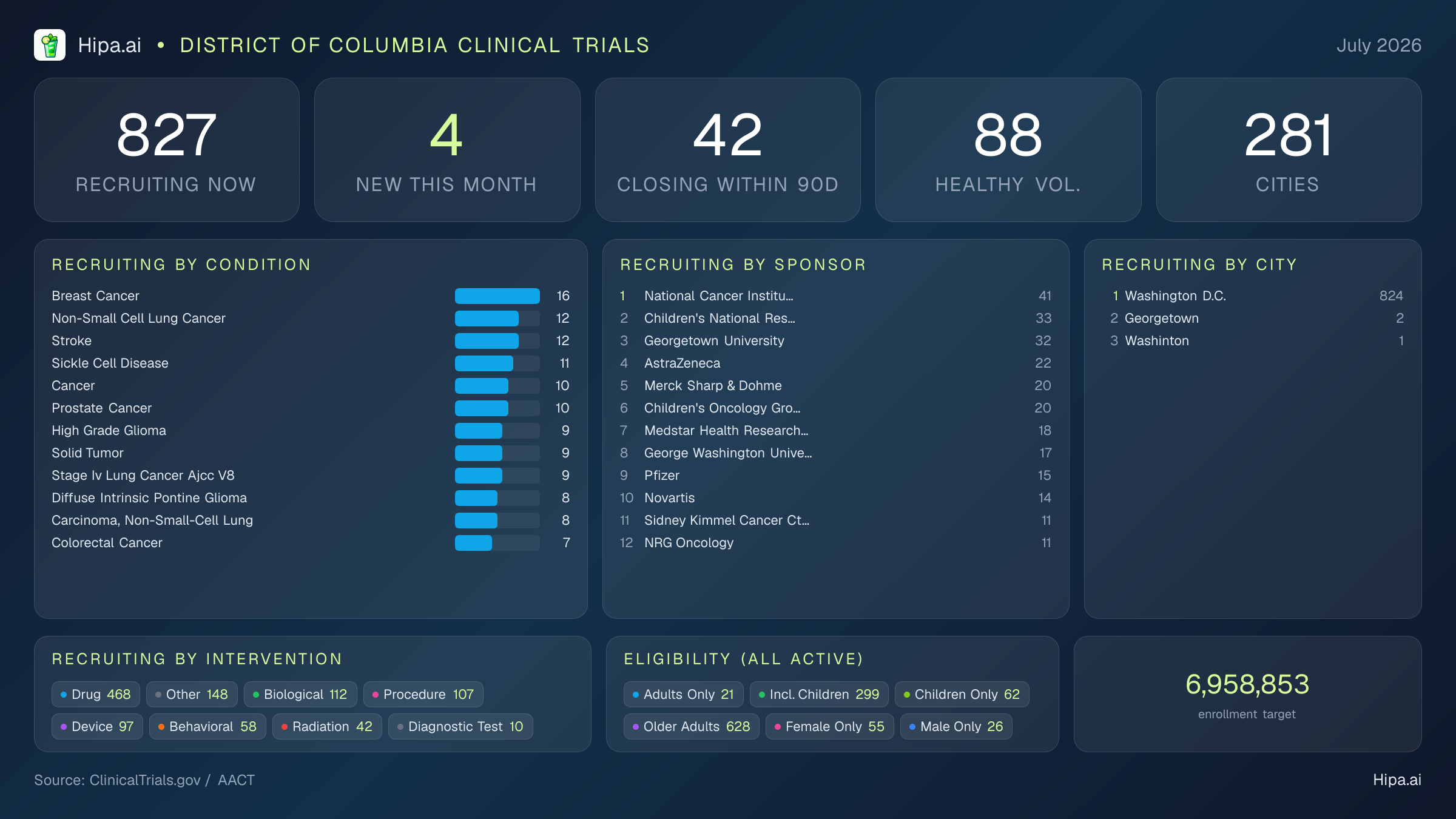
People in the District of Columbia who may qualify for a clinical trial should check closing-soon studies now: 42 recruiting trials are projected to close within the next 90 days. Only 4 of these accept healthy volunteers, so the window is especially limited for people without a diagnosed condition. Across the district, 827 trials are currently recruiting at 281 research sites in 3 cities.
July brought 4 new trials, a sharp decline from 16 in June and 8 in May. The monthly total has fluctuated during 2026, reaching 15 new trials in February before falling to 3 in March, rising to 16 in June, and returning to 4 in July. Even with fewer new openings, the district continues to offer a concentrated research market for residents who can reach Washington, D.C. sites.
Closing-soon studies create the most immediate opportunity
People with specific medical needs should not wait to begin screening. Projected closing dates can change, and eligibility checks, medical-record reviews, and study visits may take time. The largest condition groups among closing-soon trials include prostate cancer, cancer overall, pain, stroke, and neurogenic bladder.
- Prostate cancer — 2 closing-soon trials
- Cancer — 2
- Pain — 2
- Stroke — 2
- Neurogenic bladder — 2
- Bleeding, bipolar I disorder, appendicitis, chronic kidney diseases, and cervical cancer — 1 each
The district has 88 healthy-volunteer trials recruiting overall, but only 4 of the 42 studies closing soon accept healthy participants. That difference matters for people seeking research opportunities without a relevant diagnosis: the broader pool is substantial, but the most urgent studies are concentrated among patients with particular conditions.
A Phase 3 AbbVie study leads July’s new openings
The most prominent new study is AbbVie’s Phase 3 trial NCT07728188, evaluating injected etentamig plus oral pomalidomide against standard therapies in adults with relapsed or refractory multiple myeloma. The study plans to enroll 520 participants. Multiple myeloma is a blood cancer involving abnormal plasma cells in the bone marrow and can cause bone pain, fractures, low blood counts, infections, high calcium levels, and kidney problems.
As a late-stage study from a major pharmaceutical sponsor, NCT07728188 may attract attention from adults whose multiple myeloma has returned or no longer responds adequately to treatment. Prospective participants should review the full eligibility criteria with the study team, including prior therapies, current disease status, and travel requirements.
- NCT07728188 — AbbVie Phase 3 study of etentamig plus pomalidomide versus standard therapies for relapsed or refractory multiple myeloma, with a planned enrollment of 520 adults.
- NCT07728188 — A drug trial examining adverse events and changes in disease activity in a population with difficult-to-treat multiple myeloma.
July’s four new studies were sponsored by AbbVie, Boehringer Ingelheim, George Washington University, and Imbed Biosciences. Three were industry-sponsored and one was classified as other, reflecting a month led by commercial development while retaining a local academic presence through George Washington University.
Digestive health, metabolism, cardiovascular disease, and cancer broaden the pipeline
The new-trial list spans several areas rather than one dominant condition. Cardiovascular disease, dietary fiber, insulin resistance, inulin, gastrointestinal microbiome research, microbiota, and skeletal muscle all appear among July’s new topics. Cancer research also features prominently through studies involving extrapulmonary neuroendocrine carcinoma and large-cell neuroendocrine lung carcinoma.
- Cardiovascular diseases — 1 new trial
- Dietary fiber and gastrointestinal microbiome — 1 each
- Insulin resistance and inulin — 1 each
- Microbiota — 1
- Skeletal muscle — 1
- Extrapulmonary neuroendocrine carcinoma of large-cell and small-cell histology — 1 each
- Large-cell neuroendocrine lung carcinoma — 1
The intervention mix was similarly focused: 2 new drug studies, 1 device study, and 1 dietary-supplement study. This gives prospective participants options beyond medication trials, including research involving nutrition, the gut microbiome, and medical devices.
All new openings are in Washington, D.C.
Every new July trial is located in Washington, D.C., making the district’s latest research activity highly concentrated rather than spread across multiple communities. Overall recruiting studies are listed across 3 cities and 281 sites, but the month’s new opportunities are centered in the capital’s hospitals, universities, specialty clinics, and research facilities.
For residents of the district, this concentration may reduce travel compared with states where new studies are dispersed across large geographic areas. People living nearby in Maryland or Virginia may also find Washington, D.C. sites practical, depending on each protocol’s location and visit schedule. Because a trial can have many sites nationally but only one local location, applicants should confirm that the D.C. site is actively screening participants.
Who should act now?
None of July’s 4 new trials include children, and none are restricted to male-only participation. One is female-only, while 3 include older adults. The new-trial group therefore favors adults, with older participants represented in most of the month’s openings.
Healthy adults should search the district’s broader pool of 88 recruiting healthy-volunteer studies rather than focusing only on July’s new trials, since none of the four new openings accept healthy volunteers. Patients with prostate cancer, stroke, pain, neurogenic bladder, cancer, or the other conditions listed among closing-soon studies should contact research teams promptly. Those who may qualify for NCT07728188 should also consider early screening because a Phase 3 oncology study can require detailed treatment and medical-history review.
Through the rest of summer, the district’s trial landscape may shift quickly: enrollment may close in several active studies even as additional drug, device, nutrition, and academic trials appear in Washington, D.C. Checking listings regularly and contacting sites before projected deadlines will give eligible participants the best chance to enter a study while openings remain.
Data Highlights
Conditions Closing Soon
- prostate cancer (2)
- cancer (2)
- pain (2)
- stroke (2)
- neurogenic bladder (2)
- bleeding (1)
- bipolar i disorder (1)
- appendicitis (1)
Most Common New Trial Conditions
- cardiovascular diseases (cvd) (1)
- dietary fiber (1)
- extrapulmonary neuroendocrine carcinoma of large cell histology (1)
- extrapulmonary neuroendocrine carcinoma of small cell histology (1)
- gastrointestinal microbiome (1)
- insulin resistance (1)
- inulin (1)
- large cell neuroendocrine lung carcinoma (1)
Cities With the Most New Trials
- Washington D.C. (4)
Leading Sponsors
- AbbVie (1)
- Boehringer Ingelheim (1)
- George Washington University (1)
- Imbed Biosciences (1)
| Month | New Trials | Closing Soon |
|---|---|---|
| March 2026 | 3 | 3 |
| April 2026 | 4 | 4 |
| May 2026 | 8 | 2 |
| June 2026 | 16 | 12 |
| July 2026 | 4 | 14 |
| August 2026 | 2 | 0 |
New Studies This Month (4)
| NCT ID | Title | Phase | Enrollment | Sponsor | Condition | City |
|---|---|---|---|---|---|---|
| NCT07695688 | Safety Study of Microlyte DualGuard | NA | 53 | Imbed Biosciences | Wound Closure | Washington D.C. |
| NCT07707895 | DAREON®-36: A Study to Test Obrixtamig in Combination With ZL-1310 in People With Advanced Small Cell Lung Cancer or Other Neuroendocrine Cancers | Phase 1/PHASE2 | 60 | Boehringer Ingelheim | Small Cell Lung Cancer | Washington D.C. |
| NCT07724522 | Prebiotic Inulin for Late-Reproductive Individuals | NA | 27 | George Washington University | Obesity & Overweight | Washington D.C. |
| NCT07728188 | A Study to Evaluate Adverse Events and Change in Disease Activity With Injected Etentamig Plus Oral Pomalidomide Versus Standard Therapies in Adults With Relapsed or Refractory Multiple Myeloma | Phase 3 | 520 | AbbVie | Relapsed or Refractory Multiple Myeloma | Washington D.C. |
City-Level Research Reports for District of Columbia
Read the July 2026 clinical trials report for these District of Columbia cities.
Top Cities for Paid Clinical Trials in District of Columbia
Browse every recruiting paid clinical trial in the cities with the most active studies in District of Columbia.
Ready to participate?
Browse every recruiting paid clinical trial in District of Columbia, filter by condition, age, and healthy-volunteer status, and jump directly to each study to apply.
Browse Paid Clinical Trials in District of Columbia