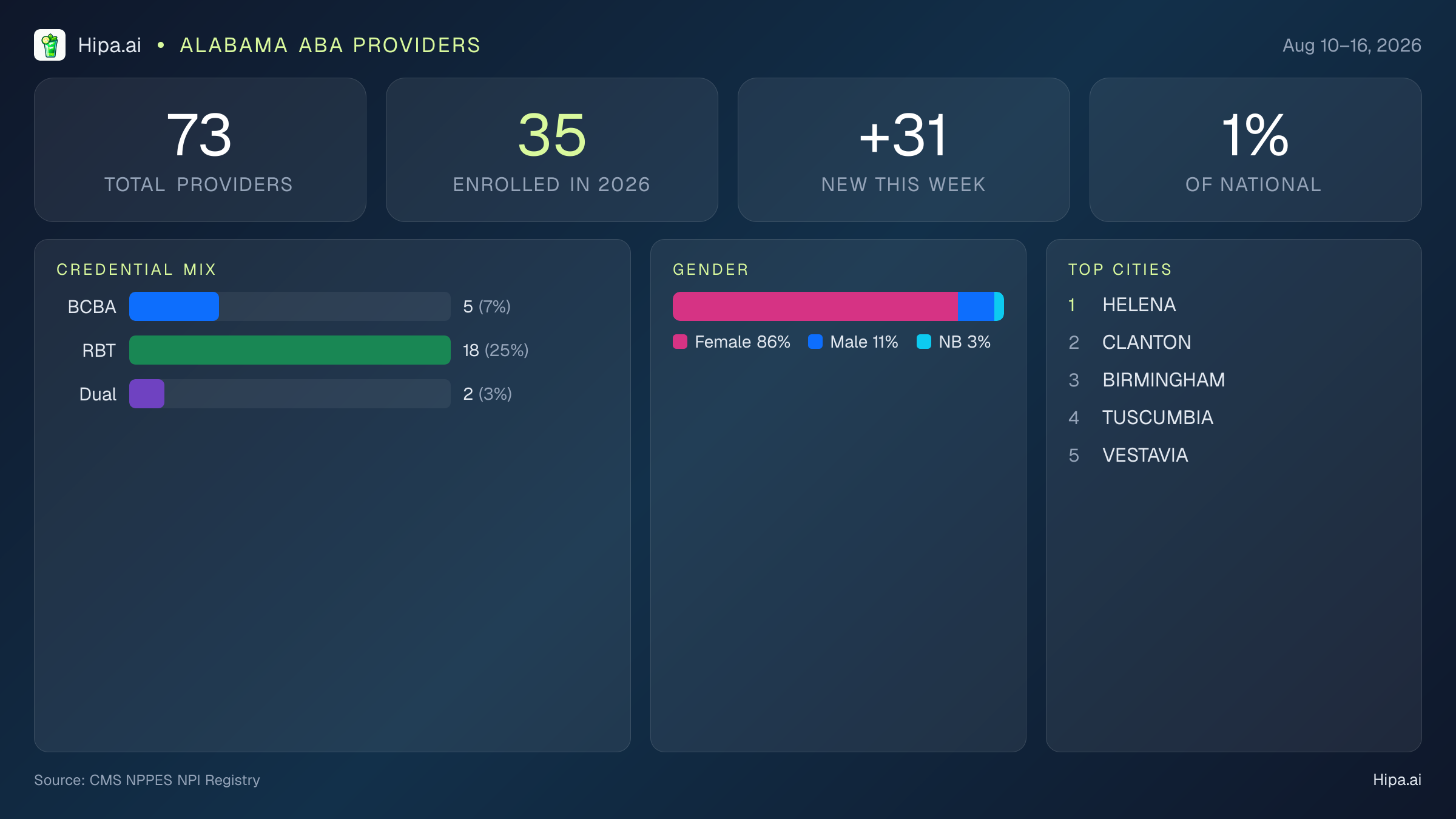
Alabama recorded 73 providers in the latest CMS NPI registry weekly update, representing 1% of the national weekly total. The registry added 31 providers in the latest week, bringing the year-to-date addition to 35 providers. Alabama’s small national share, paired with a sharp concentration of recent additions, points to an active but relatively limited state market in the broader behavioral health workforce.
ABA Workforce Mix
The registry identifies 5 BCBA credentials and 18 RBT credentials, along with 2 dual credentials combining BCBA and RBT. These categories overlap and are not mutually exclusive shares of the 73-provider total: some records can carry multiple credentials or taxonomy designations, while the registry also includes counselors, social workers, psychologists and other behavioral health professionals. Even with that caveat, the larger RBT count indicates more direct-service capacity than supervisory capacity. Because BCBAs oversee RBTs and guide treatment planning, the mix suggests that supervision could constrain expansion as Alabama adds frontline ABA workers.
Demographics and Provider Activity
The update includes 65 individuals and 8 organizations. Gender data lists 56 female providers, 7 male providers and 2 nonbinary providers, or 86%, 11% and 3%, respectively. The gender counts total 65, matching the individual-provider count. Helena, Clanton, Birmingham, Tuscumbia and Vestavia are the leading cities listed for provider activity, indicating coverage across several Alabama markets rather than one dominant metro area.
The notable-organizations field lists no organizations, so no provider appears multiple times there. Overall, Alabama’s growing RBT presence and smaller BCBA pool suggest potential gains in ABA access, but continued workforce growth will depend on expanding supervisory capacity across the state.