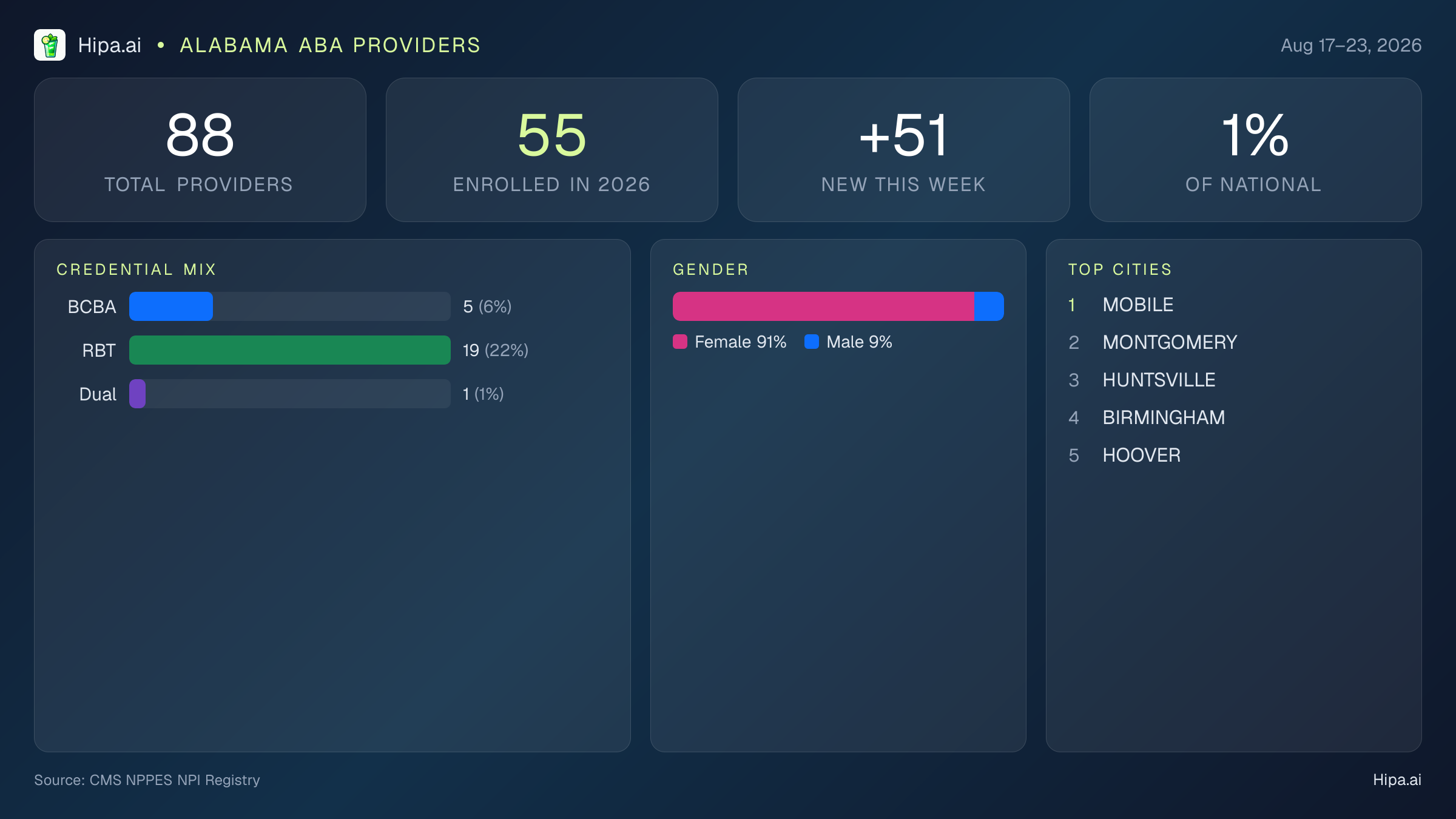
Alabama recorded 88 providers in the latest CMS NPI registry weekly update, representing 1% of the national weekly total. The registry added 51 new providers this week, bringing the year-to-date count to 55. Individuals account for 70 entries and organizations for 18. The activity signals a relatively small but active behavioral health market, with new registrations potentially broadening provider networks and employer recruiting pipelines. NPI activity does not by itself confirm that a provider is accepting patients or delivering services.
ABA Workforce Mix
The credential data lists 5 BCBAs, 19 RBTs and 1 dual BCBA-RBT. These categories overlap: the dual-credentialed provider is included in both the BCBA and RBT counts, so they should not be treated as mutually exclusive shares of Alabama’s provider total. The RBT-to-BCBA pattern points to a larger direct-service workforce than supervisory workforce. Because BCBAs supervise RBTs, develop treatment plans and monitor clinical quality, a small BCBA pool can constrain how quickly RBT capacity translates into accessible ABA services. The dual credential also indicates at least some progression between direct-service and advanced clinical roles.
Demographics and Provider Activity
Among individual providers, 64 are female and 6 are male, while no providers are listed as nonbinary. The registry reports those figures as 91%, 9% and 0%, respectively. Mobile, Montgomery, Huntsville, Birmingham and Hoover are the leading listed cities, showing activity across Alabama’s principal urban and regional centers. Fire Within Therapy appears twice in the organization records, although repeated NPI entries do not necessarily represent separate operating sites or expanded clinical capacity.
Alabama’s growing weekly registrations suggest expanding behavioral health activity, but ABA access will depend on whether the state can add supervisory BCBA capacity alongside its larger RBT workforce.