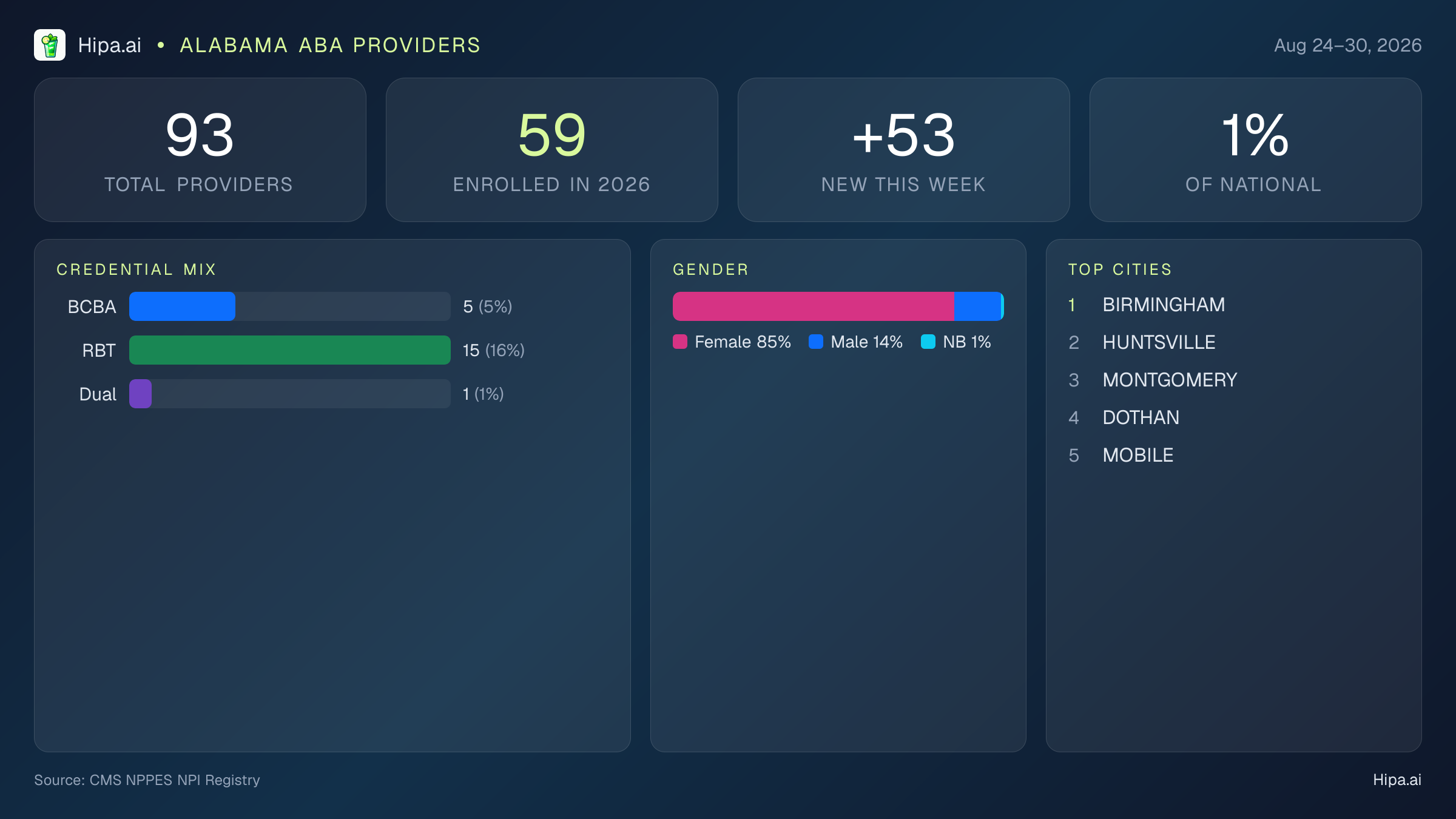
Alabama recorded 93 providers in the latest CMS NPI registry weekly update, representing 1% of the national weekly total. The registry added 53 new providers this week, including 73 individuals and 20 organizations. That relatively small national share points to a more limited behavioral health market than the largest states, but the volume of new entries signals active provider formation and credentialing. NPI activity does not confirm open caseloads, active services or appointment capacity.
ABA Workforce Mix
The registry’s credential data lists 5 BCBA credentials and 15 RBT credentials, along with 1 provider identified with dual BCBA-RBT credentials. These categories overlap and are not mutually exclusive shares of Alabama’s provider total. The separate credential-text field lists 3 RBT entries, illustrating why credential and taxonomy counts should not be combined as a single headcount. The larger RBT count than BCBA count reflects a workforce weighted toward direct implementation rather than clinical supervision. Because BCBAs supervise RBTs, conduct assessments and oversee treatment quality, a relatively smaller supervisory pool can limit how quickly technician capacity becomes available ABA care. The dual credential suggests some career progression between technician and advanced clinical roles, but it remains uncommon in this update.
Workforce Profile
Gender data identifies 62 female providers, 10 male providers and 1 nonbinary provider, corresponding to 85%, 14% and 1%. Birmingham, Huntsville, Montgomery, Dothan and Mobile are the listed leading cities, indicating activity across the state’s major population centers and regional hubs. The registry reports no notable organizations appearing multiple times, so this update does not show concentrated activity from a repeatedly listed provider group.
Alabama’s expanding NPI activity suggests growing behavioral health infrastructure, while the smaller BCBA presence remains a potential constraint on ABA access and workforce scalability.