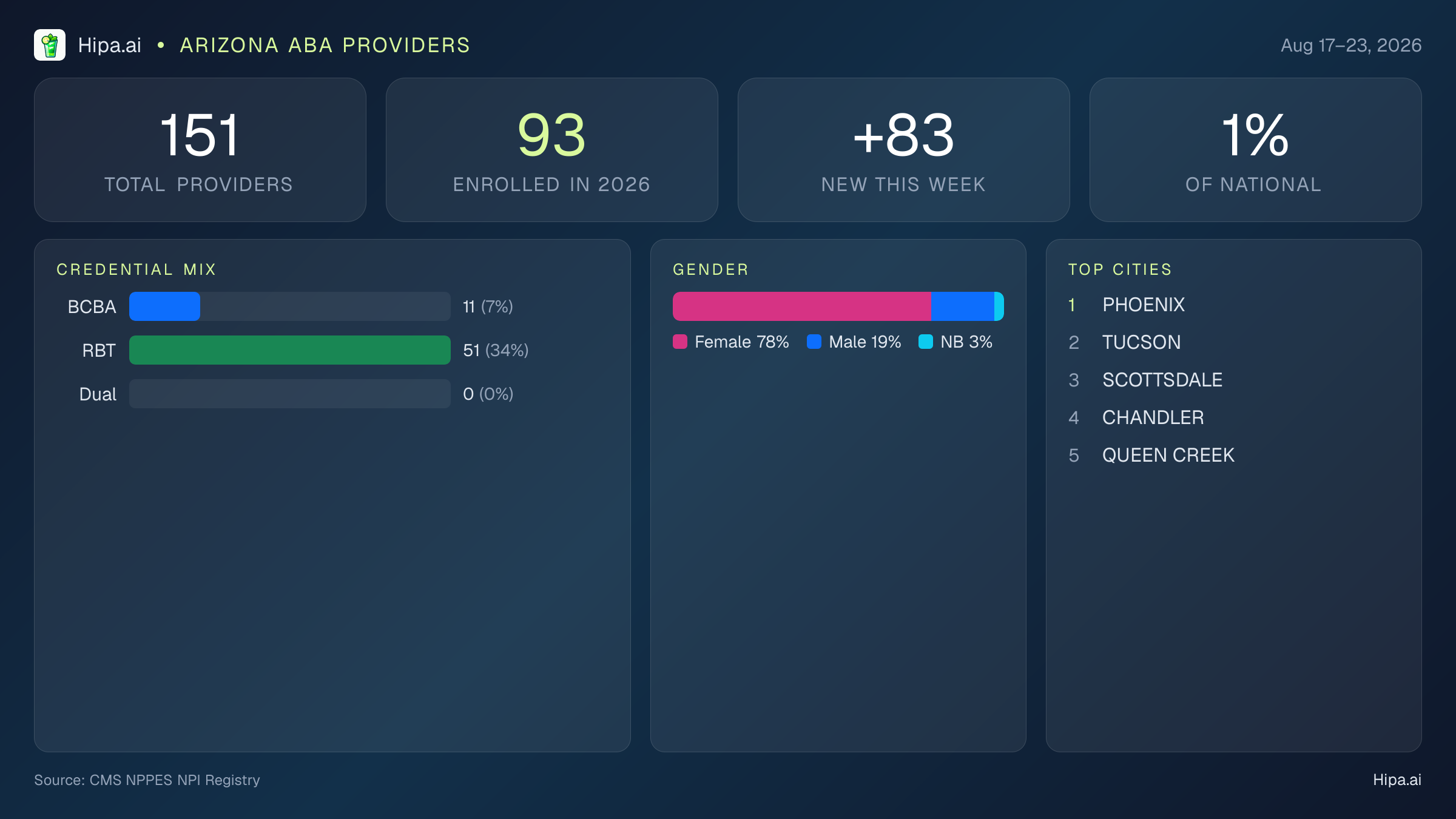
Arizona recorded 151 providers in the latest CMS NPI registry weekly update, representing 1% of the national weekly total. The registry added 83 providers this week and lists 93 new providers this year, indicating a sharp burst of recent enrollment activity. Arizona’s share remains small nationally, but the volume points to an active behavioral health market, particularly across Phoenix and surrounding communities. The update includes 129 individuals and 22 organizations; NPI activity does not necessarily confirm active clinical capacity or service availability.
ABA Workforce Mix
The registry lists 11 BCBA credentials and 51 RBT credentials, with no dual BCBA-RBT credentials reported. These categories overlap with other credential and taxonomy fields and should not be treated as mutually exclusive shares of the provider total. The much larger RBT count suggests a workforce weighted toward direct implementation of ABA treatment, while the smaller BCBA pool may constrain assessment, treatment-plan development and supervision as service demand grows. Several providers also carry BCBA-related credentials, including LBA designations, but those entries are captured within the broader credential data rather than as a separate, additive workforce category.
Demographics and Activity
Gender data identifies 101 female providers, 24 male providers and 4 nonbinary providers, corresponding to 78%, 19% and 3%. Those counts total the 129 individual providers in the update. Phoenix, Tucson, Scottsdale, Chandler and Queen Creek are the leading listed cities, showing that activity is concentrated in major population centers and their suburbs. No notable organizations were flagged as appearing multiple times in the registry data.
Arizona’s expanding RBT presence suggests potential growth in ABA direct-service capacity, but the smaller BCBA base makes supervisory capacity a key factor in whether that growth translates into broader access.