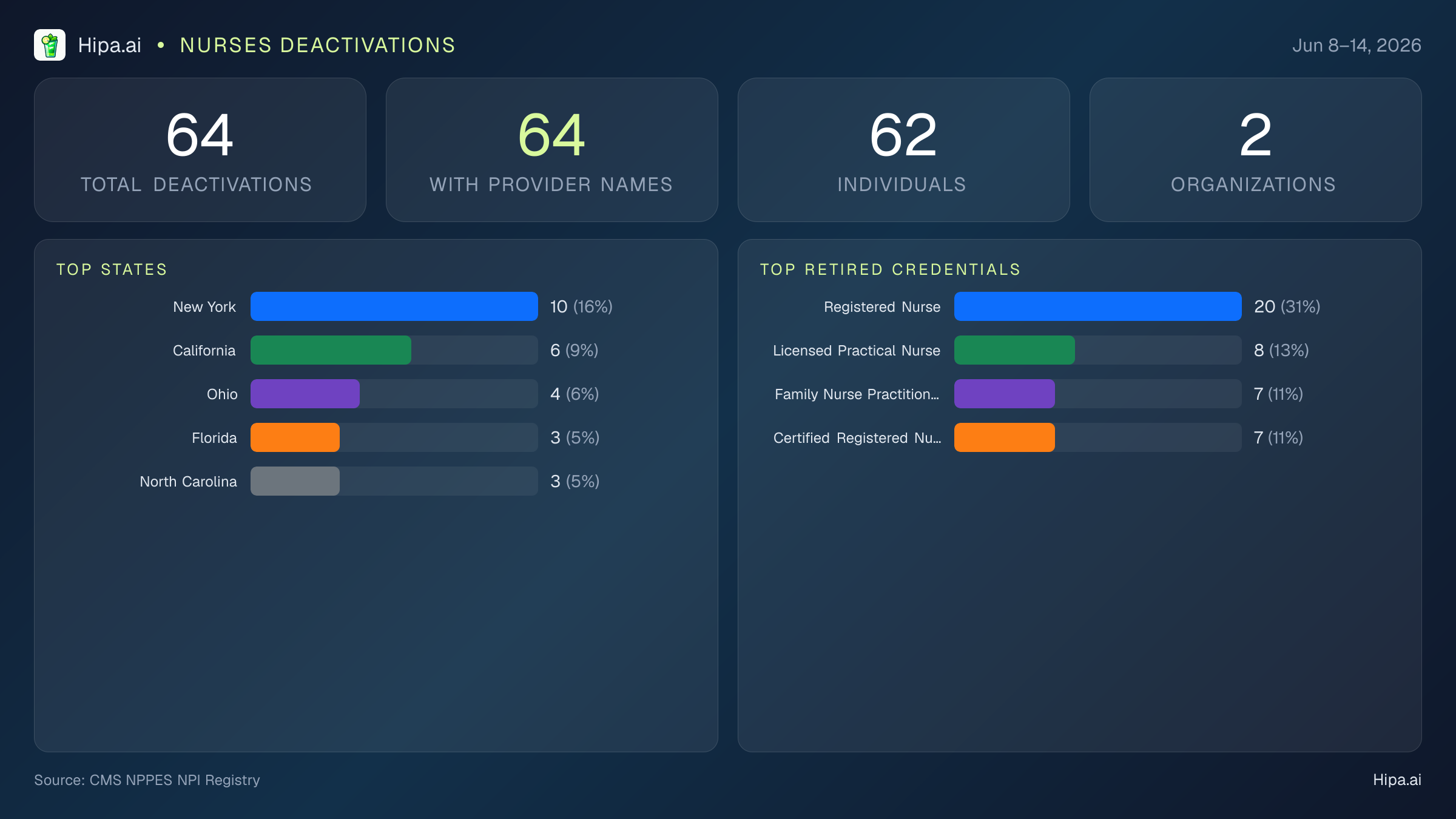
The CMS NPPES public registry recorded 64 NPI deactivations within the Nurses category for the week of June 8-14, 2026. All 64 records had retrievable names, indicating complete data capture by Hipa.ai prior to deactivation. Of these, 62 deactivations were for individual providers, with the remaining 2 deactivations attributed to organizations. New York led all states with 10 deactivations, accounting for 16% of the national total.
Geographic Distribution of Deactivations
Geographically, NPI deactivations for nurses were concentrated in several key states. New York registered the highest number with 10 deactivations, representing 16% of the total. California followed with 6 deactivations, or 9%. Ohio reported 4 deactivations, making up 6%. Several other states, including Florida, North Carolina, Illinois, Washington, Missouri, and Massachusetts, each recorded 3 deactivations, each contributing 5% to the national figure. This distribution may reflect larger nurse workforces in these regions, or a higher volume of administrative updates within the NPI registry.
Credential and Taxonomy Trends
An analysis of the primary taxonomies among the named deactivated records reveals the most common roles. Registered Nurses (163W00000X) constituted the largest group, with 20 deactivations, or 31% of the total. Licensed Practical Nurses (164W00000X) accounted for 8 deactivations, representing 13%. Advanced practice roles also saw deactivations, with Family Nurse Practitioners (363LF0000X) and Certified Registered Nurse Anesthetists (367500000X) each having 7 deactivations, both comprising 11% of the named records. Nurse Practitioners (363L00000X) added 4 deactivations, or 6%. This mix highlights deactivations across various levels of nursing practice, from foundational to specialized advanced roles.
Understanding NPI Deactivations
NPI deactivations are administrative status changes within the federal NPPES registry. Such changes do not inherently indicate a license action, malpractice, or that a provider has ceased practicing. Providers may obtain a new NPI, retire, change their entity type, or have their record retired for clerical reasons. The overall number of deactivations tends to rise year over year as the registry ages and as healthcare professionals transition roles or consolidate their NPI records. Hipa.ai retains a public-source name cache, allowing the publication of names for records captured prior to deactivation, even when CMS removes identifying information from the public registry.