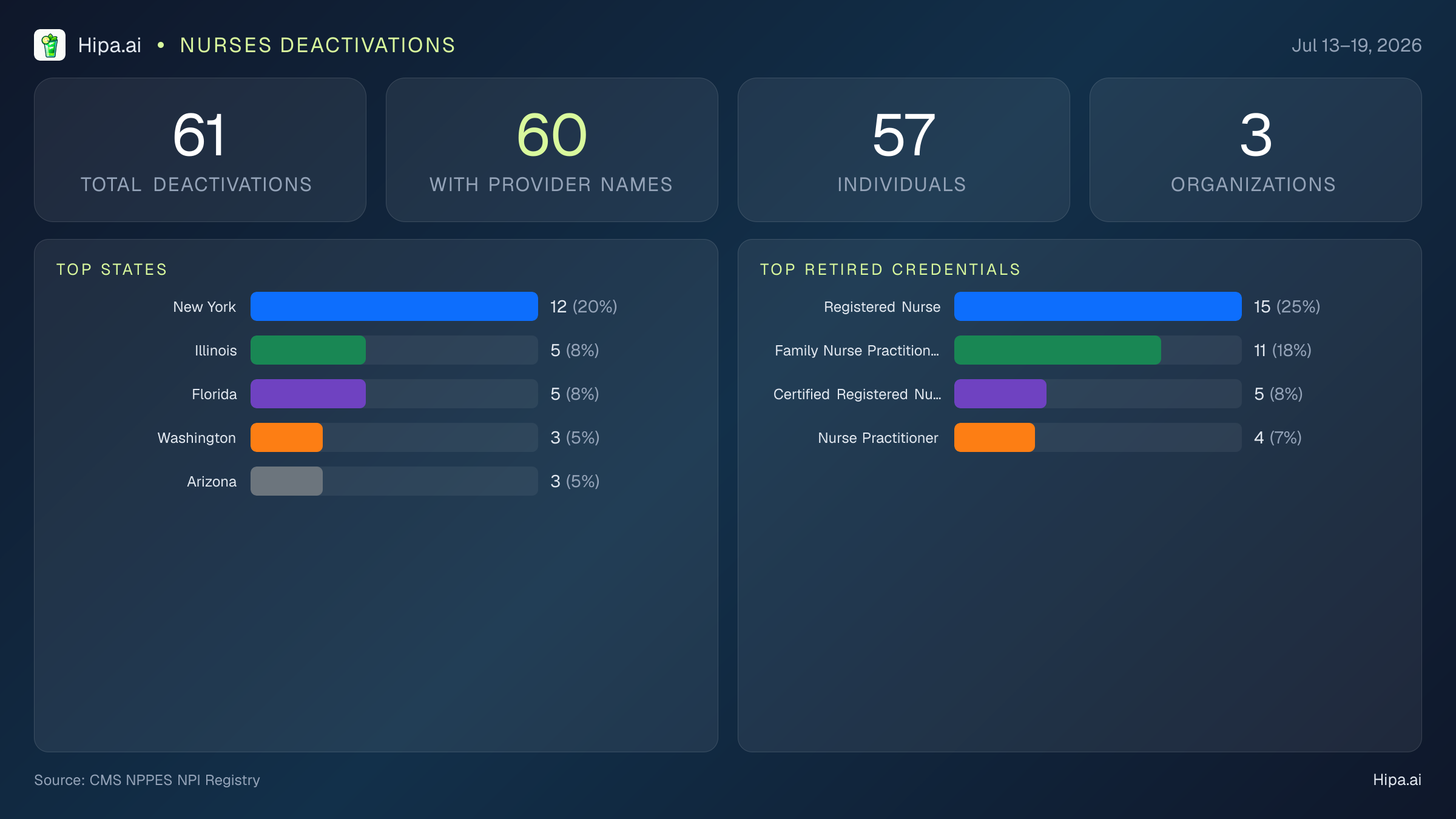
A total of 61 NPI deactivations were recorded in the Nurses category for the week of July 13-19, 2026, according to the CMS NPPES public registry. Of these, 60 records had retrievable names through Hipa.ai's cache, while one record had its identifying information scrubbed by CMS in accordance with its privacy policy. New York led all states in deactivations within this segment, accounting for 12 records.
State-Level Deactivation Trends
Geographically, New York accounted for the largest share of named deactivations, with 12 records, representing 20% of the total. Illinois and Florida each recorded 5 deactivations, both comprising 8% of the named total. Washington and Arizona followed with 3 deactivations each, or 5%. Other states with multiple deactivations included California, Texas, Alabama, Virginia, North Carolina, New Mexico, Arkansas, and Ohio, each reporting 2 deactivations. This broad distribution across states suggests that NPI deactivations are a routine administrative process affecting the nursing workforce nationwide, rather than being concentrated in specific regional hotspots. Such changes often reflect individual career transitions or practice adjustments.
Diverse Nursing Roles Affected
An analysis of the primary taxonomies among the 60 named deactivations reveals the breadth of nursing roles impacted. Registered Nurses constituted the largest single group, with 15 records, accounting for 25% of the total. Family Nurse Practitioners followed with 11 deactivations, representing 18%. Certified Registered Nurse Anesthetists (CRNAs) saw 5 deactivations, or 8%. Both general Nurse Practitioners and Psychiatric/Mental Health Nurse Practitioners each recorded 4 deactivations, each making up 7% of the named total. Additionally, Community Health Registered Nurses, Licensed Practical Nurses, and Psychiatric/Mental Health Registered Nurses each had 3 deactivations, each representing 5%. The data shows that 57 individual providers had their NPIs deactivated, alongside 3 organizational entities. This mix underscores that administrative NPI status changes occur across various levels of nursing practice and entity types.
Understanding NPI Deactivations
NPI deactivations are administrative status changes within the federal NPPES registry. They are a routine part of registry maintenance, reflecting various scenarios such as providers retiring, changing their entity type, consolidating multiple NPIs, or other clerical updates. It is important to note that an NPI deactivation does not, by itself, indicate a license action, malpractice, or that a provider has ceased practicing entirely. The ongoing churn in the registry reflects the dynamic nature of the U.S. healthcare workforce and the administrative lifecycle of provider identification numbers.