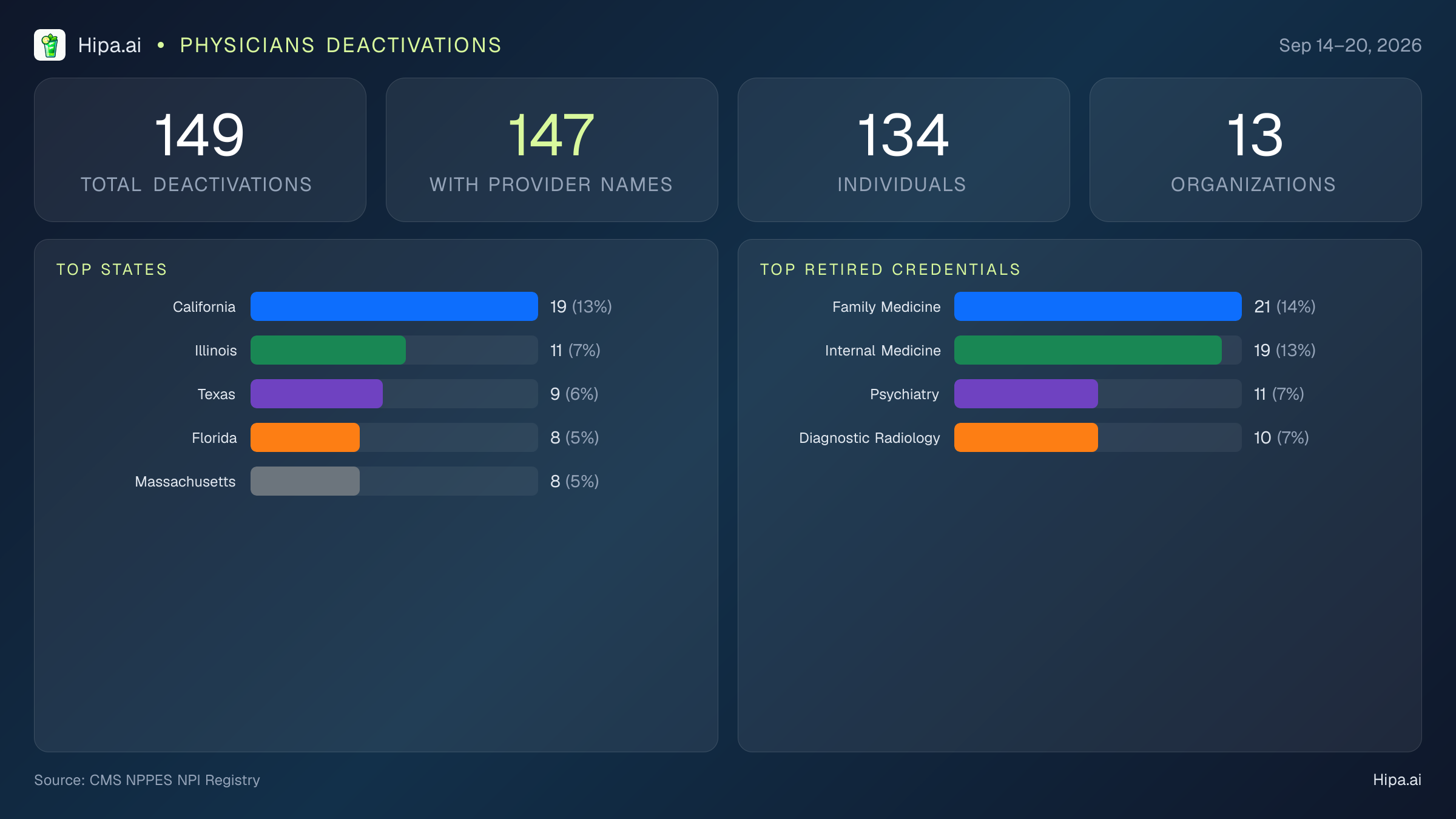
CMS recorded 149 physician-segment deactivations in the NPPES registry during the week of Sept. 14–20, 2026. Hipa.ai could retrieve names for 147 records, or about 99%; California led the state count with 19 deactivations. CMS’s total includes two records whose names were scrubbed; the named subset is what Hipa.ai’s public-source cache captured before the information was removed.
California Leads State Counts
Illinois followed California with 11 deactivations, then Texas with 9. Florida, Massachusetts and New York each had eight, while Maryland and Georgia recorded six apiece. Ohio and Michigan had five each. The leading states are spread across regions, but California’s count was higher than any other state’s and the next few states formed a smaller tier.
Together, California, Illinois and Texas accounted for 39 of the 149 records, about 26% of the weekly total. This concentration shows where the largest counts appeared in this snapshot, not how many physicians practice in each state or whether local access to care is changing. State counts can reflect the size and administrative complexity of provider markets as well as the timing of registry updates. City totals were more dispersed: Baltimore had the highest listed count, with four, followed by New York and Atlanta with three each.
Primary Care Leads Taxonomies
Among named providers, Family Medicine was the most frequent taxonomy, with 21 records, followed by Internal Medicine with 19. Psychiatry accounted for 11, Diagnostic Radiology for 10, and Pediatrics for eight. Ophthalmology and Obstetrics & Gynecology each had seven, while Orthopaedic Surgery had six. These taxonomy labels describe the specialties recorded in NPPES; they do not establish why a record was deactivated or whether the person or organization has stopped delivering care.
The distribution includes both broad primary-care specialties and a range of specialty practices. Family and Internal Medicine together made up 40 of the named records, while psychiatry and radiology were also among the leading categories. The mix offers a snapshot of the taxonomy attached to deactivated records, rather than a measure of specialty workforce losses: a provider may continue practicing under another NPI or with a changed registry record.
Administrative Changes Need Context
NPI deactivation is an administrative status change, not by itself evidence of a license action, malpractice or a practice closure. Registry records can be retired as providers leave practice, change entity types or consolidate organizations; providers may also obtain a new NPI. Weekly counts therefore reflect registry maintenance and workforce churn, but do not identify the circumstances behind any individual record. Read in that context, this week’s figures describe activity in the federal registry, not a confirmed tally of physicians exiting patient care.