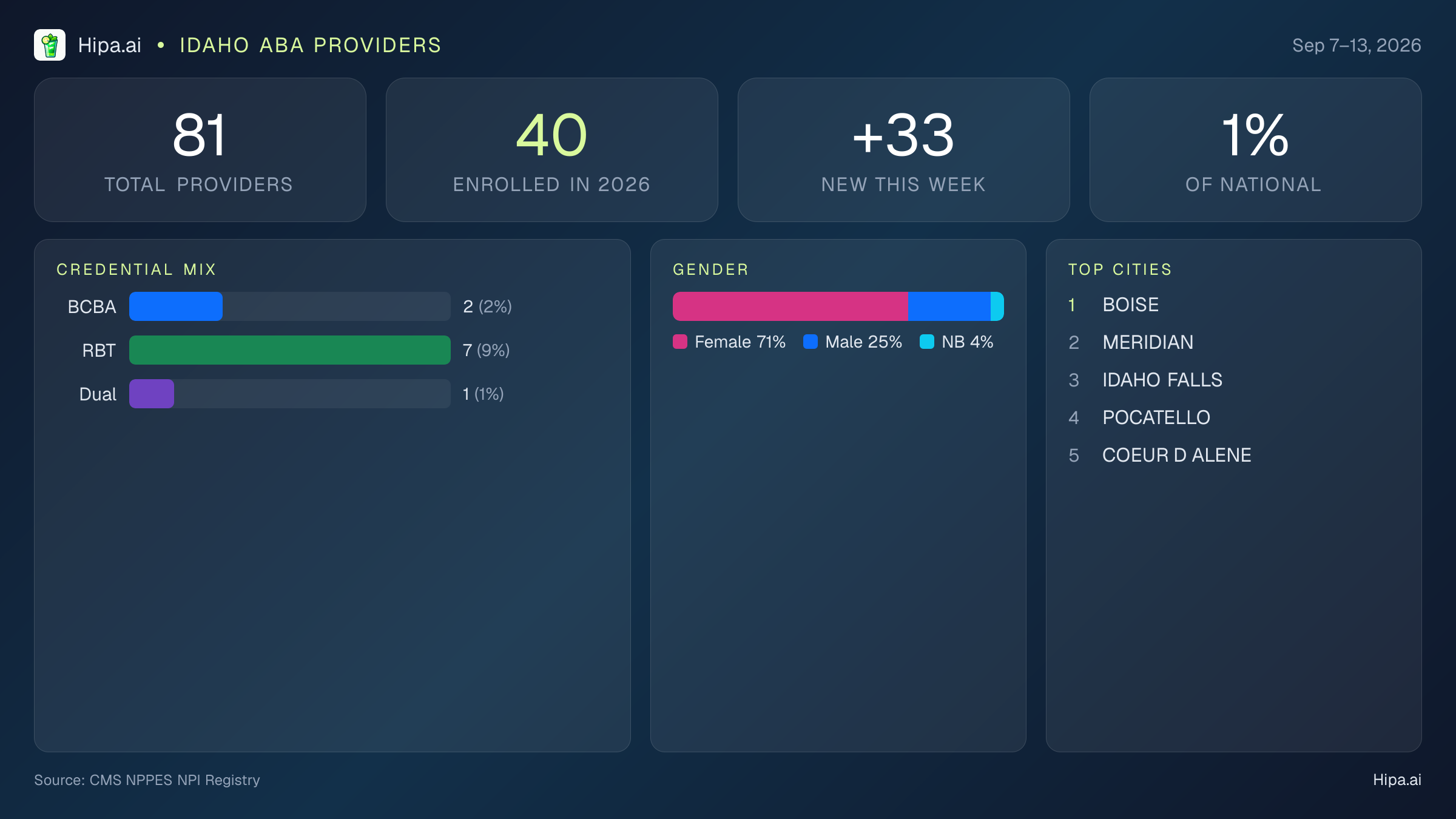
Idaho recorded 81 providers in the latest CMS NPI registry weekly update, representing 1% of the national weekly total. The update includes 33 providers added this week and 40 added this year, with 55 individuals and 26 organizations. Idaho’s share is modest, but the activity indicates a continuing flow of behavioral health organizations and professionals into the state’s registry. NPI records do not confirm staffing levels, active caseloads or appointment availability, so the concentration is best read as market participation rather than direct evidence of access.
ABA Workforce Mix
The credential summary lists 2 BCBAs, 7 RBTs and 1 provider with dual BCBA-RBT credentials. These categories overlap: the dual-credential provider is represented within the broader credential counts and should not be treated as an additional, separate provider. The mix is therefore weighted toward technician credentials, while the documented BCBA pool is small. Because BCBAs supervise RBTs, develop treatment plans and oversee clinical quality, the registry pattern points to limited visible supervisory capacity relative to technician capacity. The update also identifies 30 providers with multiple taxonomies, another sign that registry categories can describe overlapping roles rather than distinct workforce segments.
Demographics and Organizations
Gender data identifies 39 female providers, 14 male providers and 2 nonbinary providers—71%, 25% and 4%, respectively. Saint Alphonsus Regional Medical Center Inc. appears 4 times across the registry, with records spanning clinical social work, professional counseling and psychology. Those repeated entries reflect multiple NPI records and taxonomies, not necessarily four separate employers. Boise, Meridian, Idaho Falls, Pocatello and Coeur d’Alene are the leading listed cities.
Idaho’s update suggests a broad behavioral health pipeline but a comparatively small documented ABA supervisory base, making BCBA capacity important to expanding reliable ABA access.