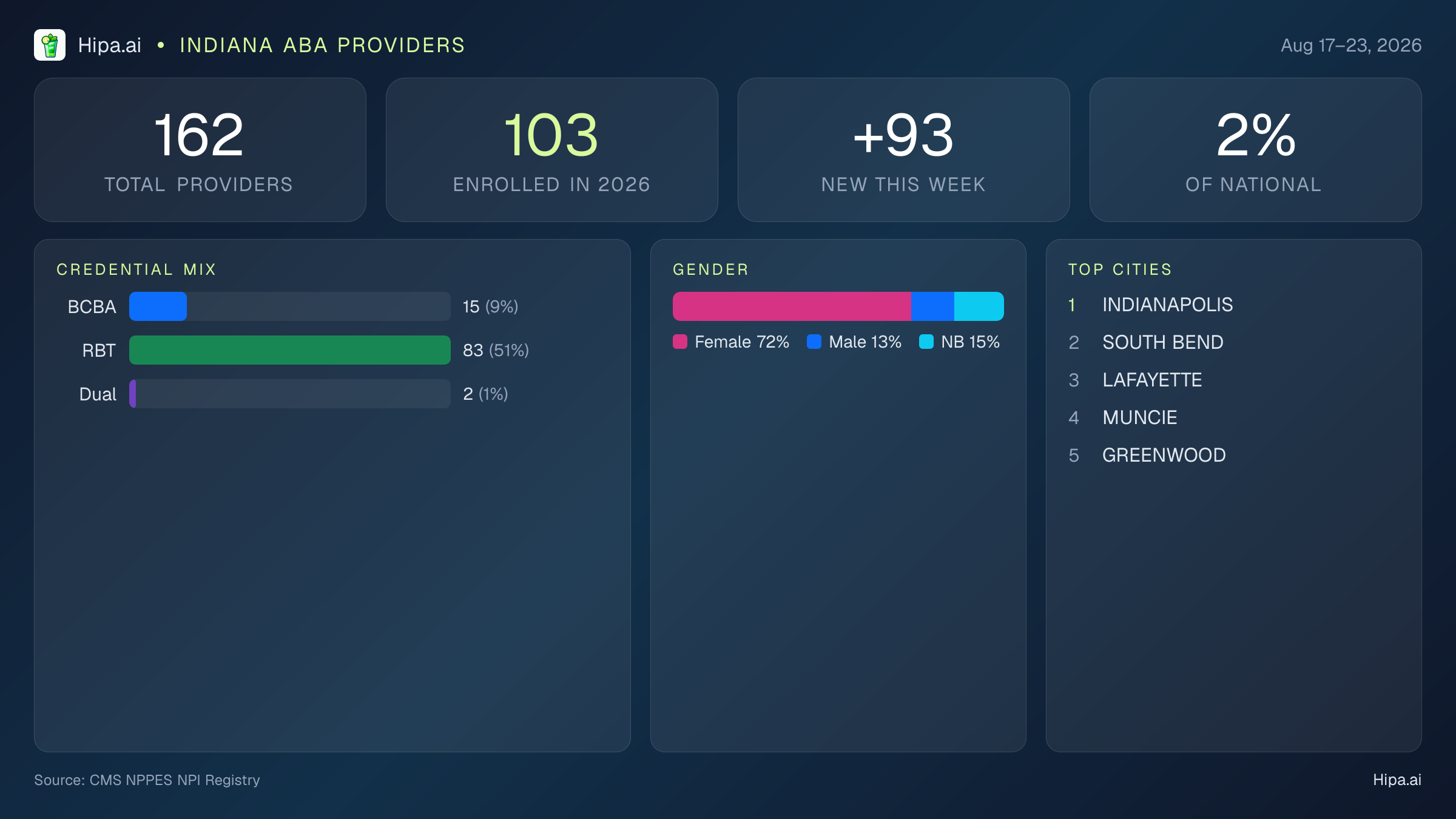
Indiana recorded 162 providers in the latest CMS NPI registry weekly update, representing 2% of the national weekly total. The registry added 93 providers this week, while 103 have been recorded this year. Indiana’s activity includes 138 individuals and 24 organizations. That concentration signals a meaningful regional market for behavioral health hiring and contracting, although NPI records do not confirm active caseloads, open positions or service availability.
ABA Workforce Mix
The registry lists 15 BCBA credentials and 83 RBT credentials, with two providers carrying dual BCBA-RBT credentials. These categories overlap and are not mutually exclusive shares of Indiana’s provider total: credential fields and taxonomy fields may describe the same provider differently. The much larger RBT count points to a workforce weighted toward direct service delivery rather than clinical supervision. Because BCBAs supervise RBTs, write and adjust treatment plans and monitor quality, the gap suggests that supervisory capacity could constrain how quickly Indiana converts RBT recruitment into expanded ABA access. The two dual-credential providers also reflect a small but visible pathway between direct-care and advanced behavior-analytic roles.
Demographics and Provider Activity
Among individual providers, the registry identifies 99 women, 18 men and 21 nonbinary providers, corresponding to 72%, 13% and 15%. The listed activity centers on Indianapolis, South Bend, Lafayette, Muncie and Greenwood, with RBT entries appearing across additional communities including Fort Wayne, Newburgh and Terre Haute. No organization is identified as appearing multiple times in the update’s notable-organization field, so the data does not point to a repeated dominant chain or provider group.
Indiana’s broad RBT footprint suggests growing direct-service capacity, while the smaller BCBA pool makes supervision availability a central workforce issue for future ABA access.