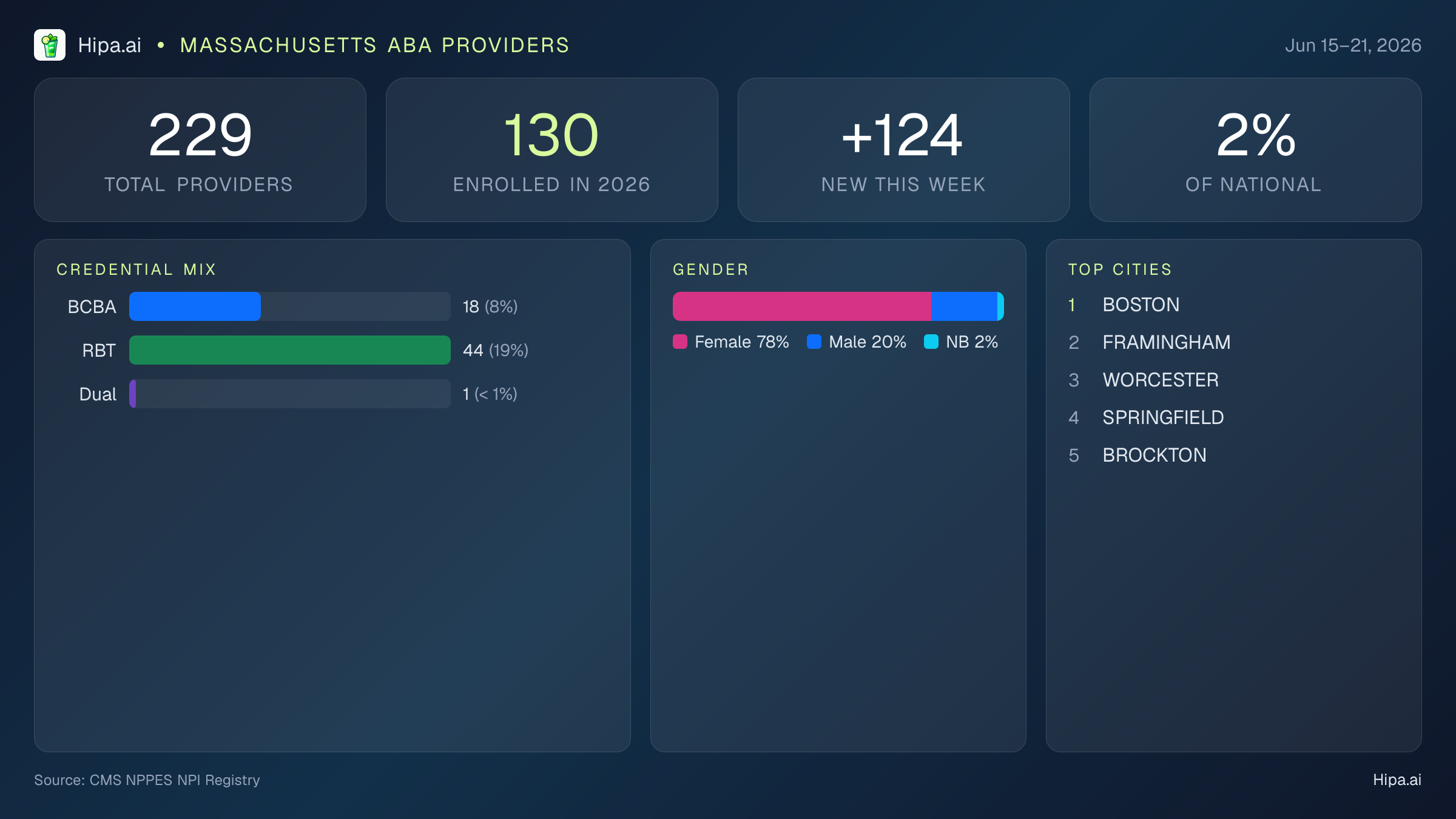
Massachusetts saw 229 behavioral health providers join the CMS NPI registry this week, accounting for 2% of the national total. This consistent activity reflects a steady demand for services and an active professional landscape within the state, with 124 new providers added this week alone, contributing to 130 new providers this year.
ABA Workforce Composition
Focusing on the ABA sector, the data shows 18 BCBA credentials and 44 RBT credentials. It is important to note that these counts are not mutually exclusive, as 1 individual holds both BCBA and RBT credentials, often signaling career progression. In Massachusetts, the state-level Licensed Applied Behavior Analyst (LABA) credential is layered on top of the national BCBA certification; 2 providers hold a LABA license alongside their BCBA. The ratio of approximately 2.4 RBTs for every BCBA (44 RBTs to 18 BCBAs) indicates a typical supervisory structure, vital for ensuring quality service delivery and RBT professional development.
Provider Demographics
Among the 205 individual providers, the workforce remains predominantly female, with 160 individuals (78%) identifying as female, 41 (20%) as male, and 4 (2%) as nonbinary. This gender distribution is consistent with national trends in behavioral health. No specific organizations appeared multiple times in this week's update, suggesting a landscape of independent practitioners and smaller local entities rather than the expansion of large, multi-state PE-backed chains often seen elsewhere.
This consistent influx of diverse behavioral health professionals, including a solid foundation of ABA practitioners, suggests a steady expansion of services to meet the state's growing demand for specialized care.