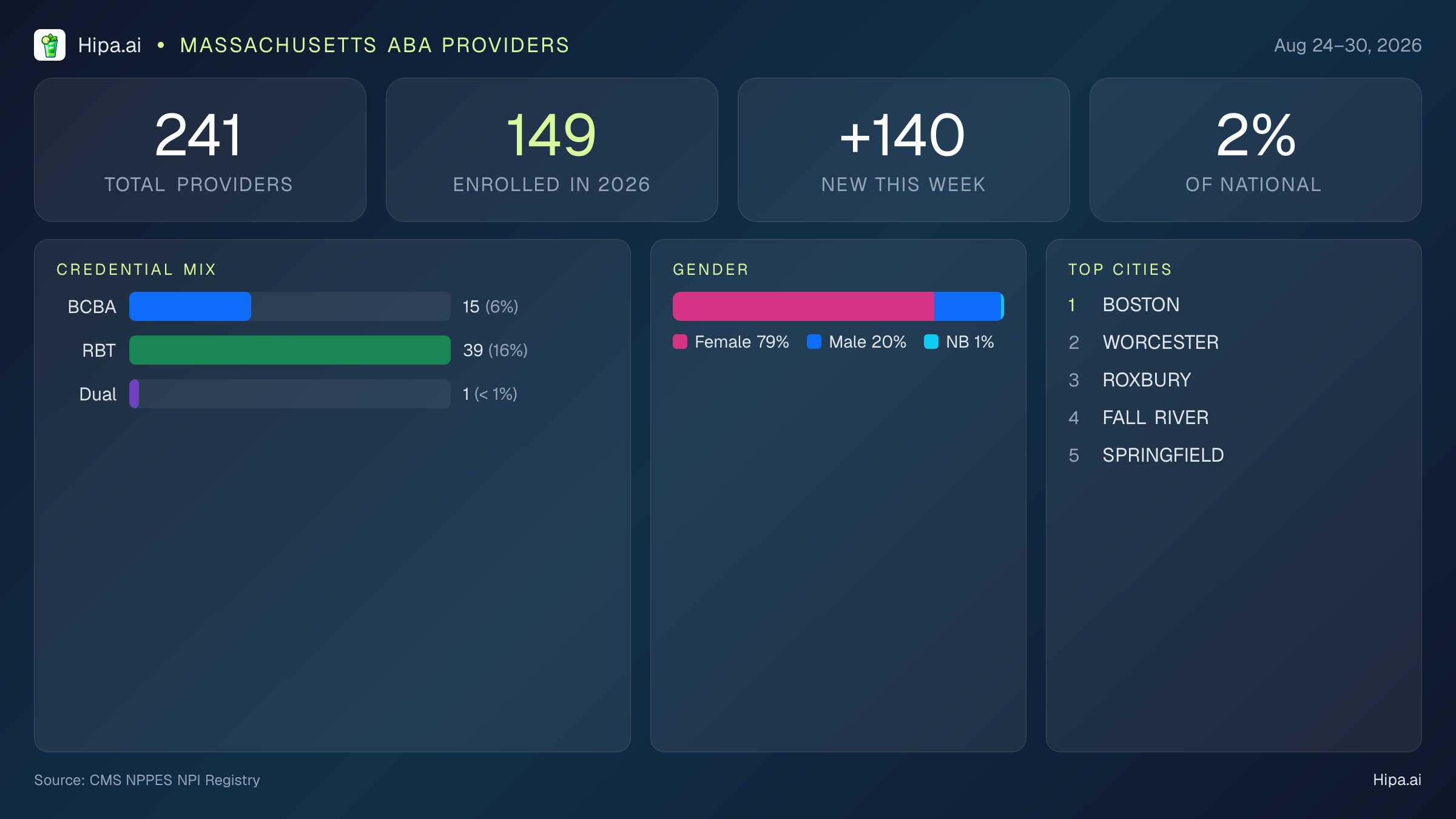
Massachusetts recorded 241 providers in the latest CMS NPI registry weekly update, representing 2% of the national weekly total. The registry lists 140 new providers this week, including 214 individuals and 27 organizations. That concentration places Massachusetts among the more active state markets in this update and signals continued behavioral health workforce movement across both independent practices and organizational providers. NPI activity does not by itself confirm active caseloads, hiring, or open appointment capacity.
ABA Workforce Mix
The credential data lists 15 BCBA credentials, 39 RBT credentials and one dual BCBA-RBT credential. These categories overlap and are not mutually exclusive shares of the 241-provider total; credential and taxonomy fields can describe the same provider in different ways. The larger RBT count points to more direct-service capacity than supervisory capacity in the ABA segment. Because BCBAs supervise RBTs, write and update treatment plans, and monitor clinical quality, the gap may limit how quickly Massachusetts clinics can expand services. The single dual credential is present but not a notable share of the registry, suggesting limited visible movement between technician and advanced clinical roles.
Demographics and Organizations
Gender data identifies 169 female providers, 42 male providers and 3 nonbinary providers, corresponding to 79%, 20% and 1%. The listed activity is concentrated in Boston, Worcester, Roxbury, Fall River and Springfield, with especially repeated entries from Boston, Worcester, Roxbury and Fall River. The update lists no notable organization appearing multiple times, so it does not point to a dominant chain or PE-backed employer driving the activity.
Massachusetts’s RBT-heavy ABA profile suggests growing direct-service capacity, but the smaller BCBA pool may remain a constraint on supervision and access.