Massachusetts Clinical Trials Report — July 2026
59 New Studies, 202 Closing Soon
Hipa.ai Research - July 1, 2026 - Source: Hipa.ai, ClinicalTrials.gov
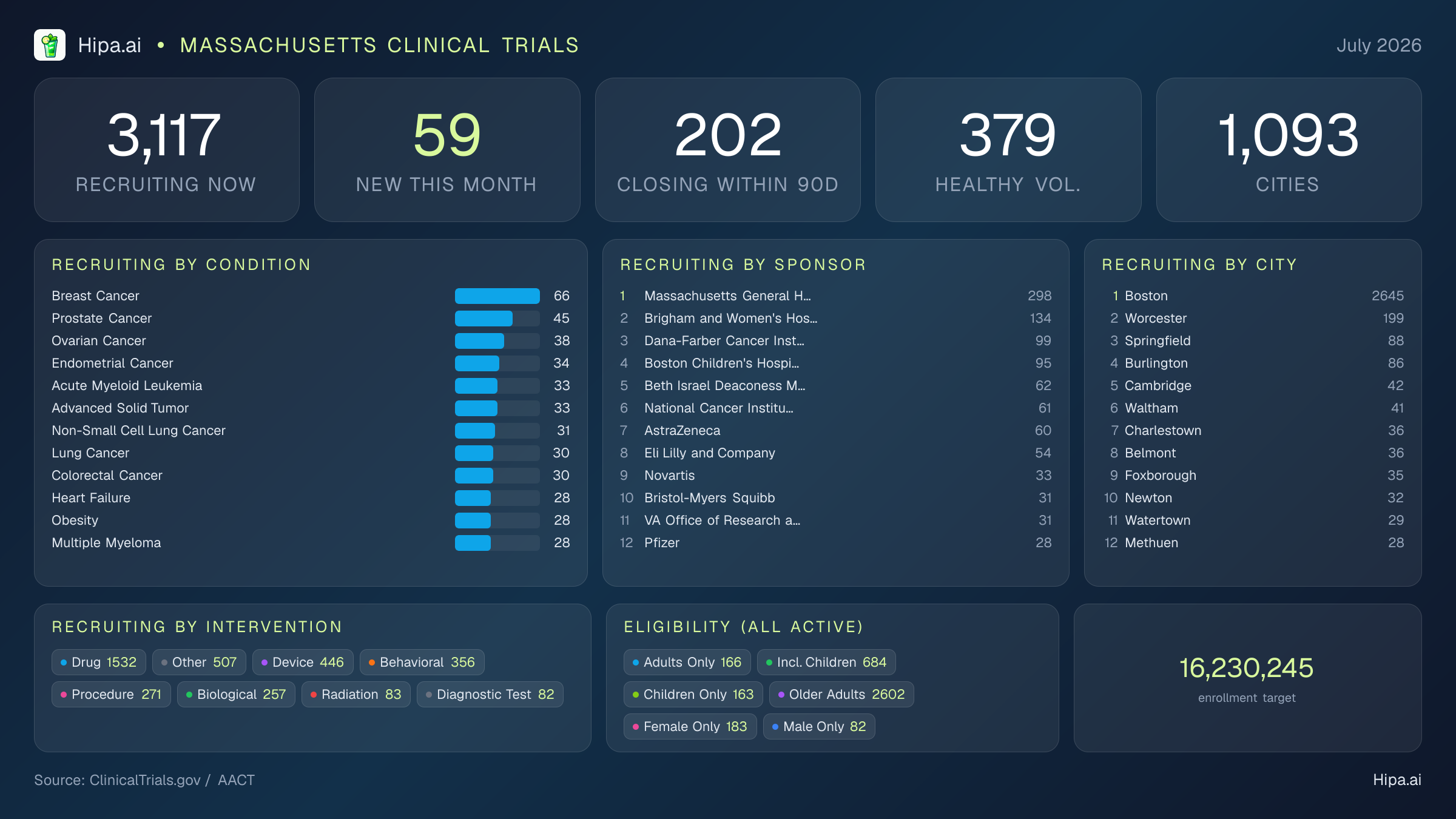
Massachusetts residents considering a clinical trial should begin with studies projected to close within the next 90 days. The state currently has 202 recruiting trials nearing their expected enrollment deadline, including 36 that accept healthy volunteers. Breast, prostate, and colorectal cancer studies make up the largest groups, but urgent opportunities also involve type 1 diabetes, opioid use disorder, recurrent glioblastoma, melanoma, long COVID, acute myeloid leukemia, and major depressive disorder.
At the same time, Massachusetts added 59 new trials in July, down from 64 in June and 81 in May. The state now has 3,117 recruiting trials across 94 cities and 1,093 research sites. People who may qualify should contact study teams promptly: screening, testing, and medical-record review can take time, and projected closing dates may change.
Closing-soon studies create the most immediate opening
Cancer patients have the broadest set of time-sensitive opportunities. Breast cancer leads with 9 closing-soon trials, followed by prostate cancer with 7 and colorectal cancer with 4. Several other conditions have three trials each approaching closure, including type 1 diabetes, opioid use disorder, recurrent glioblastoma, melanoma, long COVID, acute myeloid leukemia, and major depressive disorder.
- Breast cancer — 9 closing-soon trials
- Prostate cancer — 7
- Colorectal cancer — 4
- Type 1 diabetes, opioid use disorder, recurrent glioblastoma, melanoma, long COVID, acute myeloid leukemia, and major depressive disorder — 3 each
Healthy adults also face a limited window. Of the 202 studies expected to close soon, 36 accept healthy volunteers. Across Massachusetts, 379 trials are recruiting healthy volunteers, including 11 of the new July studies. People without a diagnosed condition may find options in imaging, behavioral research, prevention, device testing, or other studies, but they should verify compensation, visit requirements, and screening criteria directly with each research team.
New research spans cancer, obesity, cystic fibrosis, and healthy aging
The month’s new studies cover a varied group of conditions. Cancer and obesity or overweight research each accounted for 2 new trials. Healthy-volunteer and cystic-fibrosis studies also each accounted for 2. Additional July openings address aging, acute myeloid leukemia, acute kidney injury, anterior talofibular ligament injuries, adolescent substance use, and aphasia.
- Cancer — 2 new trials
- Obesity and overweight — 2
- Healthy volunteers — 2
- Cystic fibrosis — 2
- Aging, acute myeloid leukemia, acute kidney injury, anterior talofibular ligament, adolescent substance use, and aphasia — 1 each
Drug studies were the most common type of new opening, with 17 trials. Device studies followed with 15, while behavioral research accounted for 12. Other study types represented 10 openings, with procedures, biological interventions, and diagnostic tests making up the remainder. This mix gives prospective participants choices beyond drug treatment, including medical devices, behavioral programs, imaging, and clinical procedures.
Large Phase 3 studies bring prominent industry research
Several new studies stand out because of their late-stage design, planned enrollment, or sponsor. AstraZeneca opened a Phase 3 study, NCT07720284, comparing Dato-DXd plus rilvegostomig with standard care as adjuvant treatment for adults with high-risk muscle-invasive urothelial cancer after radical resection. The study plans to enroll 915 participants, with treatment lasting up to approximately 12 months and the overall study extending for about 6.5 years.
Another large Phase 3 cancer study, NCT07700979, is sponsored by Akeso and plans to enroll 900 participants with previously untreated, unresectable, or metastatic HER2-negative gastric or gastroesophageal-junction adenocarcinoma. It will evaluate cadonilimab combined with chemotherapy against chemotherapy with or without nivolumab as first-line treatment.
- NCT07720284 — AstraZeneca’s Phase 3 study of Dato-DXd plus rilvegostomig versus standard care for high-risk muscle-invasive urothelial cancer, with 915 planned participants.
- NCT07700979 — Akeso’s Phase 3 study of cadonilimab plus chemotherapy for advanced gastric or gastroesophageal-junction cancer, with 900 planned participants.
- NCT07728188 — AbbVie’s Phase 3 study of injected etentamig plus oral pomalidomide versus standard therapies for relapsed or refractory multiple myeloma, enrolling 520 adults.
- NCT07735442 — Dana-Farber Cancer Institute’s BRIDGE-SIC Efficacy Trial, a randomized study of large-language-model-generated serious-illness conversation summaries, with 600 planned participants.
- NCT07690436 — AstraZeneca’s pilot study using retinal fundus and optical coherence tomography imaging to detect transthyretin amyloid cardiomyopathy, enrolling 500 participants.
- NCT07696338 — The REACT trial, a randomized cystic-fibrosis study comparing early airway-clearance therapies, with 405 planned participants.
Healthy volunteers have a particularly distinctive new option through NCT07719049, sponsored by Brigham and Women’s Hospital. The study, “Artificial Intelligence-Based Health Assessment From Face Photographs,” plans to enroll 10,000 healthy participants. Researchers will examine how FaceAge, an estimate of biological age based on facial features, changes over time and what factors may affect the consistency of the algorithm.
Current or former cancer patients may also be eligible for NCT07731425, sponsored by the London School of Economics and Political Science. With 3,000 planned participants, the study examines whether explaining overall-survival information alongside progression-free-survival information improves patients’ expectations about the benefits of cancer drugs.
Boston dominates access, with smaller openings nearby
New trial activity is heavily concentrated in Boston. The city accounted for 51 of the 59 July openings, making it the primary access point for new research in the state. Burlington added 2, while Gloucester, Jamaica Plain, Somerville, Belmont, Wellesley, and Chestnut Hill each recorded 1 new trial.
- Boston — 51 new trials
- Burlington — 2
- Gloucester, Jamaica Plain, Somerville, Belmont, Wellesley, and Chestnut Hill — 1 each
The distribution shows a strong Boston-area concentration rather than an even statewide spread. Because many studies have specialized eligibility requirements, residents outside the metro area may need to consider travel to Boston or nearby communities. The broader total of 94 recruiting cities indicates that opportunities extend beyond the newest openings, but searchers should confirm the exact Massachusetts site and visit schedule for every trial.
Who should check eligibility now?
Families may find new options among 11 July trials that include children. Three new studies are female-only, and one is male-only. Older adults are included in 52 new-trial eligibility criteria, making aging research and studies of chronic disease especially relevant for this group.
Massachusetts hospitals and universities remain central to the state’s research activity. Massachusetts General Hospital sponsored 13 new trials, Brigham and Women’s Hospital sponsored 6, and Dana-Farber Cancer Institute and Tufts University sponsored 4 each. Boston Medical Center and Boston University Charles River Campus each sponsored 2. AstraZeneca also opened 2 new studies, while Flare Therapeutics Inc. opened one. Of the new trials, 45 were classified as other, 13 as industry-sponsored, and 1 as NIH-sponsored.
The six-month pattern has fluctuated rather than moved in a straight line: Massachusetts recorded 78 new trials in February, 74 in March, 58 in April, 81 in May, 64 in June, and 59 in July. With enrollment deadlines approaching and new studies continuing to open around Boston, patients, caregivers, and healthy volunteers should revisit eligibility listings through the rest of summer 2026.
Data Highlights
Conditions Closing Soon
- breast cancer (9)
- prostate cancer (7)
- colorectal cancer (4)
- type1diabetes (3)
- opioid use disorder (3)
- recurrent glioblastoma (3)
- melanoma (3)
- long covid (3)
Most Common New Trial Conditions
- cancer (2)
- obesity & overweight (2)
- healthy volunteers (2)
- cystic fibrosis (cf) (2)
- aging (1)
- aml (1)
- acute kidney injury (1)
- anterior talofibular ligament (1)
Cities With the Most New Trials
- Boston (51)
- Burlington (2)
- Gloucester (1)
- Jamaica Plain (1)
- Somerville (1)
- Belmont (1)
- Wellesley (1)
- Chestnut Hill (1)
Leading Sponsors
- Massachusetts General Hospital (13)
- Brigham and Women's Hospital (6)
- Dana-Farber Cancer Institute (4)
- Tufts University (4)
- Boston Medical Center (2)
- Boston University Charles River Campus (2)
- AstraZeneca (2)
- Flare Therapeutics Inc. (1)
| Month | New Trials | Closing Soon |
|---|---|---|
| March 2026 | 74 | 12 |
| April 2026 | 58 | 23 |
| May 2026 | 81 | 26 |
| June 2026 | 64 | 68 |
| July 2026 | 59 | 51 |
| August 2026 | 14 | 0 |
New Studies This Month (59)
City-Level Research Reports for Massachusetts
Read the July 2026 clinical trials report for these Massachusetts cities.
Top Cities for Paid Clinical Trials in Massachusetts
Browse every recruiting paid clinical trial in the cities with the most active studies in Massachusetts.
Ready to participate?
Browse every recruiting paid clinical trial in Massachusetts, filter by condition, age, and healthy-volunteer status, and jump directly to each study to apply.
Browse Paid Clinical Trials in Massachusetts