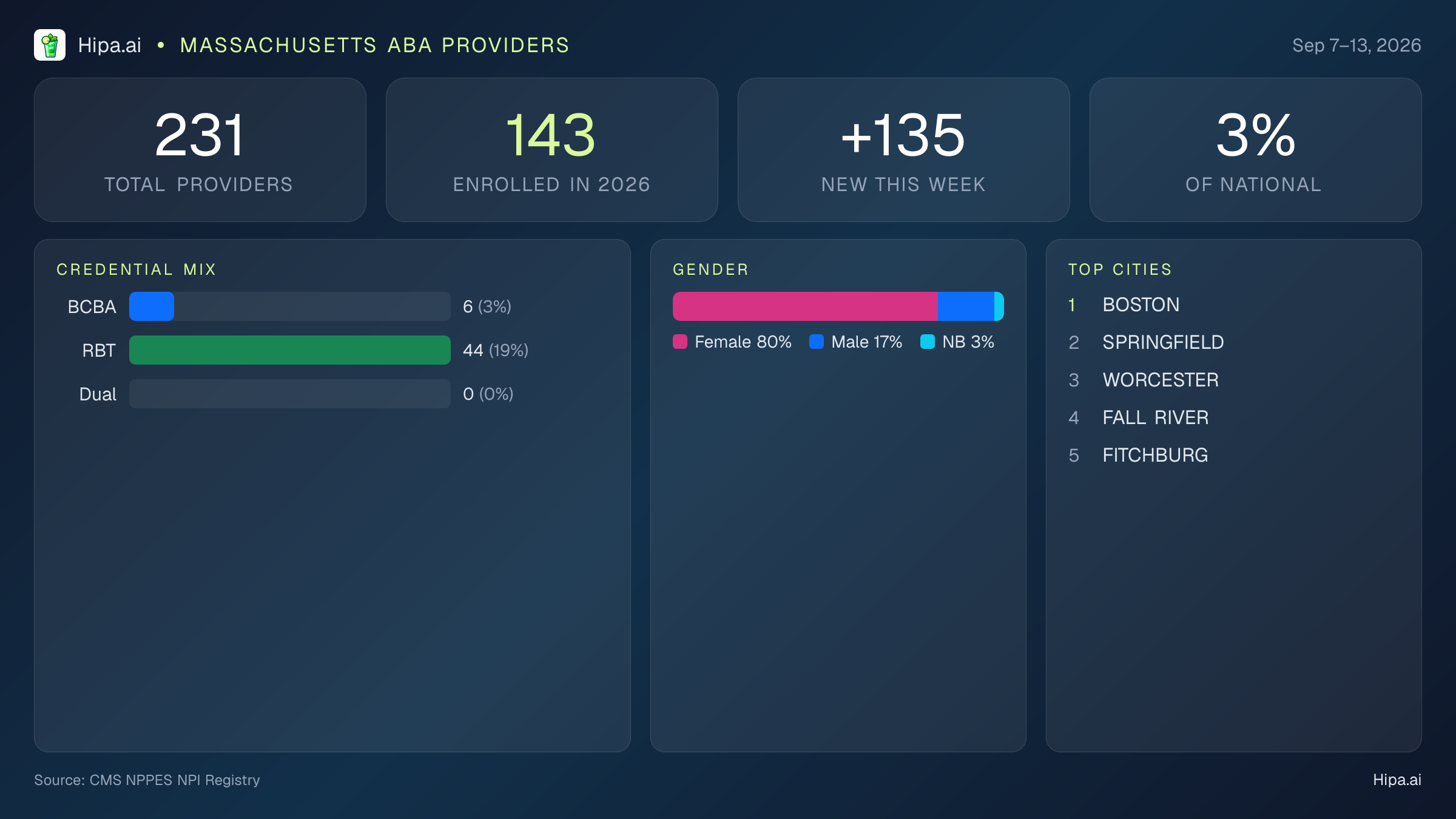
Massachusetts recorded 231 providers in the latest CMS NPI registry weekly update, representing 3% of the national weekly total. The update includes 135 new providers this week, with 212 individuals and 19 organizations. That concentration places Massachusetts among the more active state markets in this snapshot, although NPI records measure registry activity rather than confirmed staffing, caseloads or appointment availability. The volume suggests continued behavioral health participation across a large and varied provider market.
ABA Workforce Mix
The registry lists 6 BCBAs and 44 RBTs, with no dual BCBA-RBT credentials reported. These credential and taxonomy categories should not be treated as mutually exclusive shares: providers can have multiple credentials or taxonomies, and 33 providers carry multiple taxonomies. The RBT-to-BCBA pattern points to a technician-heavy ABA workforce, while the smaller BCBA count indicates a more limited pool for supervision, treatment planning and clinical oversight. That structure can expand direct-service capacity only if Massachusetts maintains enough BCBAs to supervise RBTs. The broader credential mix also includes 14 LICSWs, 10 LCSWs and 8 LMHCs, showing that the weekly registry activity extends well beyond ABA.
Demographics and Organizations
Women account for 169 providers, or 80% of the reported workforce. The update lists 37 men, or 17%, and 6 nonbinary providers, or 3%. No notable organization appears multiple times in the supplied data. Boston, Springfield, Worcester, Fall River and Fitchburg are the leading listed cities, indicating activity across both major urban centers and regional markets.
Massachusetts’s update suggests broad behavioral health growth with substantial RBT participation but a comparatively narrow documented BCBA supervisory base, a combination that may constrain expansion of ABA access.