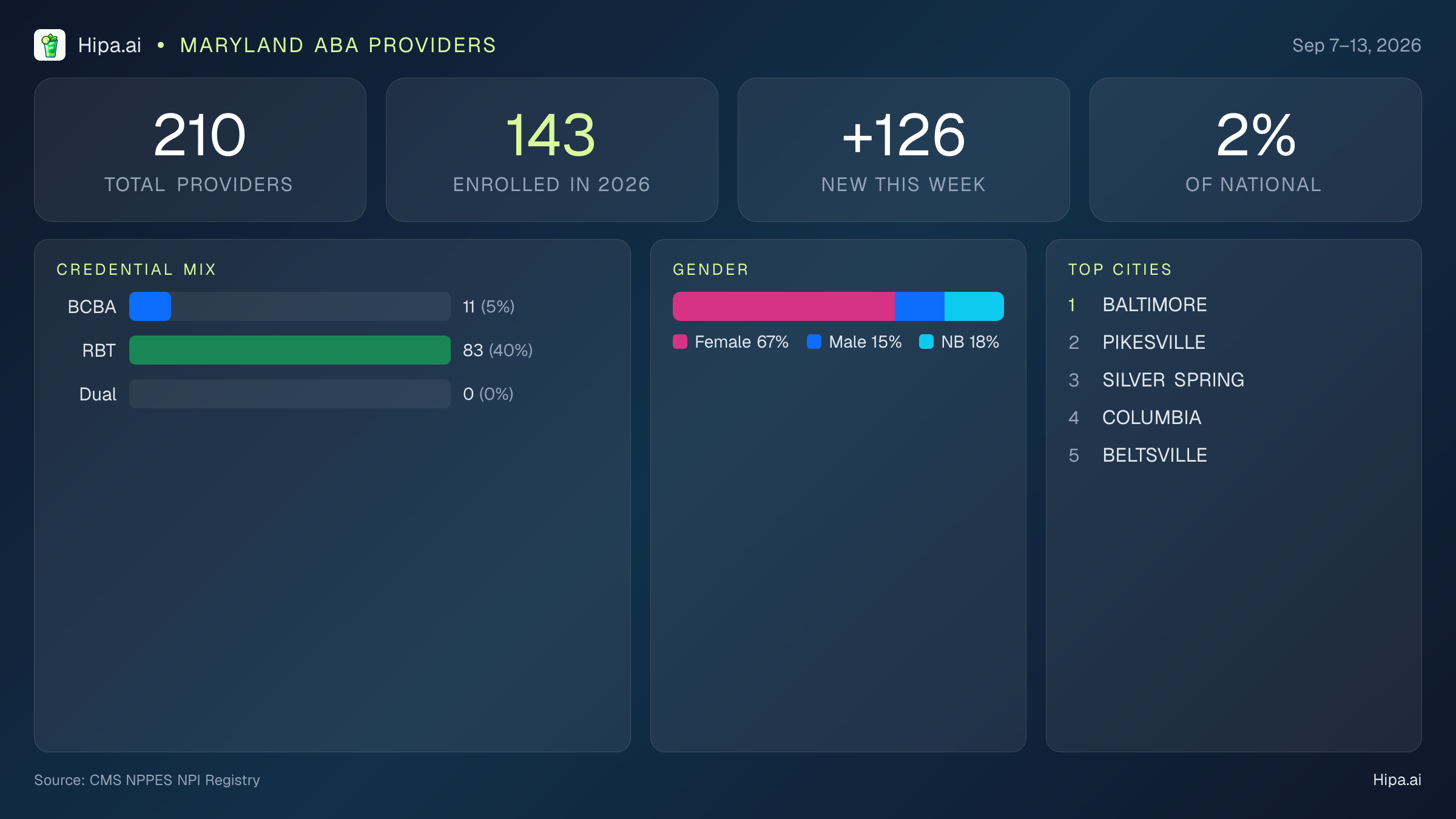
Maryland recorded 210 providers in the latest CMS NPI registry weekly update, representing 2% of the national weekly total. The update lists 126 new providers this week and 143 added this year, including 181 individuals and 29 organizations. That concentration places Maryland among the more active state markets in this snapshot. NPI activity reflects registry records rather than confirmed staffing, caseloads or appointment availability, but the volume signals continued behavioral health participation and provider formation across the state.
ABA Workforce Mix
The credential summary reports 11 BCBAs and 83 RBTs, with no dual BCBA-RBT records. These categories should not be treated as a complete, mutually exclusive workforce census: credential and taxonomy fields can overlap, and the summary also includes other behavioral health credentials. The RBT-to-BCBA ratio is therefore roughly eight to one, pointing to substantial technician capacity relative to documented supervisory capacity. RBT growth can expand direct-service delivery, but BCBAs remain essential for supervision, treatment planning and clinical oversight. The registry also identifies 29 multi-taxonomy providers, another indication that classifications overlap rather than divide the workforce into separate groups.
Demographics and Organizations
Gender data identifies 121 female providers, 27 male providers and 33 nonbinary providers, or 67%, 15% and 18%, respectively. The registry’s leading cities are Baltimore, Pikesville, Silver Spring, Columbia and Beltsville. No organization is flagged in the notable-organizations field, although K&P Enterprises appears in three organization records under closely related names, including K&P Enterprises, Inc. and K&P Enterprises.
Maryland’s update points to expanding direct-service capacity, while the smaller BCBA pool could remain a constraint on supervision and broader ABA access.