Maryland Clinical Trials Report — July 2026
33 New Studies, 138 Closing Soon
Hipa.ai Research - July 1, 2026 - Source: Hipa.ai, ClinicalTrials.gov
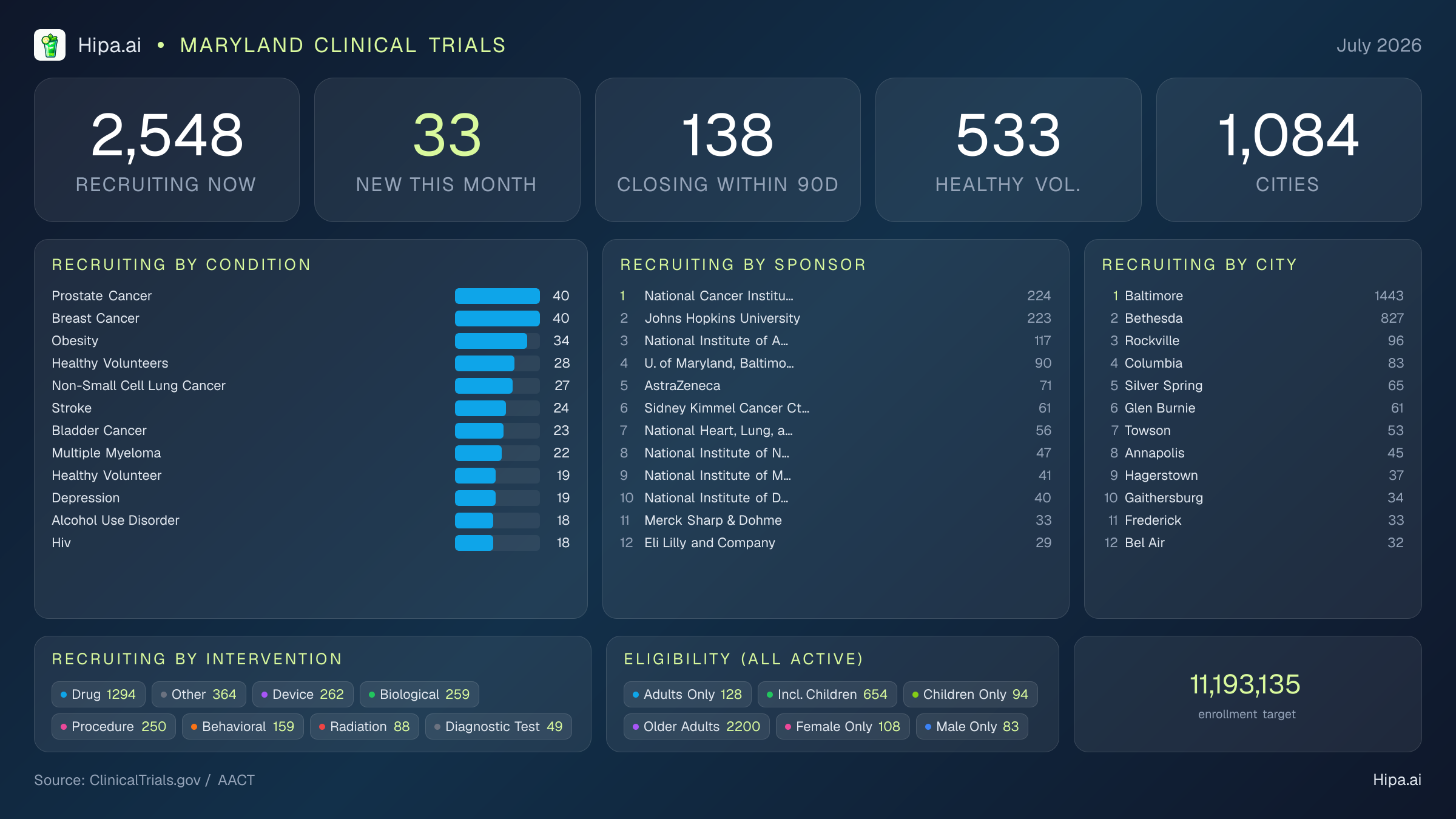
Maryland residents considering a clinical trial should check closing-soon studies now: 138 recruiting trials are expected to close within the next 90 days, including 36 that accept healthy volunteers. Prostate cancer and stroke studies lead the time-sensitive list, with 5 trials each, followed by breast cancer with 4. Screening and enrollment can take time, so people who may qualify should contact study teams as soon as possible.
Maryland currently has 2,548 recruiting trials across 86 cities and 1,084 research sites. The state added 33 new studies in July, down from 52 in June and 51 in May. Even with this month’s slower opening pace, the available research base remains broad, ranging from drug and device studies to prevention, behavioral, and observational projects.
Closing trials create a narrow window for patients and healthy adults
People with prostate cancer or stroke face the largest concentration of projected enrollment deadlines. Breast cancer follows closely, while obesity, amputation, and asthma each appear in 3 closing-soon trials. HIV studies also account for 3 trials. Alzheimer disease and medication adherence each appear in 2 studies nearing their projected closing dates.
- Prostate cancer and stroke — 5 closing-soon trials each
- Breast cancer — 4
- Obesity, amputation, and asthma — 3 each
- HIV — 3
- Alzheimer disease, healthy volunteers, and medication adherence — 2 each
The 36 closing-soon studies that accept healthy volunteers offer a particularly important opportunity for people without a diagnosed condition. Two studies are specifically associated with healthy volunteers in the closing-soon condition data. The broader Maryland landscape includes 533 recruiting studies that accept healthy volunteers, although eligibility, compensation, visit schedules, and travel requirements vary by study.
Anyone interested in a closing trial should verify that enrollment remains open, ask whether Maryland has an active site, and begin prescreening promptly. A projected closing date is not a guarantee that applications will remain available until that date.
July’s new studies favor drugs, prevention, and specialized conditions
New-trial activity slowed from recent months, with July’s 33 openings compared with 52 in June. The new studies cover both common research areas and rare or highly specialized conditions. Two new trials list healthy participants, while other openings address Alzheimer’s disease, hepatocellular carcinoma, aspergillosis, central centrifugal cicatricial alopecia, chronic pain, colorectal neoplasms, cutaneous T-cell lymphoma, and cystic fibrosis.
- Healthy participants — 2 new trials
- Alzheimer’s disease, hepatocellular carcinoma, aspergillosis, CCCA, chronic pain, chronic pain syndrome, colorectal neoplasms, cutaneous T-cell lymphoma, and cystic fibrosis — 1 each
Drug studies were the most common type of new opening, with 16 trials. Other study types accounted for 7, followed by devices at 5, biological interventions at 3, radiation and behavioral studies at 2 each, and dietary supplements at 1. This gives prospective participants options beyond experimental medicines, including medical devices, screening programs, treatment comparisons, and research that examines disease progression.
Large and notable studies include Bristol-Myers Squibb, NIH, and Johns Hopkins
Several July openings stand out because of their size, sponsor, or clinical phase. Bristol-Myers Squibb launched a Phase 3 lung cancer study, while a large Phase 4 sleep-apnea comparison could interest adults seeking alternatives to standard positive airway pressure therapy.
- NCT07680790 — Bristol-Myers Squibb’s Phase 3 IZABRIGHT-Lung02 study compares izalontamab brengitecan with osimertinib-based treatment approaches in previously untreated, locally advanced or metastatic EGFR-mutant non-small cell lung cancer. Planned enrollment is 850 participants.
- NCT07679282 — A Phase 4 study plans to enroll 2,400 adults with obstructive sleep apnea and compare positive airway pressure, a dental device, and atomoxetine-oxybutynin. Researchers are examining both effectiveness and how consistently participants can use each approach.
- NCT07728123 — Westat’s Screen2Prevent study plans to involve 84,000 participants while evaluating targeted, universally offered opt-in, and universally offered opt-out HIV screening approaches in emergency departments.
- NCT07712874 — NCCIH’s screening protocol expects 10,000 volunteers interested in future studies of pain and related processes, including emotion, mood, and decision-making.
- NCT07737535 — Johns Hopkins University is studying the clinical differences and treatment responses associated with inflammatory arthritis caused by immune checkpoint inhibitors, an increasingly recognized complication of cancer immunotherapy.
- NCT07700511 — NINDS is recruiting 500 healthy volunteers for characterization and prescreening for neurological research.
- NCT07696338 — The REACT trial examines airway-clearance therapies, including hypertonic saline and dornase alfa, in people with cystic fibrosis.
NIH-affiliated research is prominent among the new openings. NIAID sponsored 3 new trials, including NCT07683104, a natural-history study of trisomy 8-associated autoinflammatory disease and related disorders. The National Cancer Institute sponsored 2, while the National Heart, Lung, and Blood Institute sponsored 1. Johns Hopkins University and the University of Maryland, Baltimore each sponsored 3 new trials, and Bristol-Myers Squibb sponsored 2.
Across sponsor categories, 12 new studies were classified as other, 11 were NIH-sponsored, and 10 were industry-sponsored. This balance gives Maryland participants access to research from major pharmaceutical companies, federal agencies, and leading academic centers.
Baltimore and Bethesda dominate the new-trial map
New research is strongly concentrated in Maryland’s major medical and federal research corridors. Baltimore led July’s openings with 19 new trials, followed by Bethesda with 10. Together, these two cities account for nearly all of the month’s new-trial activity. Other openings were distributed across Brooklyn, Columbia, Gaithersburg, Salisbury, Silver Spring, and Wheaton.
- Baltimore — 19 new trials
- Bethesda — 10
- Brooklyn, Columbia, Gaithersburg, Salisbury, Silver Spring, and Wheaton — 1 each
The pattern reflects Maryland’s concentration of major hospitals, universities, federal agencies, and specialized research centers around Baltimore and the Washington metropolitan area. However, the state has recruiting studies in 86 cities overall, so people should search beyond the newest openings and filter by condition, distance, and visit requirements. A study with a large national enrollment target may still have only a limited number of Maryland sites.
Healthy volunteers, children, and older adults have opportunities
Healthy adults have several reasons to look now. Of the 33 new July trials, 11 accept healthy volunteers. The NINDS recruitment and NCCIH screening studies may be especially relevant to people interested in contributing to neurological, pain, or related research without having the condition under study.
Families should also review eligibility carefully: 7 new trials include children. No new July study is female-only, and 1 is male-only. Older adults appear in 25 new-trial eligibility criteria, making age-related research and studies open to broader adult populations worth checking.
People with prostate cancer, stroke, breast cancer, obesity, asthma, HIV, Alzheimer disease, or amputation-related needs should act first on studies projected to close within 90 days. Healthy volunteers should also review the 36 closing-soon opportunities rather than relying only on newly opened trials.
Maryland’s recruiting pipeline is likely to keep shifting through the remainder of 2026. Prospective participants can improve their chances by checking eligibility early, preparing medical records or medication information, and asking research teams about the next screening appointment before a study reaches its enrollment limit.
Data Highlights
Conditions Closing Soon
- prostate cancer (5)
- stroke (5)
- breast cancer (4)
- obesity (3)
- amputation (3)
- asthma (3)
- hiv (3)
- alzheimer disease (2)
Most Common New Trial Conditions
- healthy (2)
- alzheimer's disease (1)
- hcc (1)
- aspergillos (1)
- central centrifugal cicatricial alopecia (ccca) (1)
- chronic pain (1)
- chronic pain syndrome (1)
- colorectal neoplasms (1)
Cities With the Most New Trials
- Baltimore (19)
- Bethesda (10)
- Brooklyn (1)
- Columbia (1)
- Gaithersburg (1)
- Salisbury (1)
- Silver Spring (1)
- Wheaton (1)
Leading Sponsors
- Johns Hopkins University (4)
- National Institute of Allergy and Infectious Diseases (NIAID) (3)
- University of Maryland, Baltimore (3)
- National Cancer Institute (NCI) (2)
- Bristol-Myers Squibb (2)
- ML Bio Solutions, Inc. (1)
- National Center for Complementary and Integrative Health (NCCIH) (1)
- National Heart, Lung, and Blood Institute (NHLBI) (1)
| Month | New Trials | Closing Soon |
|---|---|---|
| March 2026 | 42 | 5 |
| April 2026 | 45 | 8 |
| May 2026 | 51 | 19 |
| June 2026 | 52 | 22 |
| July 2026 | 33 | 19 |
| August 2026 | 8 | 0 |
New Studies This Month (33)
City-Level Research Reports for Maryland
Read the July 2026 clinical trials report for these Maryland cities.
Top Cities for Paid Clinical Trials in Maryland
Browse every recruiting paid clinical trial in the cities with the most active studies in Maryland.
Ready to participate?
Browse every recruiting paid clinical trial in Maryland, filter by condition, age, and healthy-volunteer status, and jump directly to each study to apply.
Browse Paid Clinical Trials in Maryland