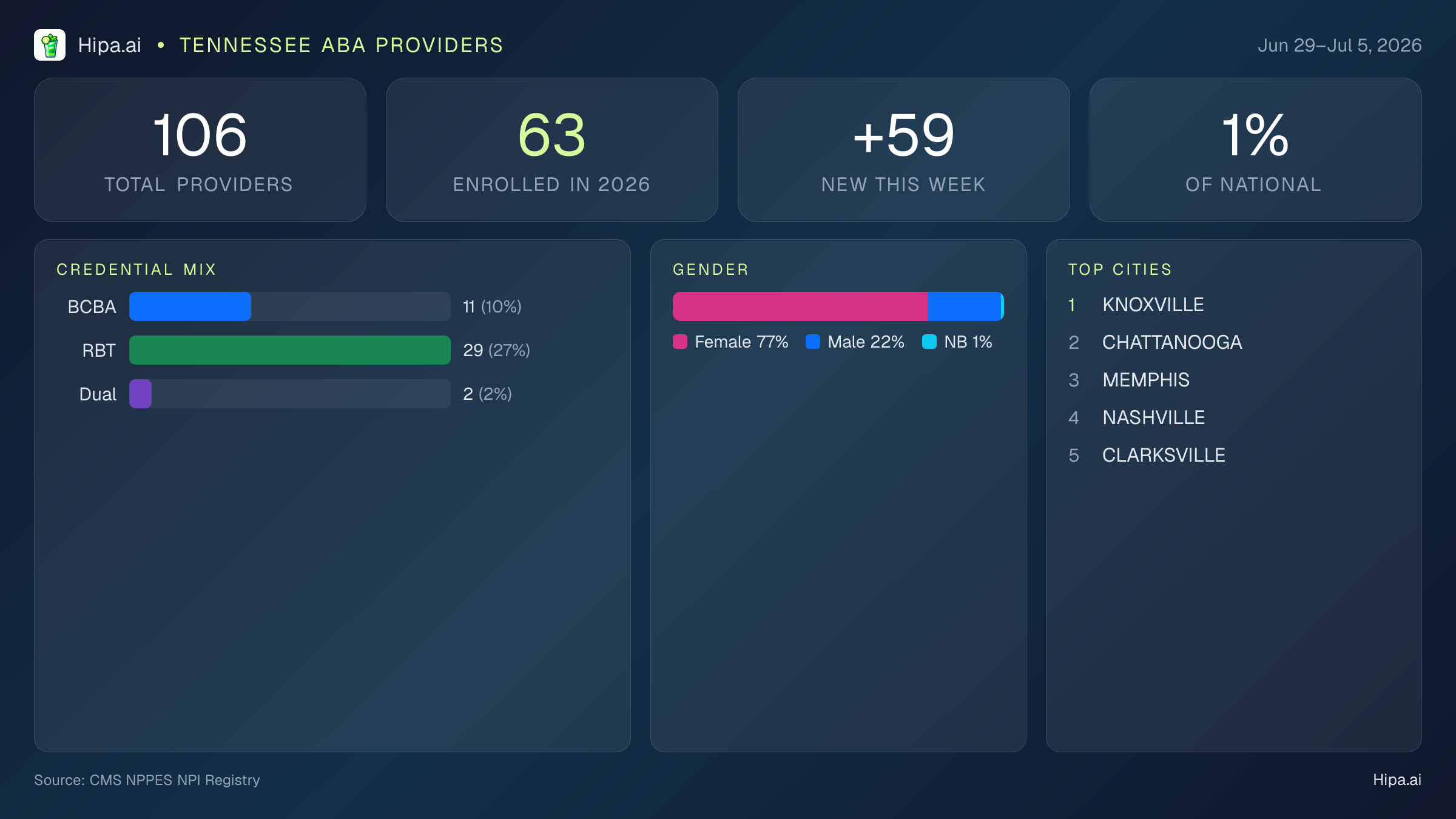
Tennessee registered a total of 106 behavioral health providers in the latest CMS NPI registry update, with 59 new additions this week alone. This activity represents 1% of the national total, signaling a consistent, albeit moderate, expansion of the state's behavioral health workforce to meet regional demands.
ABA Workforce Dynamics in Tennessee
Within the applied behavior analysis (ABA) sector, the data reveals 11 BCBAs and 29 RBTs. It is important to note that these credential categories are not mutually exclusive, as 2 individuals hold both BCBA and RBT credentials, often indicating a career progression from direct service to supervisory roles. Additionally, three providers hold a state-level LBA license, often in conjunction with their BCBA credential, which is crucial for state-specific practice. The ratio of BCBAs to RBTs, approximately 1:2.6, highlights a growing RBT workforce that relies on a smaller pool of BCBA supervisors, a common challenge in expanding ABA services while maintaining supervision standards.
Provider Demographics
The individual provider demographic data shows a workforce that is predominantly female, with 77% of individual providers identifying as female, 22% as male, and 1% as nonbinary. This gender distribution aligns with broader trends observed across the behavioral health field. No specific organizations appeared multiple times in this week's data, suggesting a diverse landscape of smaller practices or individual providers rather than dominant multi-state chains.
This measured growth in Tennessee's behavioral health workforce, particularly within the ABA sector, is vital for expanding access to critical services and addressing ongoing service demands across the state.