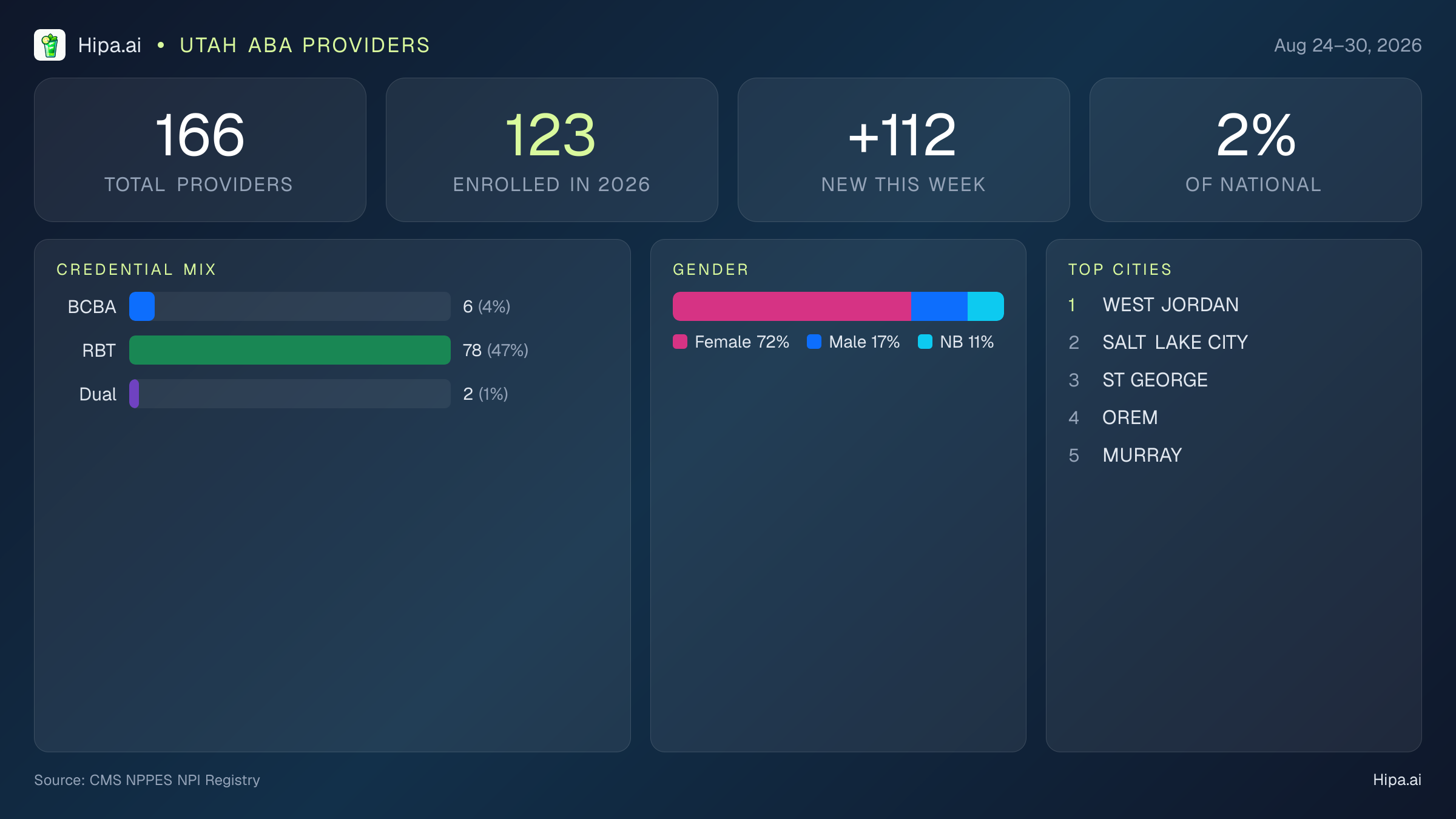
Utah recorded 166 providers in the latest CMS NPI registry weekly update, representing 2% of the national weekly total. The registry lists 112 new providers this week, including 148 individuals and 18 organizations. That concentration points to a meaningful but not nationally dominant behavioral health market, with activity spread across cities including West Jordan, Salt Lake City, St. George, Orem and Murray. NPI activity signals registry growth, not confirmed caseloads, staffing levels or open appointment capacity.
ABA Workforce Mix
The credential data lists 6 BCBA credentials, 78 RBT credentials and 2 dual BCBA-RBT credentials. These categories overlap and are not mutually exclusive shares of Utah’s provider total. The dual count is included within the broader credential picture rather than added as a separate workforce category. A second registry field lists 3 RBT entries under credential text, showing why taxonomy and credential fields should not be treated as interchangeable counts. Even with those reporting differences, the much larger RBT count points to a direct-service-heavy ABA workforce, while the smaller BCBA pool suggests limited supervisory capacity. Because BCBAs supervise RBTs and guide treatment planning and quality monitoring, that imbalance can affect how quickly Utah clinics expand services.
Demographics and Organizations
Gender data identifies 106 female providers, 25 male providers and 17 nonbinary providers, corresponding to 72%, 17% and 11%. No notable organization appears multiple times in the supplied registry activity, and the update includes 18 organizations overall. The absence of repeated organizations suggests the week’s activity is not visibly concentrated in a single named provider group in this extract.
Utah’s strong RBT presence alongside a smaller BCBA base suggests expanding ABA direct-service capacity, with supervision availability likely to remain a key constraint on access.