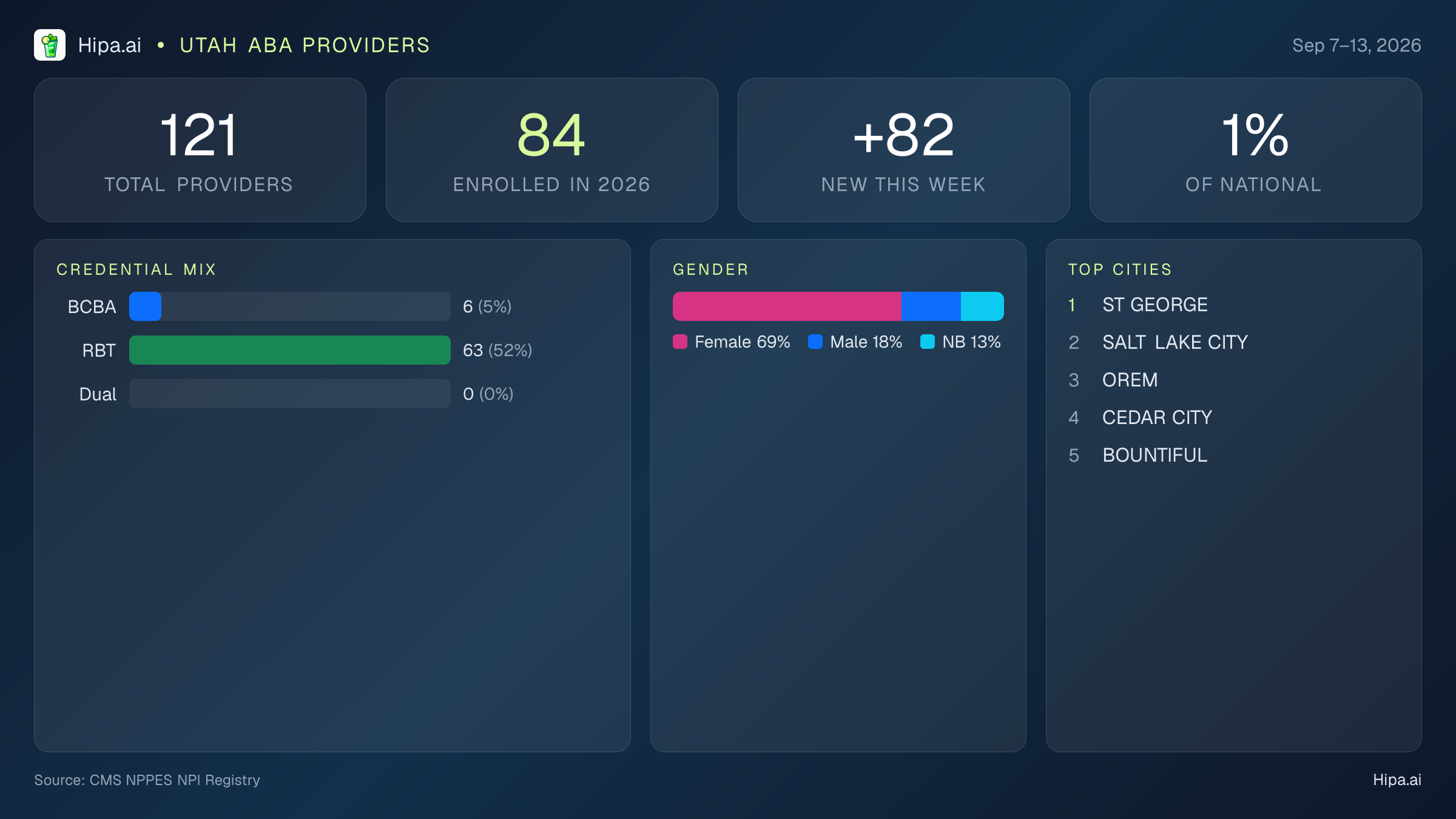
Utah recorded 121 providers in the latest CMS NPI registry weekly update, representing 1% of the national weekly total. The update lists 82 new providers this week and 84 added this year, including 106 individuals and 15 organizations. Utah’s share is modest nationally, but the weekly volume points to an active pipeline of behavioral health participation. NPI activity reflects registry records, not confirmed staffing, caseloads or appointment availability, so the data signals market activity rather than guaranteed access.
ABA Workforce Mix
The credential summary reports 6 BCBAs and 63 RBTs, with no dual BCBA-RBT credentials. These credential categories should be read alongside the registry’s overlapping taxonomy structure, not as mutually exclusive shares; the summary counts are classifications within a broader provider dataset. The technician-heavy mix indicates more documented capacity for direct ABA services than for clinical supervision. BCBAs supervise RBTs, develop treatment plans and monitor treatment quality, so the relatively small BCBA count may constrain how quickly Utah can convert technician growth into expanded service capacity. The registry also identifies 15 providers with multiple taxonomies, another reason the categories should not be added together as distinct workforce groups.
Demographics and Organizations
Gender data identifies 73 female providers, 19 male providers and 14 nonbinary providers—69%, 18% and 13%, respectively. No notable organizations were flagged as appearing multiple times in the update. The leading listed cities are St. George, Salt Lake City, Orem, Cedar City and Bountiful, suggesting activity across both the Wasatch Front and southern Utah rather than a single metro area.
Utah’s update suggests a rapidly expanding RBT pipeline alongside a smaller BCBA supervisory pool, making clinical-leadership recruitment important to sustaining and broadening ABA access.