In a joint press release on 19 August 2026, Merck and Moderna reported that their Phase 3 trial in resected melanoma, NCT05933577, met both of its efficacy endpoints. Patients who received the personalized mRNA cancer vaccine intismeran autogene alongside pembrolizumab (Keytruda) went longer without their melanoma returning, and longer without it spreading to distant organs, than patients given pembrolizumab alone. It is the first randomized Phase 3 trial of a personalized neoantigen cancer vaccine to succeed on its primary endpoint.
Background
Melanoma that has been surgically removed can still recur, and the risk rises with stage. Adjuvant pembrolizumab is already standard for high-risk resected disease, but a substantial share of patients relapse anyway. Intismeran autogene aims to close part of that gap by teaching the immune system to recognize the mutations in one patient's tumor: the resected tumor is sequenced, an algorithm selects up to 34 neoantigens, and a single mRNA strand encoding them is delivered in a lipid nanoparticle.
Trial design
The trial enrolled patients with completely resected stage IIB–IV cutaneous melanoma and no prior systemic therapy, randomizing 2:1 to intismeran 1 mg every three weeks for up to nine doses plus pembrolizumab 400 mg every six weeks, or placebo plus pembrolizumab, over roughly one year. ClinicalTrials.gov lists recurrence-free survival as the sole primary outcome, with distant metastasis-free survival among the secondary outcomes — matching the two endpoints Merck and Moderna say were met.
Key results
Merck and Moderna described statistically significant and clinically meaningful improvements in both recurrence-free and distant metastasis-free survival, with safety consistent with prior studies of the combination and no new safety signals. Detailed figures were not released: there are no published hazard ratios, confidence intervals or subgroup analyses yet, and overall survival has not been reported. Full data are promised at a future international medical meeting.
One number to handle carefully: the press release states 1,137 patients randomized, while ClinicalTrials.gov still shows an estimated 1,089, last revised in September 2025 and not yet updated.
What the registry adds
Merck and Moderna describe the program as nine Phase 2 and Phase 3 trials, which is what the registry shows when filtered to those phases. Counting every registered study gives 12. The other three are the 2017 first-in-human study NCT03313778, a Phase 1/2 bladder study NCT06305767, and NCT06295809, a Phase 2/3 trial in cutaneous squamous cell carcinoma that was terminated with 46 participants enrolled, the registry giving the reason as “Business reasons”. For scale: only 10 personalized neoantigen vaccine trials have ever reached Phase 3 or Phase 2/3, and five are this program.
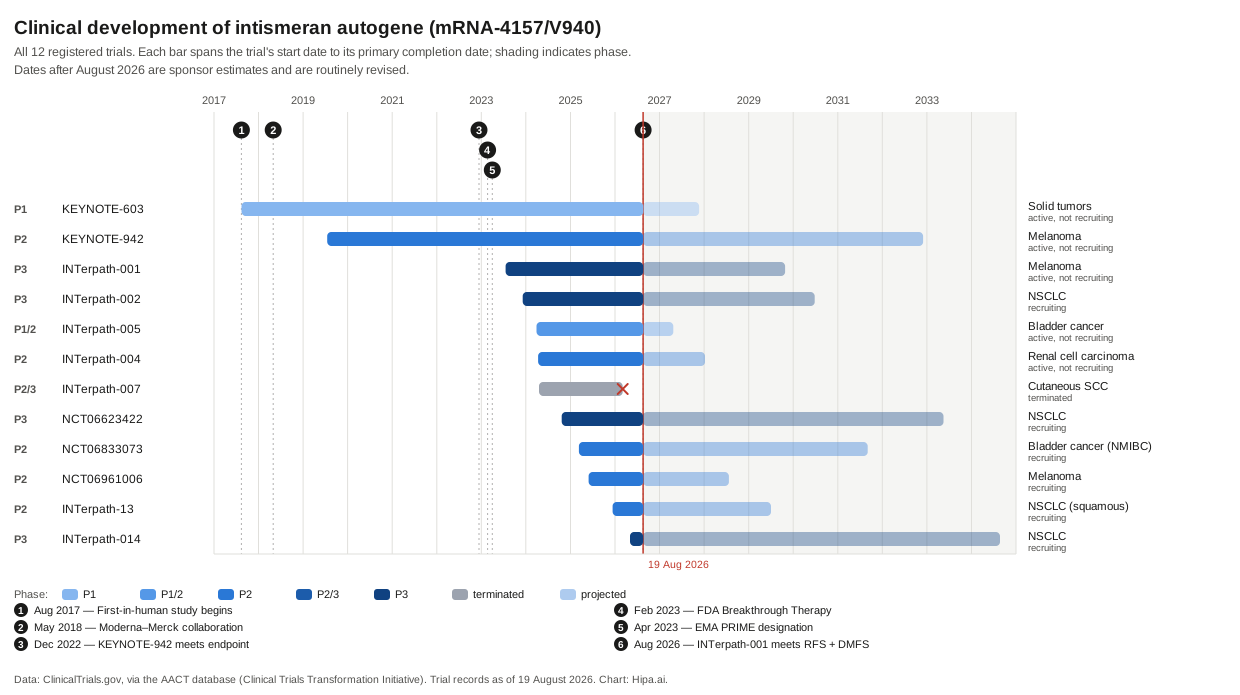
All twelve registered trials. Bars run from start to primary completion; the lighter portion is projected.
What this means
Intismeran autogene is not approved anywhere, and this trial is closed to new participants — Merck and Moderna have said only that they will now approach regulators. Nothing here is medical advice, and treatment decisions belong with an oncologist.
For patients looking at options today, six trials in the program are still enrolling across 164 US sites in 35 states, though most are in lung and bladder cancer rather than melanoma; the open melanoma study is NCT06961006. A fuller breakdown of all twelve trials and where each is recruiting is on our intismeran autogene page.
Source
Efficacy claims, the randomized patient count and the safety statement come from the joint Merck and Moderna press release of 19 August 2026 (merck.com). Trial design, endpoints, enrollment, statuses and termination reasons come from the AACT database, the public mirror of ClinicalTrials.gov maintained by the Clinical Trials Transformation Initiative. Where the two disagree — as on enrollment — both figures are given.