What intismeran autogene actually is
Intismeran autogene is an investigational individualized neoantigen therapy — a cancer vaccine built separately for each patient. It is not an off-the-shelf drug, and its mechanism is well characterized rather than unknown. A sample of the patient's resected tumor is sequenced alongside healthy tissue; an algorithm picks the mutations most likely to be visible to that person's immune system; and a single synthetic mRNA molecule encoding up to 34 of those neoantigens is manufactured and packaged in a lipid nanoparticle. Injected intramuscularly, the mRNA is translated in the body and the resulting neoantigen fragments are presented to the immune system, priming T-cell responses against cells carrying those exact mutations.
The agent has carried several names across its development, and all three still appear in the trial registry: mRNA-4157 (Moderna's original designation), V940 (the Merck code adopted after the companies partnered), and intismeran autogene (the current international nonproprietary name). Searching for only one of them returns an incomplete picture of the program — a point that matters below.
It is developed jointly by Moderna and Merck (Merck Sharp & Dohme). Moderna led the two earliest studies and Merck leads the later ones, with the other company listed as collaborator throughout. In every trial to date it is given in combination with pembrolizumab (Keytruda), never as monotherapy in the registrational setting.
The INTerpath-001 melanoma readout
In a joint press release on 19 August 2026, Merck and Moderna announced that the Phase 3 trial NCT05933577, known as INTerpath-001, met both of its efficacy endpoints. In patients with completely resected stage IIB–IV cutaneous melanoma, intismeran plus pembrolizumab produced statistically significant and clinically meaningful improvements in recurrence-free survival (the primary endpoint) and distant metastasis-free survival (a secondary endpoint) compared with pembrolizumab alone. Merck and Moderna reported no new safety signals and said they would take the data to regulators and to an international medical meeting.
The registry record corroborates the endpoint structure independently of the press release: ClinicalTrials.gov lists recurrence-free survival as the sole primary outcome for NCT05933577, with distant metastasis-free survival and overall survival as secondary outcomes. The trial randomized patients 2:1 to intismeran 1 mg every three weeks for up to nine doses plus pembrolizumab 400 mg every six weeks, versus placebo plus pembrolizumab, over roughly one year of treatment.
One discrepancy is worth flagging for anyone citing figures. The press release states that 1,137 patients were randomized. The ClinicalTrials.gov record still carries an estimated enrollment of 1,089, last updated in September 2025 — the registry has not yet been revised to the actual figure. Both numbers are correct for what they describe; they are not interchangeable.
Overall survival data have not been reported, and the detailed efficacy results — hazard ratios, confidence intervals, subgroup breakdowns — were not released with the topline announcement.
The development program: 12 registered trials
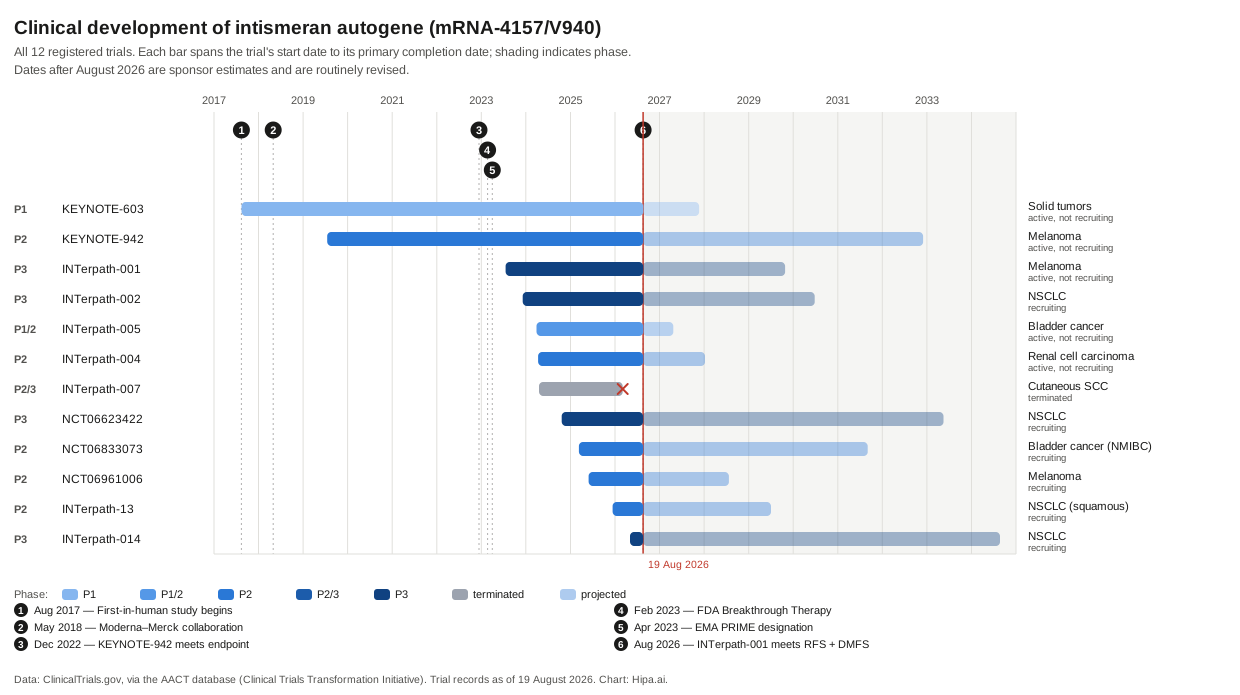
The full intismeran autogene programme as registered on ClinicalTrials.gov. Bars run from each trial's start date to its primary completion date; the lighter portion to the right of the August 2026 line is projected.
Merck and Moderna describe the program as nine Phase 2 and Phase 3 trials, which is what the registry shows when you filter to those two phases. Counting every registered study brings the total to 12; the other three sit outside that phase band:
- NCT03313778 — KEYNOTE-603, the Phase 1 first-in-human study opened by Moderna in 2017, which is why the program's first registry posting is 2017-10-18 and not 2023.
- NCT06305767 — INTerpath-005, a Phase 1/2 study in muscle-invasive urothelial carcinoma.
- NCT06295809 — INTerpath-007, a Phase 2/3 study in cutaneous squamous cell carcinoma, terminated with 46 participants enrolled against a much larger target. The registry gives the reason as “Business reasons”. It is the one discontinued study in the program.
Here is the full roster in start-date order, as registered:
- NCT03313778 — KEYNOTE-603 — Phase 1, Solid Tumors. Enrollment 161; status active not recruiting; started 2017-08-14.
- NCT03897881 — Phase 2, Melanoma. Enrollment 267; status active not recruiting; started 2019-07-18.
- NCT05933577 — Phase 3, Melanoma. Enrollment 1,089; status active not recruiting; started 2023-07-19.
- NCT06077760 — INTerpath-002 — Phase 3, Non-small Cell Lung Cancer. Enrollment 868; status recruiting; started 2023-12-06.
- NCT06305767 — Phase 1/2, Bladder Cancer. Enrollment 230; status active not recruiting; started 2024-03-28.
- NCT06307431 — INTerpath-004 — Phase 2, Renal Cell Carcinoma. Enrollment 272; status active not recruiting; started 2024-04-10.
- NCT06295809 — INTerpath-007 — Phase 2/3, Carcinoma, Squamous Cell, Skin Neoplasms. Enrollment 46; status terminated; started 2024-04-18. Terminated (reason on file: “Business reasons”).
- NCT06623422 — Phase 3, Carcinoma, Non-Small-Cell Lung. Enrollment 680; status recruiting; started 2024-10-21.
- NCT06833073 — Phase 2, Carcinoma in Situ, Non-Muscle Invasive Bladder Neoplasms, Urinary Bladder Neoplasms. Enrollment 308; status recruiting; started 2025-03-11.
- NCT06961006 — Phase 2, Malignant Melanoma. Enrollment 160; status recruiting; started 2025-05-29.
- NCT07221474 — INTerpath-13 — Phase 2, Squamous Non-small Cell Lung Cancer. Enrollment 180; status recruiting; started 2025-12-12.
- NCT07513376 — INTerpath-014 — Phase 3, Non-small Cell Lung Cancer. Enrollment 876; status recruiting; started 2026-05-04.
Across all 12 studies the combined planned enrollment is roughly 5,137 participants, spanning melanoma, non-small cell lung cancer, bladder cancer, renal cell carcinoma and cutaneous squamous cell carcinoma.
Where the program is still enrolling
6 of the 12 trials are currently recruiting, across 164 US research sites in 35 states and 102 cities. Note that the melanoma trial that just reported is not among them — INTerpath-001 closed to enrollment before the readout. The open studies are concentrated in lung cancer:
- Non-small cell lung cancer — NCT06077760 (INTerpath-002, Phase 3, adjuvant) and NCT06623422 (Phase 3, resectable stage II–IIIB) are the two largest open studies, together covering more US sites than the rest of the program combined. NCT07513376 (INTerpath-014, Phase 3) tests the combination with subcutaneous pembrolizumab, and NCT07221474 (INTerpath-13, Phase 2) addresses first-line metastatic squamous disease.
- Bladder cancer — NCT06833073, a Phase 2 study pairing intismeran with BCG in high-risk non-muscle-invasive disease.
- Melanoma — NCT06961006, a Phase 2 study, remains open.
Enrollment is open to adults aged 18 and over, with no upper age limit specified in any of the open studies. Sites cluster in the major research metros — you can see what is recruiting near New York, Los Angeles, Houston, Chicago, Boston, Nashville, Philadelphia, Seattle, Miami and Dallas, among others.
How rare a positive Phase 3 is in this field
Personalized neoantigen cancer vaccines have been an active research area for a decade, but almost entirely at early stage. Across the 209 interventional trials of individualized or neoantigen cancer vaccines registered on ClinicalTrials.gov, the phase distribution is heavily bottom-weighted: 77 Phase 1, 31 Early Phase 1, 33 Phase 1/2 and 33 Phase 2.
Only 10 have ever reached Phase 3 or Phase 2/3 — and five of those 10 belong to this program. The remainder are a scattering of older or smaller efforts, several terminated or of unknown status. That is the context for the INTerpath-001 result: it is not merely a positive trial, it is the first randomized Phase 3 in this class to report a win on its primary endpoint.
Regulatory status
Intismeran autogene is investigational and not approved by any regulator for any indication. It received FDA Breakthrough Therapy designation in February 2023 and the EMA's PRIME designation for adjuvant melanoma, both on the strength of the earlier randomized Phase 2b study NCT03897881 (KEYNOTE-942). Following the INTerpath-001 readout Merck and Moderna have said they will engage with regulators on filings, but no submission date has been announced and no approval exists today. Nothing here is medical advice; treatment decisions belong with a qualified oncologist.
Source and method
Trial counts, phases, enrollment figures, statuses, termination reasons and site locations on this page are derived from the AACT database, the public relational mirror of ClinicalTrials.gov maintained by the Clinical Trials Transformation Initiative, queried across the intervention names intismeran, mRNA-4157 and V940 together with their registered synonyms. Efficacy claims, the randomized patient count and the safety statement come from the joint Merck and Moderna press release of 19 August 2026. Where the registry and the press release disagree — as they do on enrollment — both figures are shown rather than reconciled. Individual trial records are linked throughout and can be verified directly at ClinicalTrials.gov.