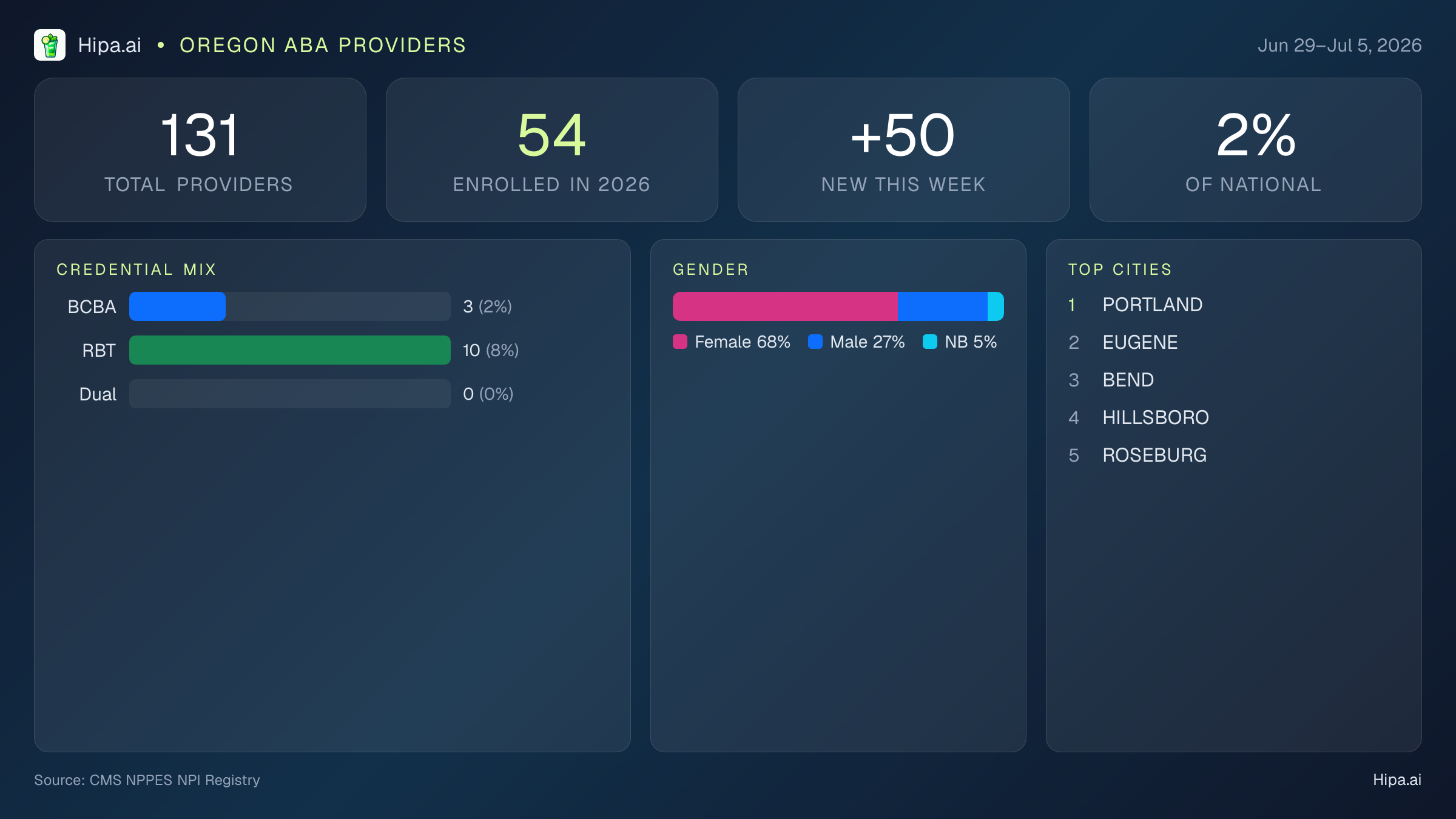
Oregon recorded 131 behavioral health providers in the latest CMS NPI registry weekly update, accounting for 2% of the national total. While a smaller percentage compared to larger states, this consistent activity signals a sustained effort to meet regional demand for behavioral health services, with 50 new additions this week alone contributing to the 54 new providers this year.
ABA Workforce Dynamics
Within the applied behavior analysis (ABA) field, the data reveals 3 BCBA credentials and 10 RBT credentials. It is important to note that no providers in this specific update held dual BCBA and RBT credentials, which typically signifies career progression from direct service to supervisory roles. The observed ratio of RBTs to BCBAs underscores a clear demand for direct service providers, highlighting the critical need for these BCBAs to provide sufficient supervision and maintain the quality and ethical standards required for ABA therapy delivery.
Provider Demographics
Of the 124 individual providers, the gender breakdown shows 84 (68%) are female, 34 (27%) are male, and 6 (5%) identify as nonbinary. This distribution largely mirrors national trends within the behavioral health workforce. No specific organizations appeared multiple times in this week's update, suggesting that recent growth is driven by individual practitioners or smaller, independent practices rather than large, multi-state chains commonly seen in the ABA industry.
This snapshot of Oregon's behavioral health workforce indicates a steady, diverse expansion, with continued attention needed to ensure adequate supervisory capacity for the growing direct service provider roles, particularly within ABA, to improve overall access to care.